Felix Laurent
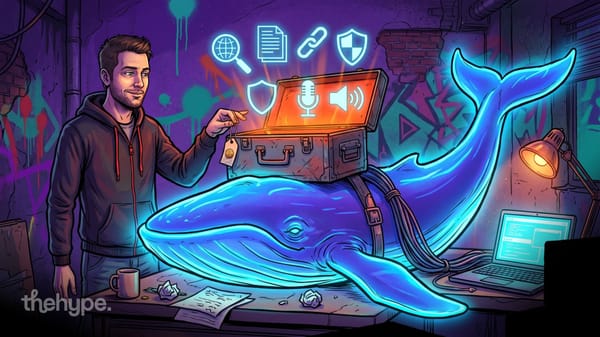
DeepSeek has opened the features of its chat app to developers. Since November 13, 2026, the DeepSeek API can search the web, read links and files, check safety and speak. All of it takes a few parameters on the V4.1-Flash model.
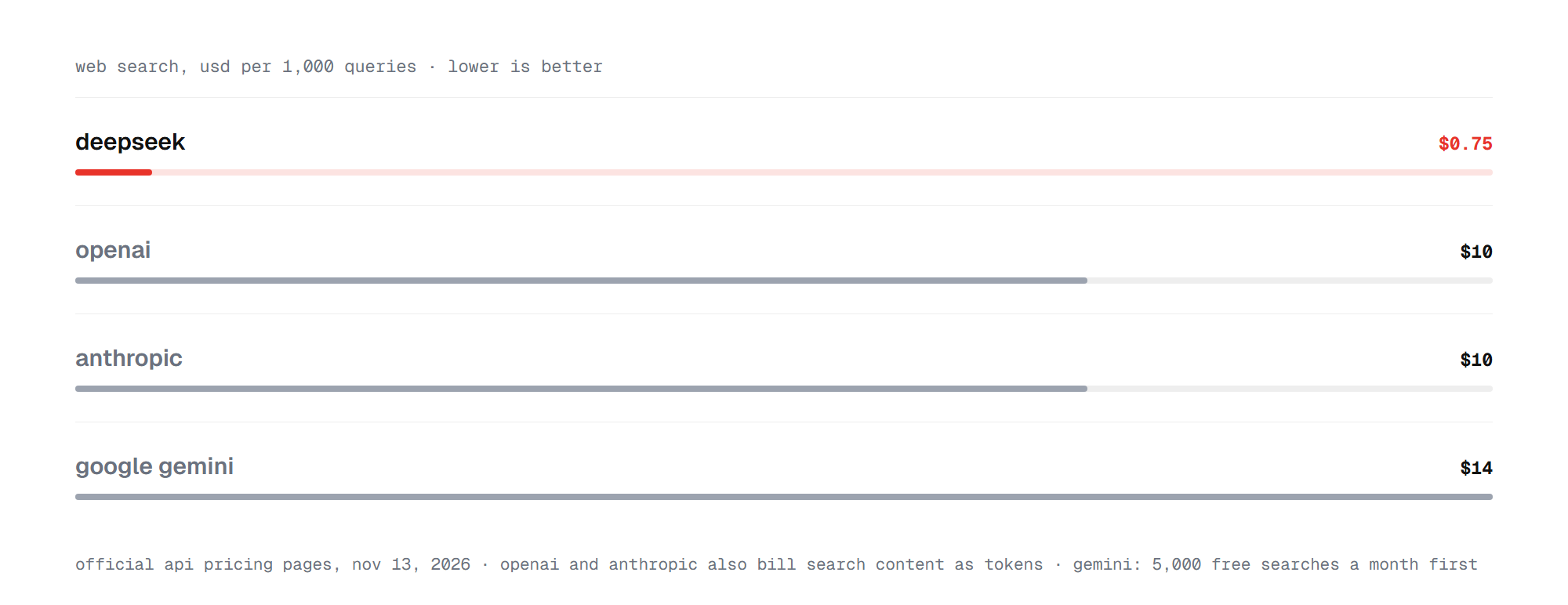
DeepSeek also released an open-source copy of its app's interface that can import chat history from DeepSeek. Its web search costs $0.75 per 1,000 queries, about 13 times less than OpenAI and Anthropic charge.
What DeepSeek added to its API
The new features are the same ones behind the DeepSeek app. DeepSeek handles the tool calls and the context on its own servers, so a developer only turns them on.
- Web search finds web pages or images and answers with citations. It works in the model's non-thinking mode.
- Deep thinking search searches and reads pages during multi-step reasoning, with up to about 20 tool calls per answer.
- File input parses PDFs, Word and PowerPoint files and images into the conversation.
- URL reading fetches the links in a user's message, up to the first 10.
- Safety checks screen both the request and the answer and return a refusal when they detect a risk.
The features work with deepseek-flash, the API name for V4.1-Flash. They run through all three API formats DeepSeek supports: Chat Completions, OpenAI's Responses format and Anthropic's Messages format. Web search is turned on with deepseek_web_search and link reading with deepseek_read_url.
There are also two small extras from the app. One generates a conversation title for free. The other passes the user's date, location, platform and language to the model.
Not everything has to go through the chat model.
Standalone OCR, speech and search APIs
DeepSeek also sells five tools as separate endpoints for custom workflows:
- Search queries DeepSeek's own search engine and returns up to 50 results. It supports operators such as
site:and date filters. - Fetch turns a web page into Markdown.
- OCR reads text from PDFs, Office files and images, page by page with box coordinates. Files can be up to 100 MiB and 1,000 pages.
- ASR transcribes speech in 21 languages, including English, Chinese, Russian, Arabic and Hindi. Clips are limited to 120 seconds.
- TTS reads text aloud in 10 languages with two voices, one female and one male. It also streams over WebSocket.
DeepSeek's search engine is in-house. In October, the company said it serves "hundreds of millions of requests daily."
The tools have limits. A developer cannot force the model to search, cannot combine web tools with other server-side tools yet, and cannot restrict search to chosen domains. Results from earlier turns are not carried into later ones.
The biggest difference from rivals is the price.
DeepSeek API pricing for tools
Tool fees come on top of token charges. Web search and URL reading cost the same, and speech prices are discounted for now.
| Tool | DeepSeek | OpenAI |
|---|---|---|
| Web search | $0.75 per 1,000 queries | $10 per 1,000 calls plus content tokens |
| URL reading or fetch | $0.75 per 1,000 | no separate tool |
| OCR | $0.225 per 1,000 pages | no listed OCR price |
| Speech to text | $0.058 per hour (promo), $0.116 list | about $0.18 to $0.36 per hour |
| Text to speech | $22.50 per 1M characters (promo), $45 list | $15 to $30 per 1M characters |
Search is the clear win. It is about 13 times cheaper than OpenAI and Anthropic, and about 19 times cheaper than Gemini once its free tier runs out. Speech recognition is also far cheaper than OpenAI. Text to speech is the exception, priced above OpenAI's tts-1 even with the discount.
The model itself is cheap too. During peak hours, deepseek-flash costs $0.30 per million input tokens and $1.20 per million output tokens. Off-peak, prices are half that. Safety checks are billed as output tokens.
Low prices are one part of the pitch. The other is a ready-made app.
The open-source chat demo
DeepSeek published the code of a demo chat app on GitHub under the MIT license. It is written in TypeScript with React. The repository gathered almost 500 stars in its first hours.
The demo runs entirely in the browser, with no backend. The API key and chats stay on the user's device. It uses the Messages and Files APIs for chat and the ASR and TTS endpoints for voice.
It can also import a ZIP export of conversations from DeepSeek's own chat app. That lets users move their history into an interface they control. Chinese tech outlet Zhidongxi wrote that developers can now replicate the DeepSeek app "1:1".
There are strings attached. DeepSeek says public-facing apps must turn on safety checks. Developers remain responsible for content moderation, model registration where it applies and labeling AI-generated content, rules that mirror Chinese regulations.
These features arrive at the end of a busy year for DeepSeek.
How DeepSeek's API got here
DeepSeek has been building toward this in steps:
- August 2025: V3.1 added support for Anthropic's API format.
- April 2026: V4 Preview with 1 million tokens of context and open weights.
- July 2026: V4-Flash became official with native support for OpenAI's Responses format, used by Codex.
- September 2026: V4.1-Flash, a mixture-of-experts model with vision and lower prices.
- October 2026: the Search and Fetch APIs opened to everyone.
- November 13, 2026: the full app feature set.
A V4.1-Pro model has not been released. One of the top replies to the announcement asked for exactly that.
Rivals offered parts of this earlier. OpenAI's Responses API has built-in web and file search, and Anthropic launched a web search API in May 2025 at $10 per 1,000 searches. DeepSeek is the first to ship the whole app stack, including voice and a copy of the app itself.
Access is still limited in some places. In October 2026, the US Department of Homeland Security barred federal civilian agencies from buying DeepSeek products. Italy, Australia, South Korea and Taiwan restricted DeepSeek in 2025, mostly on government devices.
Is the DeepSeek API worth it for app builders
For cost-sensitive apps that need search, file parsing and speech, yes. Web search at $0.75 per 1,000 queries and a model at $1.20 per million output tokens are hard to match. The open-source demo saves weeks of interface work.
The trade-offs are control and jurisdiction. The tools cannot be forced or limited to chosen domains, and safety checks are mandatory for public apps. Data also goes to a Chinese provider that several governments restrict. For a prototype or an internal tool that is fine. For a regulated product, check those limits first.
FAQ
Which model supports the new DeepSeek API features?
Only deepseek-flash, the API name for V4.1-Flash. It works through the Chat Completions, Responses and Anthropic-compatible Messages formats.
How much does DeepSeek web search cost?
$0.75 per 1,000 queries, on top of token charges. URL reading costs the same.
Can I use DeepSeek's speech features without the chat model?
Yes. ASR and TTS are standalone APIs, along with Search, Fetch and OCR.
Is the DeepSeek chat demo open source?
Yes. The code is on GitHub under the MIT license, and the demo runs in the browser without a backend.
Sources
- DeepSeek on X – November 13, 2026
- Build a chatbot guide, DeepSeek API docs – November 13, 2026
- Pricing, DeepSeek API docs – accessed November 13, 2026
- chat-demo, GitHub – November 13, 2026
- API pricing, OpenAI – accessed November 13, 2026
- DHS bans DeepSeek across federal government networks, PYMNTS – October 20, 2026