Felix Laurent
Block has unveiled Dessa, a full-duplex speech-to-speech model that its team says was trained from scratch on human conversation only – no text and no pretrained models. Jack Dorsey announced it on X on October 23, and the post passed 10.8 million views within a day. We read Block's launch page and compared its claims with published work on speech-only and full-duplex models. Block has released live recordings, not a paper, weights, benchmarks or a public demo.
What Block announced
Dessa takes audio in and gives audio out. It is full-duplex: it listens and speaks at the same time, so it can cut in, laugh mid-sentence and backchannel with short "yeah" and "got it" cues instead of waiting for the user to finish. Block says inference runs faster than real time and that the model runs locally on a MacBook Pro M4 Max or better.
The central claim is about training data. "We trained Dessa from scratch on nothing but human conversation," the launch page says, and Block calls it, "as far as we know," the first AI trained only on human speech that can hold a realistic live conversation. According to Block, Dessa learned language from "hundreds of times fewer words" than LLMs need, and the whole model was trained on a single NVIDIA GB200 NVL72 rack.
Dorsey added in a follow-up post that the model is "really really small… small enough to run on your macbook."
The launch page carries six recorded conversations, from 1:52 to 4:57 long. In them, Dessa finishes a movie title the speaker can't remember, gasps at an anniversary surprise and gets louder when asked to speak up. The last clip is a conversation between Dessa and GPT-Live-1, the model Block identifies as ChatGPT Live. Block notes that both voices in that clip are AI-generated and that the other model's developer has not reviewed or endorsed Dessa.
What Block has published
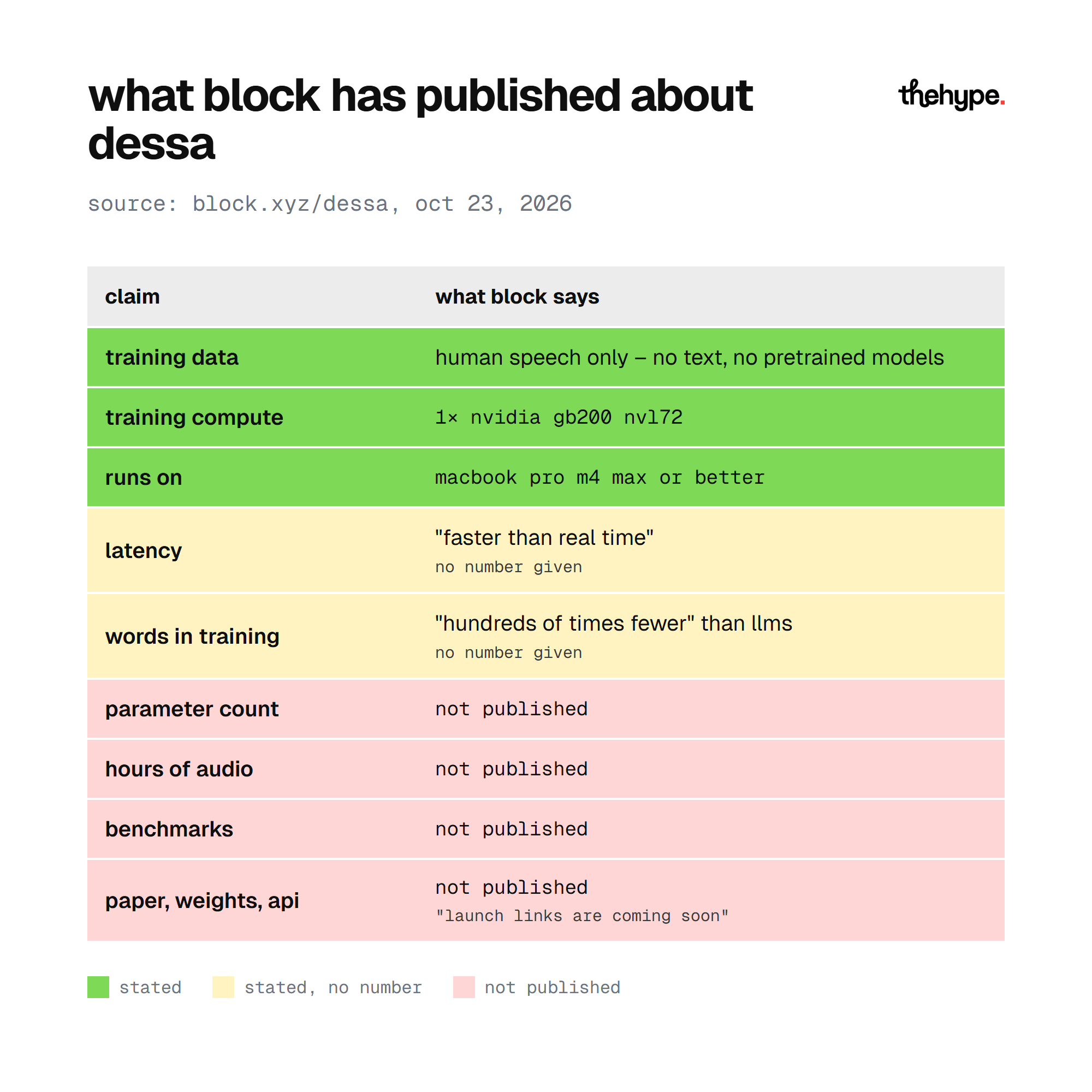
Block's launch page states some facts with numbers, some without numbers, and leaves the rest out.
| Claim | What Block says |
|---|---|
| Training data | Human speech only – no text, no pretrained models |
| Training compute | 1× NVIDIA GB200 NVL72 |
| Runs on | MacBook Pro M4 Max or better |
| Latency | "Faster than real time", no number given |
| Words in training | "Hundreds of times fewer" than LLMs, no number given |
| Parameter count | Not published |
| Hours of audio | Not published |
| Benchmarks | Not published |
| Paper, weights, API | Not published; "launch links are coming soon" |
Only the compute and the hardware come with specific figures.
What earlier models did
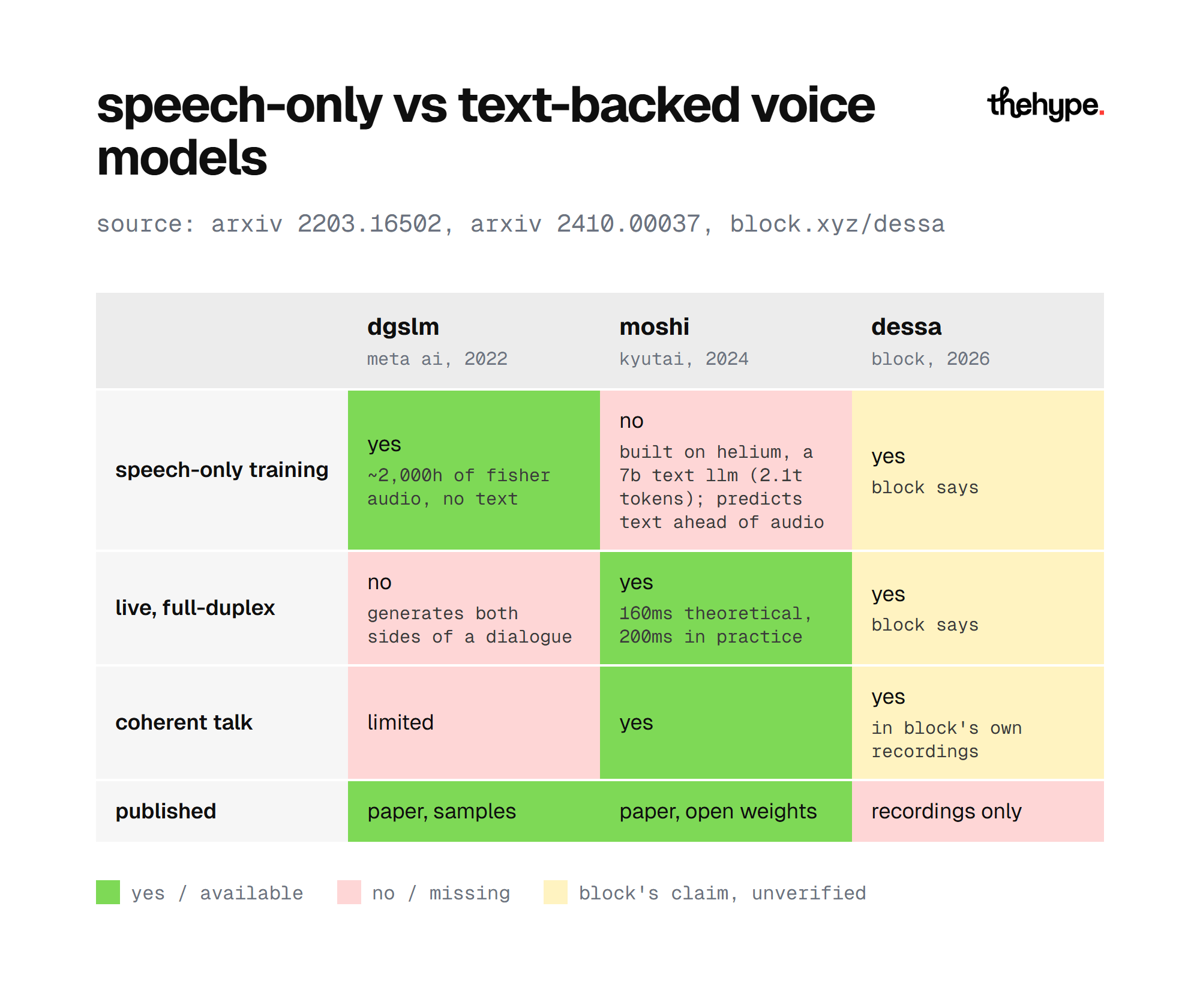
Dessa is not the first full-duplex voice model, and it is not the first dialogue model trained without text. What Block claims is new is the combination: speech-only training with live conversation quality.
| dGSLM (Meta AI, 2022) | Moshi (Kyutai, 2024) | Dessa (Block, 2026) | |
|---|---|---|---|
| Speech-only training | Yes – ~2,000h of Fisher audio, no text | No – built on Helium, a 7B text LLM (2.1T tokens); predicts text ahead of audio | Yes, Block says |
| Live, full-duplex | No – generates both sides of a dialogue | Yes – 160ms theoretical, 200ms in practice | Yes, Block says |
| Coherent talk | Limited | Yes | Yes, in Block's own recordings |
| Published | Paper, samples | Paper, open weights | Recordings only |
Meta's dGSLM showed back in 2022 that a model trained on raw conversation could produce laughter, overlapping speech and natural turn-taking without any text. It could not hold a coherent conversation. Kyutai got Moshi to talk coherently in real time by building it on a text LLM and having it write out text tokens alongside its audio. Block's claim is that Dessa closes that gap without the text scaffolding.
Why the recordings are not enough
The six clips were picked by Block. They show timing, laughter and tone, which is exactly where text-based voice assistants fall short, but they say nothing about how often Dessa gets facts wrong, how it handles a topic it has never heard discussed, or how it behaves when a conversation goes off track. Block says it does not steer the model in the recordings and that subtitles were added afterward. That cannot be checked without access.
"Trained only on speech" is also a claim about the data pipeline that outsiders can't verify yet. Without the size of the training set, the parameter count or a technical report, there is no way to compare Dessa's efficiency with Moshi's or to test the "hundreds of times fewer words" figure.
Who built it
The team is a small research lab inside Block, founded by former members of Dessa, a Toronto deep learning startup that Square, now Block, bought in February 2020. Dessa was known for deepfake detection work at the time. The lab says it has built generative speech models for more than eight years and reports directly to Jack Dorsey. Ragavan Thurairatnam leads the project.
Block frames the release partly as a safety issue. Its argument is that voice AI built on text can't hear distress in someone's voice, and the team is offering early access to a small group of AI safety researchers to look for risks it hasn't anticipated.
What is still missing
Block has not said when Dessa will be available, in which product, or under what license. The launch page promises more recordings on X and says launch links are "coming soon." Until there is a technical report or hands-on access, every capability above is Block's own description.