Felix Laurent

Qwen says one of its developers recreated NASA's "Your Name in Landsat" over a weekend. The project used Qwen3-VL-Embedding-2B to search 20 million satellite image patches for letters hidden in nature. Qwen Developers shared the claim on X on Oct 27.
What Qwen announced
The post says the developer spent "just a weekend" on the recreation. It names the model and the corpus size: 20 million patches. The post links a longer write-up on X, "Finding Your Name on Earth with Qwen", which explains the method. The figures in it are Qwen's own.
How the search works
The project is called Your Name in Sentinel, and it runs as a free app on ModelScope Studio. You type a description of a landscape, and the app returns ranked satellite images that match it. Qwen3-VL-Embedding-2B puts the images and the text query into the same vector space, so the search is a matter of finding the closest vectors.
The team ran 104 searches to collect candidate letters. From those it picked 85 letter cards from A to Z, such as an S-shaped river in Colombia, an A in a frozen Siberian lake and a V in cracked sea ice off northern Canada. The app then assembles the cards into names and messages, and a Gradio API supports batch searches.
Storage is the practical win. The write-up says the embeddings for the whole set take about 35 GB, while the original imagery is roughly 23 TB. That is why a search over 20 million patches fits a weekend project instead of a data center.
Sentinel, not Landsat
The imagery does not come from Landsat. According to the write-up, it comes from Sentinel-2 via the Major-TOM Core-S2L2A collection, which holds about 2.2 million source scenes. Sentinel-2 is part of the EU's Copernicus program and is operated by the European Space Agency, while Landsat is a NASA and USGS mission.
So the project copies NASA's idea, not its data. The precomputed Qwen embeddings for the collection are published on ModelScope in FP8 format, which lets others repeat the search without encoding the images again.
The search engine underneath is EarthEmbeddingExplorer. Researchers from the University of Chinese Academy of Sciences, AIRCAS, Asterisk Labs and LGND AI describe it in an arXiv paper last revised on Oct 25. The paper's demo uses a sample of 248,719 Sentinel-2 patches and eight embedding models, Qwen3-VL-Embedding among them, while the letters project uses a denser Qwen-only version.
What NASA built first
NASA's original tool lets visitors spell names and messages with Landsat images that look like letters. NASA says more than 715,000 visitors have used it. NASA also states that the letters were not found by AI. In its words, it was "old-fashioned Human Intelligence".
The model behind it
Qwen3-VL-Embedding-2B has 2B parameters and an Apache 2.0 license, according to its Hugging Face card. An embedding model turns images and text into vectors, so a program can compare them quickly. That is what makes a search over millions of patches possible.
Qwen released the model on Jan 8 with an 8B sibling and two matching reranker models. The 2B version is built on Qwen3-VL-2B-Instruct, has 28 layers and a 32K-token context, and works in more than 30 languages. It accepts text, images, screenshots and video, and its vectors can be cut from 2,048 down to 64 dimensions to save space.

On Qwen's own numbers, the 2B model scores 73.2 on the MMEB-V2 multimodal benchmark, against 77.8 for the 8B version. On the MMTEB text benchmark it scores 63.87 against 67.88. The small model gives up a few points for a much lighter footprint.
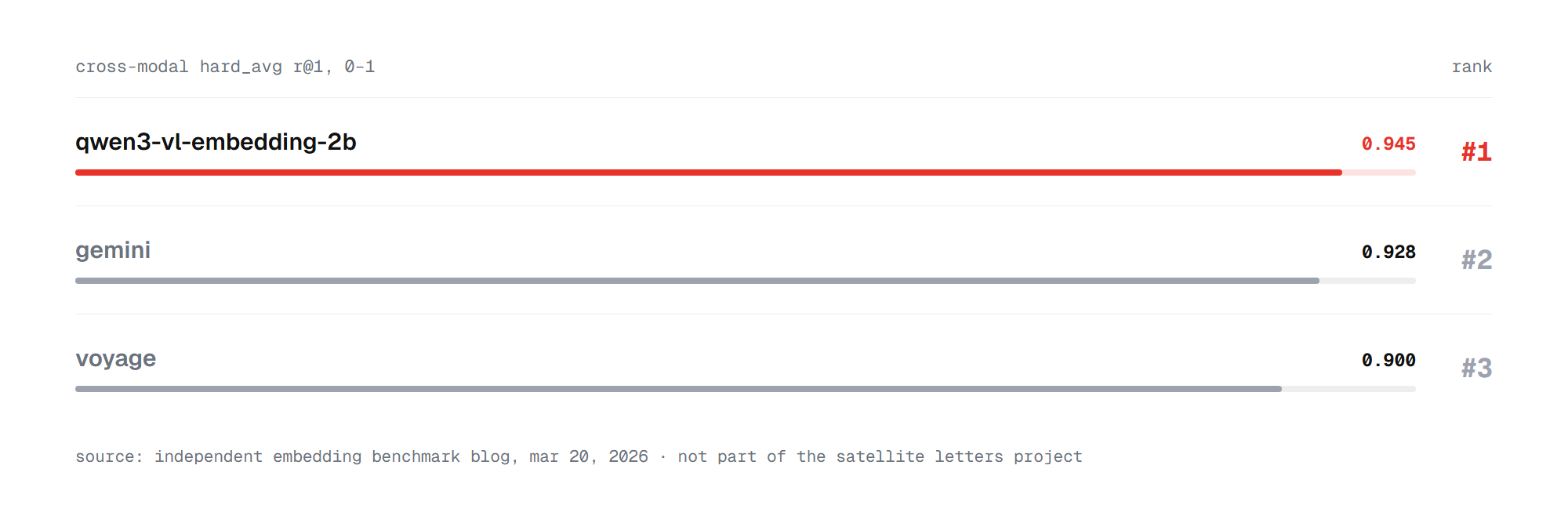
An independent benchmark published in March gives some context. Its author reports a cross-modal hard_avg_R@1 of 0.945 for the 2B model, ahead of Gemini at 0.928 and Voyage at 0.900. The same author says the 2B version fits on a single 11GB consumer GPU. These results come from one blog's test, not from the letters project.
What is still unverified
Qwen has not published numbers on accuracy, runtime or hardware for the letter search. The EarthEmbeddingExplorer paper does not give retrieval accuracy either; its evaluation is visual, and the authors list a numeric benchmark as future work. The claim that this took a weekend rests on Qwen's post alone.
So can a 2B model really search the planet in a weekend? On the published details, yes, with help. The heavy lifting was done before the weekend: the satellite collection, the explorer and the precomputed embeddings already existed. What the project shows is that a small open model is now good enough to match a short text description to millions of images, but not how often it gets the match right.
Sources
- QwenDevs post on X, Oct 27 – the announcement
- Finding Your Name on Earth with Qwen, X article – method, data and storage figures
- Your Name in Sentinel, ModelScope Studio – the app
- EarthEmbeddingExplorer paper, arXiv – the search engine
- NASA, finding your name in Landsat – the original project
- Qwen3-VL-Embedding-2B model card, Hugging Face – size, license and benchmarks
- Embedding models benchmark, independent blog, Mar 20 – third-party test