
 Julia Daimio

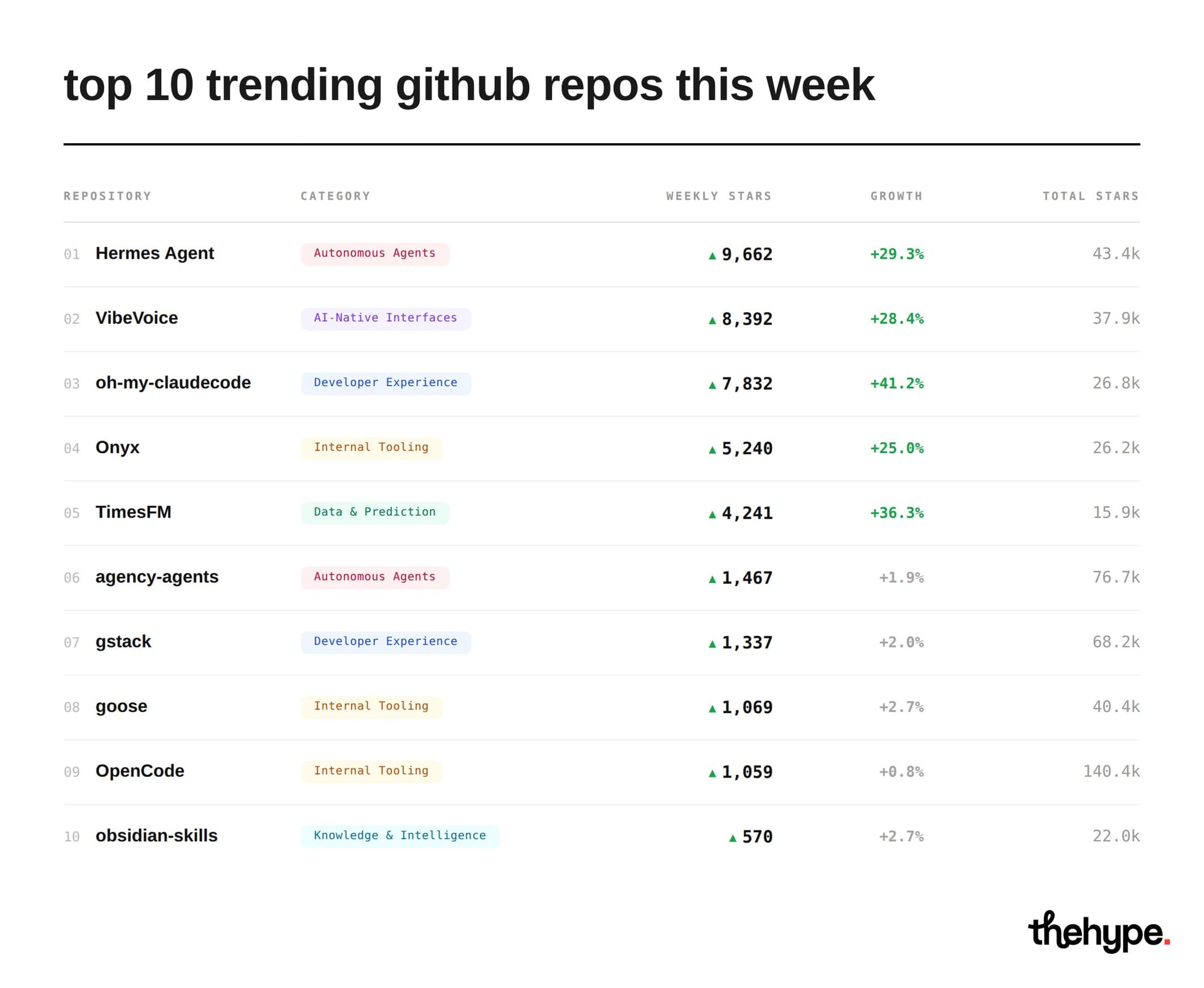
this week's trending repositories aren't random. together, they tell a story about autonomy, voice, memory, workflow automation, and the continuous growth of ai as infrastructure. we have picked 10 repos that don't just matter individually - they map where things are going.
autonomous agents
no surprise they are the first ones on this week's list: the hype is strong with this one, and it's not going anywhere in the long term.
first is hermes agent (43,355 stars/+9662 this week, @nousresearch). the premise is simple but powerful: an ai that lives on your server and operates continuously. what makes it interesting isn't just autonomy - it's persistence. this isn't something you prompt occasionally; it's something that works in the background, closer to an operator than a tool.
then there's agency-agents (76,727 stars/+1467 this week, author: @msitarzewski_), which leans into coordination. instead of a single agent trying to do everything, it structures not just multiple agents, but a full set of highly-structured ai personas - each with their specific role - that act like a system that can collaborate. that shift from single outputs to coordinated behavior is where complexity starts to scale.
ai-native interfaces
vibevoice (37,940 stars/+8,392 this week, @microsoft) represents this shift clearly. what makes it stand out isn't just that it "does voice," but how it approaches structure and control in real-time interaction. voice systems tend to break under real conditions - interruptions, latency, flow - and this project directly tackles that. it's a signal that voice might be moving from experimental to practical, becoming something that can realistically plug into workflows rather than sit on the sidelines as a demo.
again, this category is still early, but the direction is obvious: interfaces are becoming less visible, more natural, and more embedded into real-world interaction.
data and prediction
here, we feel a strong emphasis on usability. time series foundation model (15,914 stars/+4,241 this week, @googleresearch) tackles time-series forecasting - historically one of the more painful areas to implement well. what's notable here isn't just performance, it's accessibility. it brings a foundation-model approach to a domain that's usually fragmented and difficult to scale.
this is where ai quietly becomes valuable. not flashy, but deeply embedded in decision-making.
internal tooling and infrastructure
that might be the most important category of all that we mention here.
onyx (26,179 stars/+5,240 this week, @onyx_dot_app) positions itself as a team's entry point into generative ai. it's less about novelty and more about centralization: one place to plug in tools, workflows, and models. these are the kinds of repos that don't trend loudly but end up powering real systems.
goose (40,395 stars/+1069 this week, @goose_oss) takes a different angle - lightweight, flexible, and adaptable. it reflects where many teams are right now: experimenting fast and needing tools that don't lock them into rigid structures.
opencode (140,422 stars/+1059 this week, author: @anomalyco) pushes toward something more ambitious: an ai-driven approach to building software itself. not just assisting developers, but shaping the process. this is where the line between tool and collaborator starts to blur.
developer experience and leverage
a subtle but important layer that is forming right now. this week, we picked oh-my-claudecode (26,832 stars/+7,832 this week, author: @bellman_ych); it stands out because of how immediately usable it is. no heavy onboarding, no complexity - it just works. that "zero learning curve" angle is more important than it sounds: the faster someone can get value from these tools, the more likely they actually stick.
another pick is gstack (68,192 stars/+1337 this week, author: @garrytan). similarly, it reflects a growing appetite for opinionated stacks that simplify building with ai. instead of piecing everything together manually, you start from a structured foundation and move faster.
knowledge and reusable intelligence
finally, there's the layer that ties it all together. one great repo in this category is obsidian-skills (21,998 stars/+570 this week, author: @kepano). it's not trying to reinvent ai, but is merely integrating it into how people already think and work. extending tools like obsidian, an app to store and organize ideas securely, with practical ai capabilities, it turns passive notes into something active. this is where things get interesting: when ai stops being a destination and starts becoming part of the workflow itself.
what this week actually tells us
individually, these repositories are useful; together, they're pointing in a very specific direction.
ai is becoming persistent. systems are becoming multi-agent. interfaces are becoming invisible. and the tooling layer is consolidating into something that looks a lot like real infrastructure.
the barrier to building is dropping very fast. you no longer need a large team to experiment with ideas that used to be out of reach. you just need the right components, and increasingly, those components are open source and evolving in public.