
 Addy Crezee
today @SpaceXAI released grok 4.5 – a model built around coding, agentic tasks and knowledge work. key facts:
• trained across tens of thousands of nvidia gb300 gpus, with rl over hundreds of thousands of tasks centered on multi-step software engineering
• served at 80 tps, priced at $2/m input and $6/m output
• xai claims ~2x token efficiency: 15,954 avg output tokens per swe bench pro task vs 67,020 for opus 4.8 max
• published benchmarks: swe marathon 29.0% (1st), terminal bench 2.1 83.3% (3rd), deepswe 1.0 62.0% (3rd), swe bench pro 64.7% (3rd) – fable 5 leads 3 of the 4
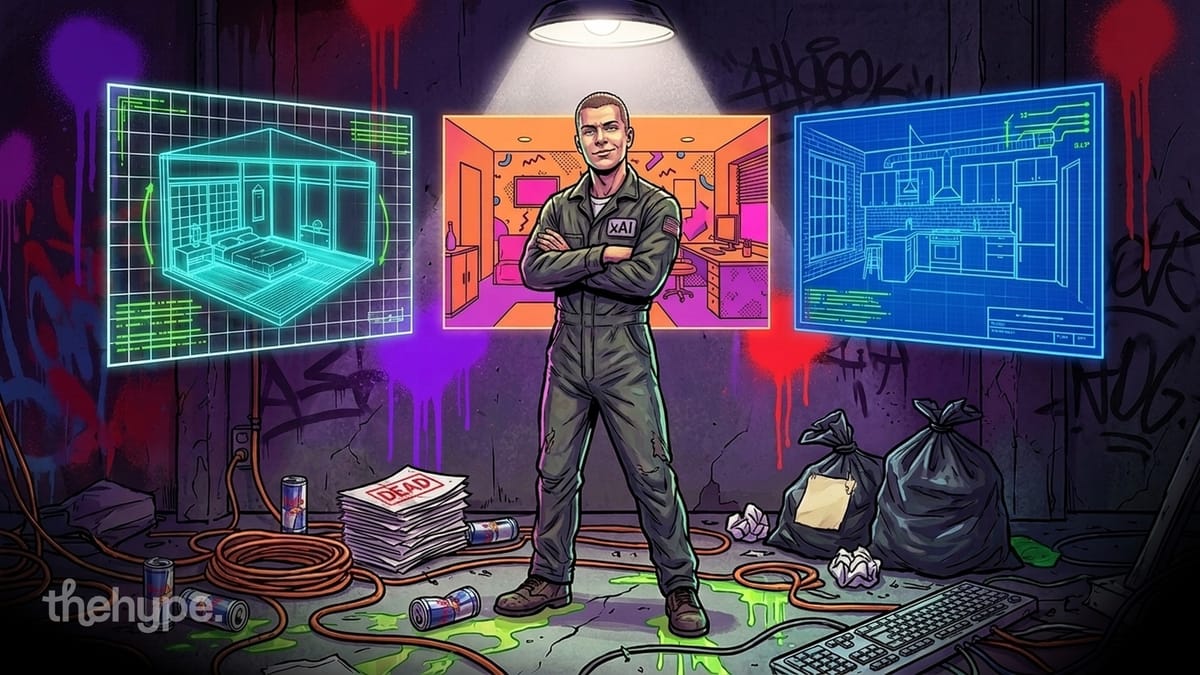
our test – 3 prompts, single-file html, three.js:
1. photorealistic 3d interior planner for a japanese-style bedroom
2. 3d interior planner for a 1980s memphis-design home office, flat cel-shaded – not photoreal
3. architectural 3d interior planner for a loft kitchen, rendered as a live technical blueprint
results:
- cost
#1 grok 4.5 – $0.32
#2 glm 5.2 – $2.46
#3 gpt 5.5 – $2.63
#4 fable 5 – $7.20
- output tokens
#1 grok 4.5 – 41,368
#2 gpt 5.5 – 65,940
#3 fable 5 – 110,368
#4 glm 5.2 – 401,698
- attempts
#1 grok 4.5 – 3
#1 fable 5 – 3
#2 glm 5.2 – 4
#3 gpt 5.5 – 5
- lines of code
#1 fable 5 – 1,535
#2 gpt 5.5 – 2,429
#3 glm 5.2 – 2,835
#4 grok 4.5 – 3,318
observations:
• grok 4.5 takes cost and token count outright and ties fable 5 on attempts, but writes the most code to get there
• fable 5 is 22x more expensive per run and produces the leanest files – 1,535 loc against grok's 3,318.
• glm 5.2 spent 401k tokens, nearly 10x grok, for the third-longest output. the token efficiency claim holds up
grok's code quality – reviewed by opus 4.8:
upsides: all three run first try, zero external assets. every texture is procedural – tatami weave, wood grain, plaster, terrazzo, animated crt scanlines. rotation-aware aabb collision, 900mm clearance-gap detection, kelvin-to-rgb sun model tied to tone-mapping exposure
downsides: three.rgbformat in the memphis file – removed in r137, file pins r160, cel-shading bands silently break. dead code throughout: an unused layouts array, mat positions set twice, three overlapping loops in getmovablefromintersect where two are unreachable. new materials allocated on every mode switch. no disposal anywhere
pattern: dense, working, visually ambitious code, fast and cheap – and no cleanup. it optimizes for a demo that runs, not code that gets reviewed
Announcing Grok 4.5, our first model trained specifically for coding and agents. It was trained with Cursor and offers frontier intelligence at leading speeds and cost efficiency.https://t.co/i8HpU7w64k pic.twitter.com/oBjGtTsoNc
— SpaceXAI (@SpaceXAI) July 8, 2026