 Vladimir Arustamov
48 teams. 3 countries. 104 matches. and three lessons for anyone shipping ai
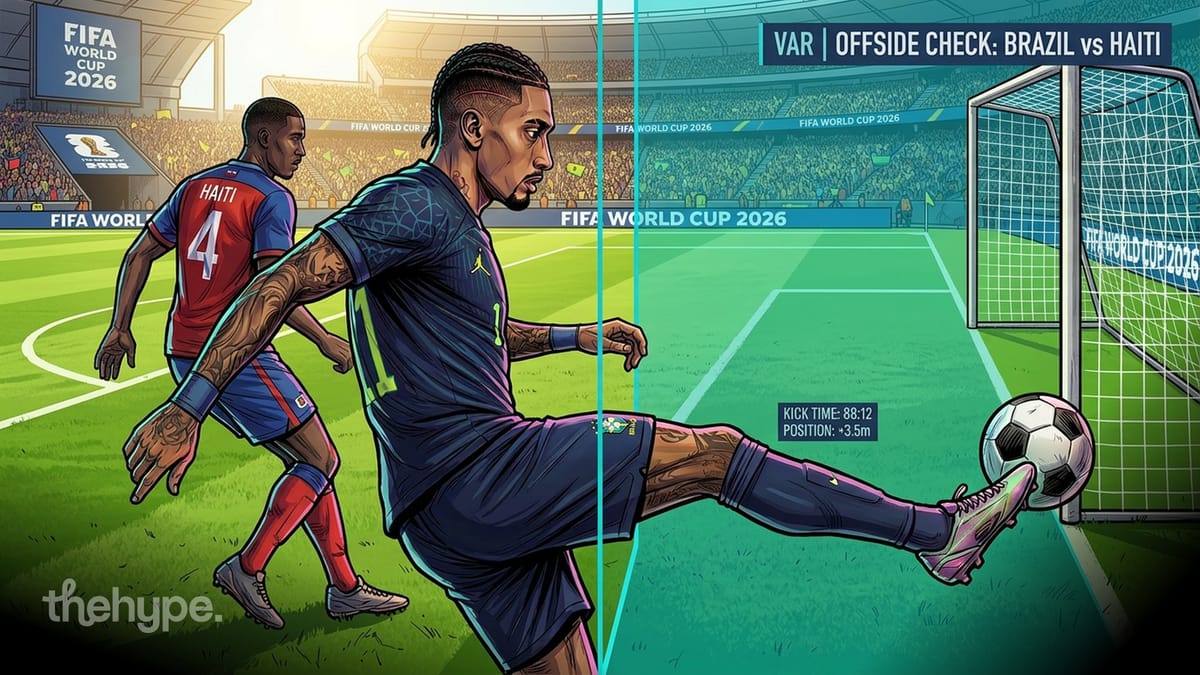
raphinha scored against haiti in the opening minutes. the goal lasted about four seconds. then it was gone – cancelled for offside. no referee squinting at a replay, no debate. a sensor inside the ball had been sampling at 500 frames per second. 3d skeletal models of all 22 players were being tracked in real time. at the exact frame the pass left the boot, raphinha had drifted a few centimetres past the last defender. the system flagged it automatically. the decision was instant
RAPHINHA IS CAUGHT OFFSIDE ❌ https://t.co/wWACZiYULM pic.twitter.com/agZL6c5SO9
— Goals Xtra (@GoalsXtra) June 20, 2026
that wasn't officiating as football knew it. that was a spatial algorithm running live, in a stadium of 80,000 people, surfacing a millimetre-level call before any human had formed an opinion
but raphinha's goal wasn't the only call that turned on the technology. and the two calls turned on different halves of the system
raphinha's hinged on spatial position – where every player stood at the kick point. later in the knockouts, croatia vs portugal hinged on something the cameras couldn't see at all: a touch
round of 32, deep into stoppage time. portugal 2-1 up after gonçalo ramos' added-time header. then joško gvardiol slid home what looked like the equaliser, mario pašalić teeing it up after a cross from ivan perišić. the goal stood on the field. television replays seemed to show that igor matanović had missed his flick-on, which would have left pašalić onside
According to the data provided by Connected Ball Technology housed within the @adidasfootball Trionda, the official match ball of the @FIFAWorldCup, it was proven that contact was made by Croatia's #20 Igor Matanović in the build up to the goal against Portugal, allowing the… pic.twitter.com/AyBz11N3wV
— FIFA Media (@fifamedia) July 3, 2026
the ball disagreed. the adidas trionda carries an imu sampling at 500hz. as the cross passed matanović, the sensor logged a faint contact – a touch off his hair, invisible to every camera angle, surfaced on the broadcast as a spike on a 'heartbeat' graphic, the same principle cricket uses to detect an edge. that touch reset the phase of play. at that frame, pašalić was offside. the goal was disallowed. croatia were out, and luka modrić's world cup ended with it. zlatko dalić said var had ruined the spirit of the game
there was a second touch the system had to resolve. on its way through, the ball also grazed portugal's renato veiga. under law 11, a deflection only resets the offside phase if it's a deliberate play – and var judged veiga's touch accidental, so the phase held. the system wasn't just detecting contact. it was classifying it: whose touch, and whether it counted
for builders: this is the architecture. the camera array validates spatial position. the ball resolves touch attribution. two independent data streams, cross-referenced, closing an ambiguity legacy video review couldn't – one contact no camera could see, sorted from a second contact that didn't count
these are small pieces of something much bigger
world cup 2026 – usa, canada, mexico – is a live production environment running at a scale and scrutiny level no synthetic benchmark can replicate. forget the football for a second: it's the most instructive ai system running anywhere right now. and if you build ai products, it's quietly teaching three things.
1. latency is the moat
the offside calls only mattered because they shipped live. there's no 15-minute break to fix an officiating decision – it lands on camera, in front of a billion people, with a referee waiting. that's the hardest constraint in the tournament, so look at the pipeline behind it:
calibrated camera array, cv neural networks (trained on millions of annotated frames), pose estimation, 3d skeletal reconstruction, decision layer, broadcast render.
five sequential ml-dependent stages, each with a hard latency budget, all closing during play. hawk-eye (owned by sony) handles the vision, football technology centre ag wrote the core algorithms, lenovo runs the infrastructure. new this year: "last touch" detection – attributing the final deflection in a pile of bodies to a specific player's limb, in real time, with a referee waiting.
demo: https://youtu.be/5bG7StS2zg4
the lesson: data access is commoditized – every team gets the same tools (more on that below). what's defensible is whether your pipeline closes in 2 seconds or 20. the real-time constraint is the moat. speed isn't a feature of the product. it's the product
2. the last mile is the product
alongside the officiating stack runs a second system off the same positional firehose – this one built for coaches, not referees.
FIFA AI Pro, powered by Lenovo AI infrastructure, is designed to analyze millions of data points and more than 2,000 match metrics in real time to deliver deeper tactical insights for teams competing at the FIFA World Cup 2026™.
— Lenovo (@Lenovo) June 2, 2026
From personalized player analysis to tactical… pic.twitter.com/2kn1DssFYZ
fifa ai pro is built on fifa's "football language model": hundreds of millions of data points, 2,000+ match metrics, multi-modal output – text, video, 3d visualizations – in multiple languages.
but the model isn't the value. the value is that the output lands in a format a coach can actually use during a 15-minute half-time break. the last mile – turning a torrent of data into something usable under time pressure – is where the real work is.
Lenovo AI-powered 3D Digital Avatars are designed to help transform how fans experience key moments during the FIFA World Cup 2026™.
— Lenovo (@Lenovo) June 16, 2026
Using advanced AI and 3D reconstruction technologies, ultra-realistic player avatars provide richer visual contextualization during replay… pic.twitter.com/PXDxRrjmBe
underneath it: 1,248 player models from 1-second body scans, stadium digital twins predicting crowd congestion live, a smart ball with an embedded imu.
The moment we have been working towards has arrived. Beginning this week, billions of people around the world will turn their attention to the FIFA World Cup 2026™, and it fills me with great pride to say that @Lenovo is at the center of it all as the only Official Technology… pic.twitter.com/IrLUg0lWHe
— Yuanqing Yang (@YuanqingYang) June 9, 2026
one more thing worth noting: fifa gives all 48 nations equal access. that's deliberate – it stops a data moat opening up between large and small federations. if you sign federation-level deals, access parity is becoming table stakes.
3. the dataset is the prize
every match feeds both systems, and both systems leave something behind.
104 matches of labeled, real-time pose data – collected by hawk-eye, processed by lenovo, owned by fifa. referee decisions, tactical sequences, all linked to outcomes. when the final whistle goes on july 19, that corpus still exists somewhere. what gets trained on it next cycle is the question worth watching.
the latency and the multimodal delivery win this cycle. the dataset wins the next one. the world cup ends july 19. the training data doesn't.
one more system was running at this world cup, and it's the one the others can't account for.
folarin balogun – usa's leading scorer – was sent off in the round of 32 against bosnia and herzegovina on july 1, raking his studs down tarik muharemović's ankle. brazilian referee raphael claus gave the red card after a slow-motion var review. it triggered an automatic one-match ban, ruling balogun out of the round of 16 against belgium.
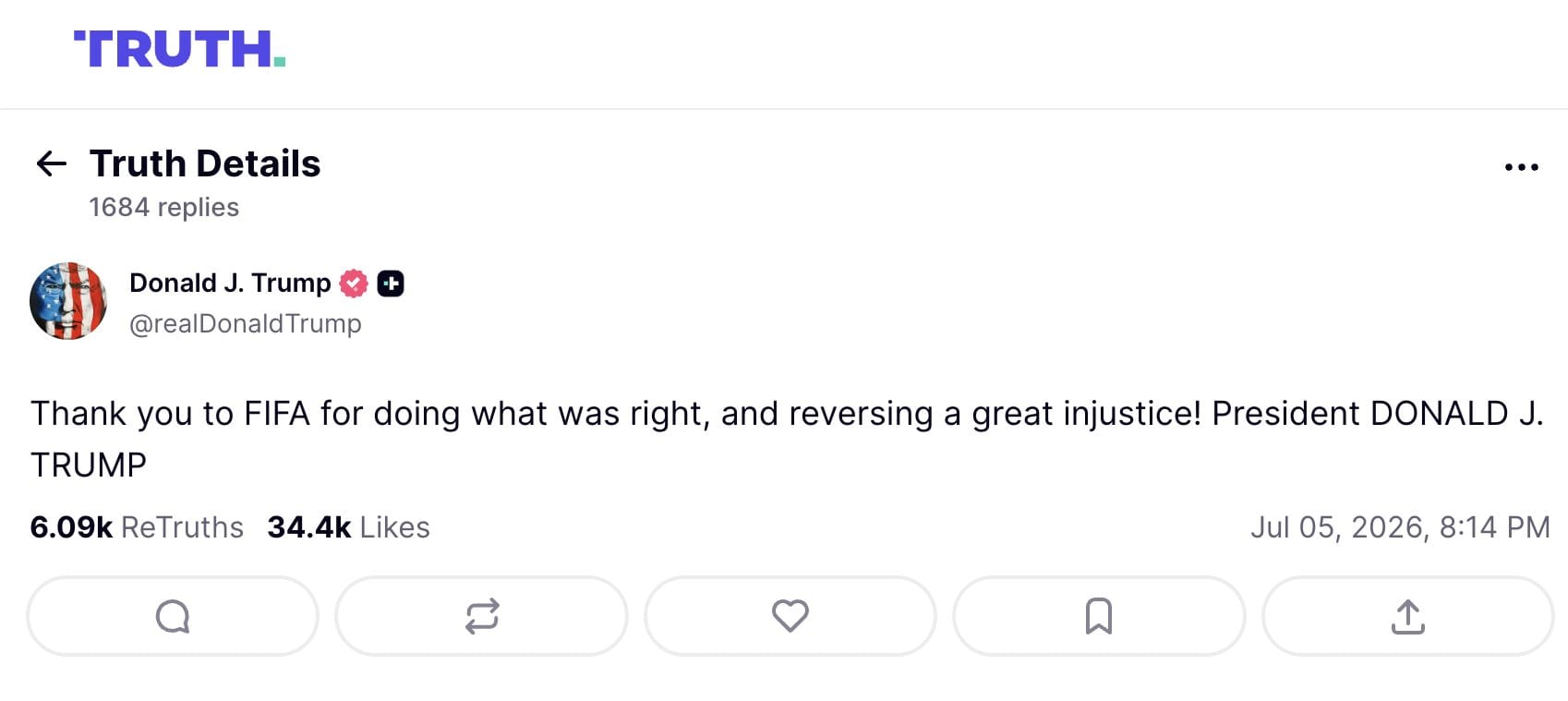
then it was reversed. president donald trump called fifa president gianni infantino to ask for a review of the card. days later, fifa suspended the sanction under article 27 of its disciplinary code – not revoking the red card, but placing balogun on a one-year probation so he could play. trump then thanked fifa on truth social for reversing what he called an injustice.
infantino confirmed the call and said he had told trump the case was for fifa's independent judicial bodies to decide. trump said he "had nothing to do with the decision." almost no one else accepted that framing. uefa said fifa had "crossed a red line." belgium's federation said it was astonished, and reported that a slide covering automatic suspensions had gone missing from fifa's standard pre-match presentation. balogun played against belgium.
for builders: the officiating stack ran flawlessly all tournament – 500hz sensors, skeletal models, millimetre calls closing in real time. balogun's ban was overturned by none of it. the technical layer is autonomous, sensor-driven, auditable. the layer above it runs on discretion, relationships, and override conditions no model can predict or price in. you can build the most precise system on earth and still watch a decision get made one level up, by rules your system was never allowed to see.