Felix Laurent

GLM-Legal is Z.ai's legal-domain model, released on October 12, 2026 and built on GLM-5.3-Flash. There are three ways to use it. The quickest is OpenRouter, which has listed it since November 2 with no application. Developers can also call it through the Z.ai API as glm-5.3-flashx-legal. People who prefer no code can use it in Z.ai's AutoClaw desktop app. Every route costs $0.37 per million input tokens and $1.25 per million output tokens.
This guide covers each route step by step and shows how to edit Word contracts with Z.ai's legal tools. It also explains how to prompt the model and what the independent benchmarks say. Facts were checked against Z.ai's docs, OpenRouter and Vals AI on November 20, 2026.
What GLM-Legal is
GLM-Legal is a fine-tuned version of GLM-5.3-Flash, a mixture-of-experts model with 320B total and 18B active parameters. Z.ai added legal mid-training on statutes, legal concepts and interpretive frameworks. It then ran reinforcement learning "across tens of thousands of realistic legal environments". Practicing lawyers' feedback became part of the training signal.
The model targets contract review and negotiation, evidence analysis, compliance research and legal drafting. Its context window is 1M tokens, enough for a full data room of contracts, with up to 128K tokens of output. Z.ai's legal tools cover more than 31 jurisdictions, including the US, EU, UK, Japan, Hong Kong and Singapore.
On price lists and in the API, the model appears as GLM-5.3-FlashX-Legal. Our news story on the GLM-Legal launch covers Z.ai's announcement. Independent tests give a more mixed picture than the launch claims.
How good GLM-Legal is: independent benchmarks
Vals AI ran the model on three legal benchmarks. The headline test is Harvey's Legal Agent Benchmark (LAB), where a model works through real legal tasks as an agent across 24 practice areas. A task only counts if every check passes.
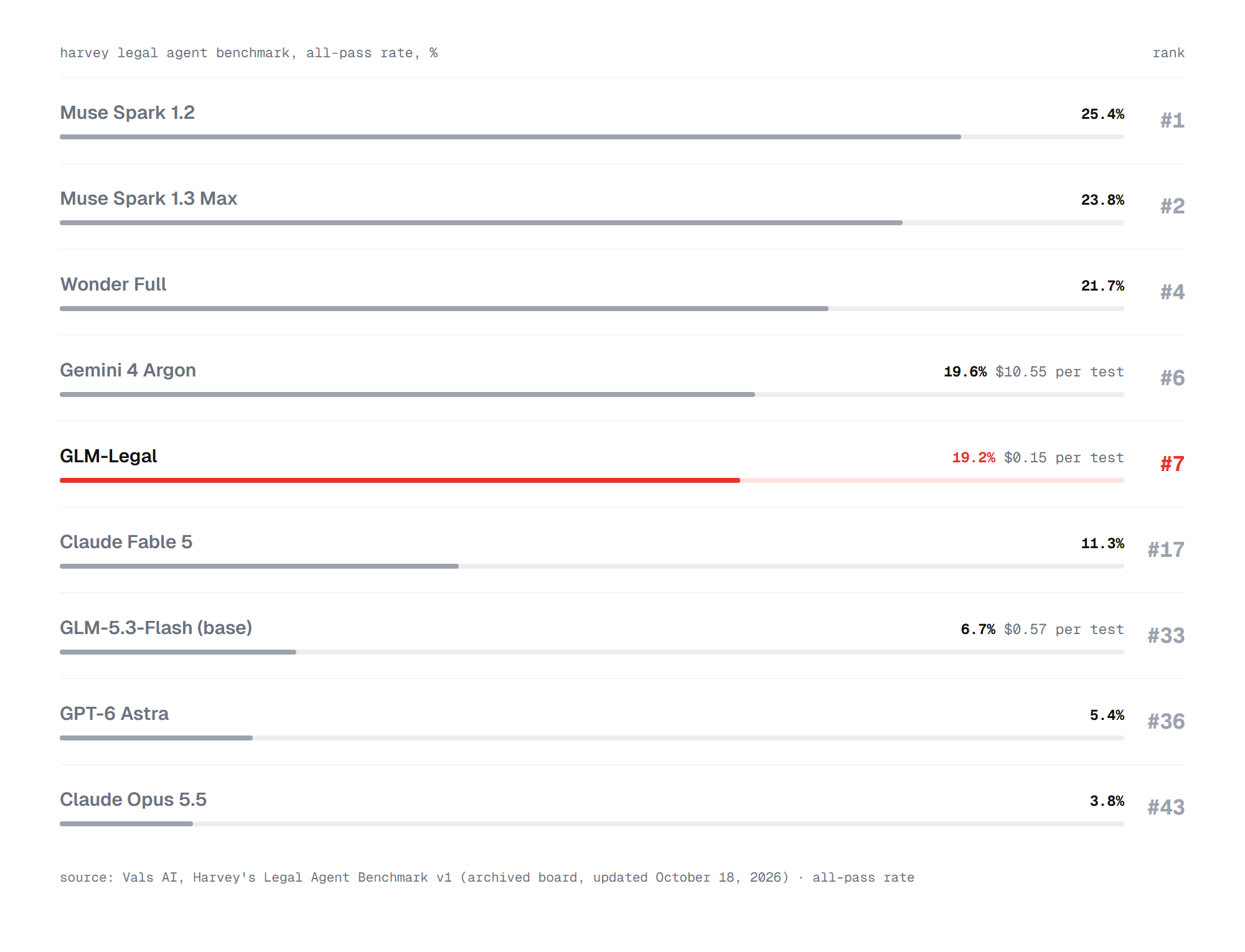
GLM-Legal scored 19.2% and ranked seventh, almost level with Gemini 4 Argon at 19.6%. The gap is in cost: $0.15 per test against $10.55 for Argon. GLM-Legal also tripled its base model, which scored 6.7%. Meta's Muse Spark models held the top spots. General frontier models such as GPT-6 Astra at 5.4% and Claude Opus 5.5 at 3.8% scored far lower.
The test is slow by design. Vals' archived board lists 1 hour 12 minutes per Harvey task for GLM-Legal, because the agent harness reads and edits many documents. Expect long runs on big agent jobs, while a single contract review takes minutes.
Two caveats apply. Vals has since moved to a new HLAB-Vals-1.1 board that is not comparable with the old one, and GLM-Legal is not on it yet. Z.ai's claim to rank first among open-source models also comes from its own announcement. The other two Vals tests show where the model is weaker.
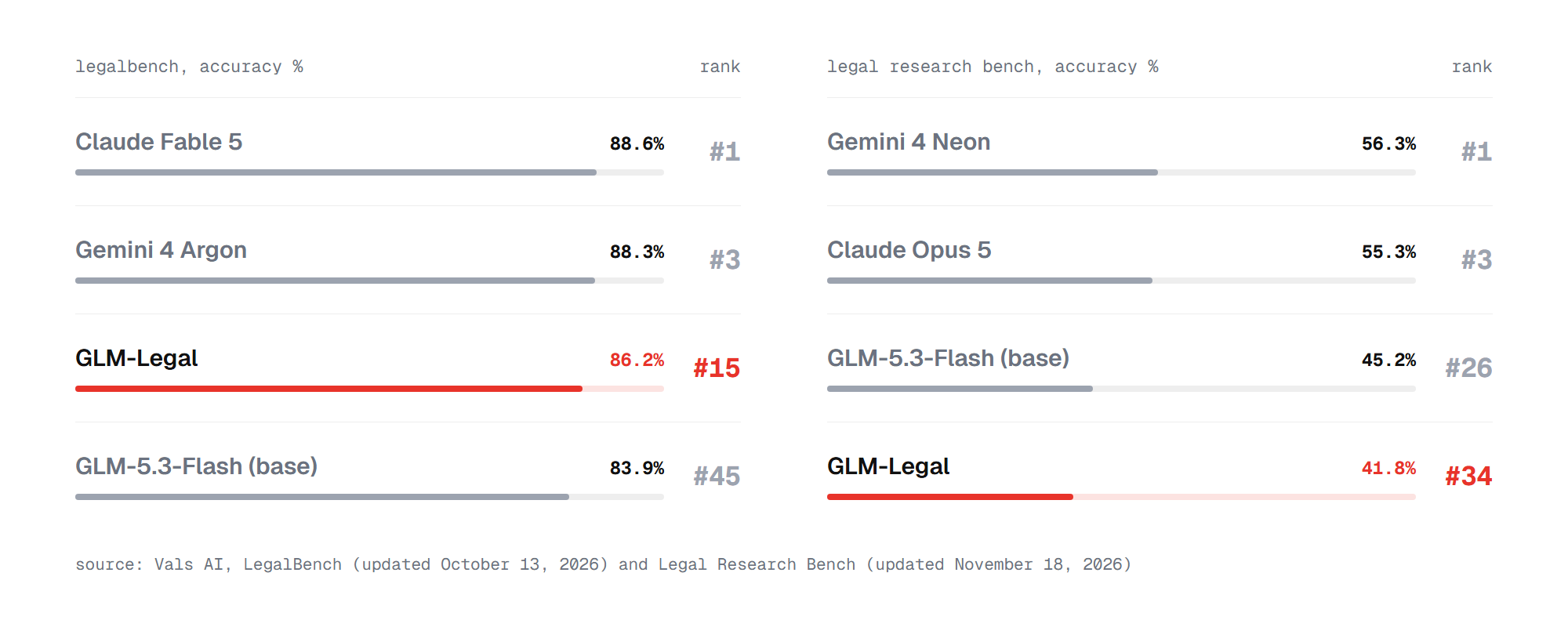
On LegalBench, a set of legal reasoning tasks, GLM-Legal scores 86.2%. That is 2.3 points behind the leader, Claude Fable 5. On Legal Research Bench, it scores 41.8%, below its own base model at 45.2%. Use it for document work, and check its research answers against primary sources. It also helps to know how it compares with the other models lawyers use.
GLM-Legal vs other legal AI models
On Vals' current Harvey board, HLAB-Vals-1.1, Gemini 4 Argon leads at 27.1%, at $10.55 per test. Meta's Muse Ember follows at 25.0% for only $0.12 per test, the closest rival to GLM-Legal on price. GPT-6.2 Astra scores 16.3%, and Claude Opus 5.5 scores 9.2%. GLM-Legal has not been tested on this version yet, so a direct comparison will have to wait.
The practical split looks like this:
- GLM-Legal suits high-volume contract review and redlining where cost per document matters.
- Gemini 4 Argon is the strongest agent on Harvey's tasks, at about 70 times the cost per test.
- Claude Fable 5 and Gemini 4 Neon lead LegalBench and Legal Research Bench, so they fit research-heavy work better.
- Harvey and other legal platforms wrap models in case management, citations and firm-level security, which an API alone does not give you.
For a firm, the choice often comes down to cost and data rules more than a few benchmark points. With that in mind, here is how to get access.
Option 1: use GLM-Legal through OpenRouter
This is the fastest route, because it needs no application to Z.ai and works with any OpenAI-compatible client. The model ID is z-ai/glm-5.3-flashx-legal.
- Create an account at openrouter.ai and add credits.
- Create an API key in the Keys section.
- Pick the model in the OpenRouter chat to test it in the browser, or call it from code.
OpenRouter uses the OpenAI format, so the official OpenAI SDK works with a changed base URL:
import os
from openai import OpenAI

client = OpenAI(base_url="https://openrouter.ai/api/v1",
                api_key=os.environ["OPENROUTER_API_KEY"])
nda_text = open("nda.txt", encoding="utf-8").read()
resp = client.chat.completions.create(
    model="z-ai/glm-5.3-flashx-legal",
    messages=[
        {"role": "system", "content": "You are a contract lawyer. Jurisdiction: England and Wales."},
        {"role": "user", "content": "Review this NDA and list risky clauses:\n\n" + nda_text},
    ],
)
print(resp.choices[0].message.content)
The system prompt in this example is a template. Before you run it, change the jurisdiction and the area of law to match your matter, such as "Delaware corporate law" or "German employment law". The model applies the rules you name, so a prompt left on England and Wales contract law will give wrong answers for other cases.
The price matches Z.ai's own. OpenRouter passes requests to Z.ai, so the same data terms apply. Teams that want a direct contract go to Z.ai.
Option 2: use the Z.ai API
Z.ai opened GLM-Legal as a beta for law firms, legal tech companies, in-house teams and independent lawyers. The application form is at z.ai/consultation/legal and asks for a company, role and use case. Z.ai does not publish eligibility rules or approval times. Once you have an API key, send requests to the chat completions endpoint:
curl https://api.z.ai/api/paas/v4/chat/completions \
  -H "Authorization: Bearer $ZAI_API_KEY" \
  -H "Content-Type: application/json" \
  -d '{
    "model": "glm-5.3-flashx-legal",
    "messages": [{"role": "user", "content": "Summarize the termination rights in this contract: ..."}],
    "temperature": 1,
    "top_p": 0.95,
    "thinking": {"type": "enabled"}
  }'
Z.ai's docs recommend temperature 1, top_p 0.95 and maximum reasoning effort for the GLM-5.3-Flash family. Thinking is always on. The model supports function calling with up to 128 tools, JSON output and context caching. The OpenAI SDK works with base_url="https://api.z.ai/api/paas/v4/". For lawyers who do not code, there is a desktop app.
Option 3: use GLM-Legal in AutoClaw
Z.ai's desktop agent app has offered GLM-Legal since November 13, with no API key or code needed. It works with Word files directly. You can drop in a contract, ask for a review and get the file back with tracked changes and comments.
Z.ai shows three workflows in its examples: contract review with redlines, cross-checking evidence across documents and building compliance checklists. As of November 20, AutoClaw's public model list did not show the legal model yet. Check the model picker in the app after updating it. The same Word editing is available to any agent through Z.ai's legal tools.
Edit Word contracts with the Z.ai legal MCP
Z.ai publishes legal MCP servers that plug into agents such as Claude Code, Cursor or OpenCode. The main one, Edit Word DXE, edits .docx contracts with tracked changes. Add it to your agent's MCP config with a standard Z.ai API key (a Coding Plan key does not work):
{
  "mcpServers": {
    "legal-dxe": {
      "url": "https://api.z.ai/api/mcp-broker/proxy/legal-dxe/mcp",
      "headers": {"Authorization": "Bearer YOUR_ZAI_API_KEY"}
    }
  }
}
The agent must support Streamable HTTP and file upload. Z.ai's sample prompt shows the idea: "Change the payment term from 30 days to 15 days. Keep tracked changes and return the revised DOCX." Separate servers search official sources for the US federal register, EU law, Japan and Hong Kong. Skill packs add contract review rules per jurisdiction. Good prompts matter as much as the tools.
How to prompt GLM-Legal for legal work
Legal answers depend on the jurisdiction, the document and the client's side. A short prompt leaves the model to guess all three. These habits help with any legal model, GLM-Legal included:
- Name the jurisdiction and governing law in the system prompt, such as "New York law, US federal regulations".
- Say whose side you are on: buyer or seller, employer or employee, licensor or licensee.
- Paste the full document. The 1M-token context fits long contracts, so avoid summaries that drop clauses.
- Ask for clause references for every finding, such as "cite the section number and quote the clause".
- Ask for a fixed format, like a risk table in JSON with clause, risk level, reason and suggested wording.
- Ask the model to flag uncertainty and list what it would need to check.
Then check citations and statutes yourself, since Legal Research Bench shows the model's research gaps. A few technical limits are worth knowing too.
Known limits of GLM-Legal
GLM-Legal inherits some quirks from its base model and its beta status.
- Thinking is always on. Every answer starts with reasoning, which adds time and output tokens even for short questions.
- Tool calls run in auto mode only. You cannot force a specific tool with
tool_choice, which some agent frameworks expect. - Input types are unclear. Z.ai's docs list text, images, video and files for the family, while Vals lists GLM-Legal as text only. Test PDFs and scans before you rely on them.
- No Anthropic-compatible endpoint is documented for the legal model. Agents built for Claude need an OpenAI-compatible setup or the MCP route.
None of these blocks normal contract work. Cost and data terms decide whether it fits your practice.
GLM-Legal pricing and data privacy
GLM-Legal costs $0.37 per million input tokens and $1.25 per million output tokens. Cached input costs $0.075. That is the same as GLM-5.3-FlashX and about 2.5 times the base GLM-5.3-Flash. There is no free tier. Z.ai's Coding Plan page names the model, but the plan docs list only GLM-5.3 and GLM-5.3-Flash, so check before you subscribe.
In practice, a single review is cheap. A 50-page contract runs to roughly 30,000 tokens, which costs about one cent to read. A detailed review of 5,000 tokens adds less than one more cent. Thinking tokens bill as output, so expect the real figure to be a few times higher, still well under a dollar.
Z.ai's API is run by a Singapore company, and its data processing agreement says customer data is "generally processed in Singapore". For API users, Z.ai says it will not use content to improve its services without explicit consent. Its terms also say outputs do not constitute advice. Many firms will need a client consent check before sending documents to any cloud model. Z.ai has not announced an on-premises version, and the weights are not on Hugging Face. Those terms shape who gets the most out of the model.
Who GLM-Legal is for
GLM-Legal fits four kinds of users best:
- Law firms with high review volume, such as due diligence or lease portfolios, where cost per document adds up fast.
- In-house compliance teams in Asia. Z.ai's own compliance example maps one obligation across Singapore, Malaysia and Indonesia data protection laws.
- Legal tech companies that build review or drafting products and need a cheap model with tool calling and a 1M-token context.
- Solo practitioners who want Word redlines without code, through AutoClaw.
It is a weaker fit for case law research and for firms that cannot send documents to a Singapore cloud. Anyone who needs on-premises hosting should look elsewhere.
So should you use GLM-Legal?
GLM-Legal is worth trying for contract review, redlining and compliance checklists, especially at volume. It matches Gemini 4 Argon on Harvey's agent benchmark at a fraction of the cost per task. Start on OpenRouter for a quick test on a few of your own past contracts, then apply to Z.ai if you need a direct contract. Keep a lawyer on every output. For legal research, a frontier model is still stronger, and every citation needs checking.
FAQ
Here are short answers to common questions about GLM-Legal.
Is GLM-Legal open source?
No public weights are available. Z.ai has not published GLM-Legal on Hugging Face or announced a license. Its base model family, GLM-5.3-Flash, has open weights under the MIT license.
Is GLM-Legal on OpenRouter?
Yes. OpenRouter has listed it as z-ai/glm-5.3-flashx-legal since November 2, 2026, at the same price as Z.ai's API.
Is GLM-Legal free?
No. It costs $0.37 per million input tokens and $1.25 per million output tokens. Z.ai's free models are older Flash versions, such as GLM-4.7-Flash.
Which languages and jurisdictions does GLM-Legal cover?
Z.ai tested it on English legal tasks and on PLawBench, a Chinese legal practice benchmark. Its legal tools cover more than 31 jurisdictions, from the US and EU to Japan and Singapore.
How do I get GLM-Legal API access from Z.ai?
Apply through the form at z.ai/consultation/legal with your company, role and use case. OpenRouter needs no application.
Can GLM-Legal replace a lawyer?
No. It speeds up review, redlining and drafting, but Z.ai's terms say its outputs are not legal advice. A qualified lawyer should check every result.