Felix Laurent

Pika, the AI video generator from Palo Alto, launched Pika H3 Flex on October 29, 2026. It is an open-weight video model, a post-trained version of MiniMax H3. It makes video with synchronized stereo audio in six sampling steps, down from 50. Pika says it can render a 15-second 768p clip with sound in as little as seven seconds of transformer compute. The company also says it is the #1 open-weights model on DesignArena's text-to-video leaderboard.
The announcement post on X ends with "it's kind of a flex". The name fits, but the model is not one Pika built from scratch, and that matters for everything that follows.
What Pika released: MiniMax H3 LoRA adapters
Pika H3 Flex is not a new architecture. Pika took MiniMax H3, the omni-modal video model MiniMax launched on July 31, 2026, and fine-tuned it on its own curated audio-video dataset. Then it compressed the model to six steps and tuned it for quality.
According to Pika's technical post, the work came in three stages:
- Supervised fine-tuning on an in-house dataset of everyday scenes, performance, narrative, technical and stylized clips, keeping H3's 50-step schedule.
- Distillation from 50 steps to 6 with Projected Distribution Matching Distillation (PDMD). Pika says this is a more stable version of the DMD method.
- Reward tuning with two methods: ReFL for aesthetics and visual clarity, DPO for instruction following and realism. Each was trained as its own LoRA adapter, and the two were merged with no extra inference steps.
The public release is just as modest. It ships as two MiniMax H3 LoRA adapters, FL2VA for text and first/last frames and Ref2VA for multimodal references, about 5.5 GB in total. They run on top of the MiniMax H3 base model, whose components take up about 210 GB. The adapters are on Hugging Face, and the inference code is on GitHub under Apache 2.0. Pika tested a single request on one Nvidia H100 with 80 GB of memory. ComfyUI added three ready MiniMax H3 workflows on launch day: text to video, first and last frame, and reference to video.
So the "open weights" are an add-on to someone else's open model. The next question is what those adapters change in practice.
Speed: where the seven seconds come from
The headline number is narrower than the X post suggests. In a footnote on the blog, Pika says the seven seconds measure "transformer (DiT) computation" for a 15-second 768p clip in a controlled benchmark. It is not end-to-end API latency. References, upscaling, stem separation and network overhead all add time.
The technical post gives the setup. The tests ran on eight Nvidia B300 GPUs. After kernel work (fused kernels, FlashAttention-4, block-sparse attention), full inference on a 5-second 768p clip dropped from 3.409 to 2.129 seconds, 1.6x faster. Pika says it is about 1.8x faster on average than fal's H3 Max at 768p. The gap is 1.5x on 5-second clips and about 2x on 10- and 15-second clips.
On a single card the numbers look very different. The ComfyUI guide says a 5-second 1344×768 clip takes "about a minute". Pika's GitHub repo lists one H100 80GB as the tested setup, and a 768p, 15-second run only passed with CPU offload. Anyone running it locally should expect a minute, not seven seconds.
The speed is the strongest claim in the launch. The 4K and audio claims depend on something else.
4K video and audio stems stay on Pika's servers
Open-weight Flex generates natively at 480p or 768p. Getting to 1080p, 2K or 4K takes Pika's upsampler, a separate 1B-parameter single-step transformer that Pika trained from scratch, partly on native 4K footage. The technical post says the upsampler will be open-sourced later. For now it is a hosted feature.
The same goes for audio. Flex itself outputs mixed stereo audio at 32 kHz. Through the Pika API, users can request five separate stems: dialogue, score, SFX, foley and ambience. Pika gets them through prompted source separation after generation, so it did not need stem-labeled training video. The research post calls editable stems "a first for a video model". We could not check that claim.
That leaves a clear split. The local release covers text to video, first and last frame, and reference to video at 480p and 768p. The 4K finish, the stems, prompt enhancement and the fast serving stack are all Pika-hosted. The same split shows up in how Pika prices it.
Price and the 12-reference input
Flex takes up to 12 reference files in one generation: 9 images, 3 videos and 3 audio clips. Video and audio references must each be 2–15 seconds long. Pika's examples include character sheets, a product shot turned into a multi-shot ad, and a dance copied from a motion-reference video.
Pika's own comparison table lists Flex's starting price at $0.01 per output second for text and image to video and $0.03 for reference to video. In the same table, MiniMax H3 starts at $0.08, fal H3 Max at $0.0325, Wan 3.0 at $0.03 and Seedance 2.5 at $0.103. These are Pika's figures, and the announcement post itself names no price.
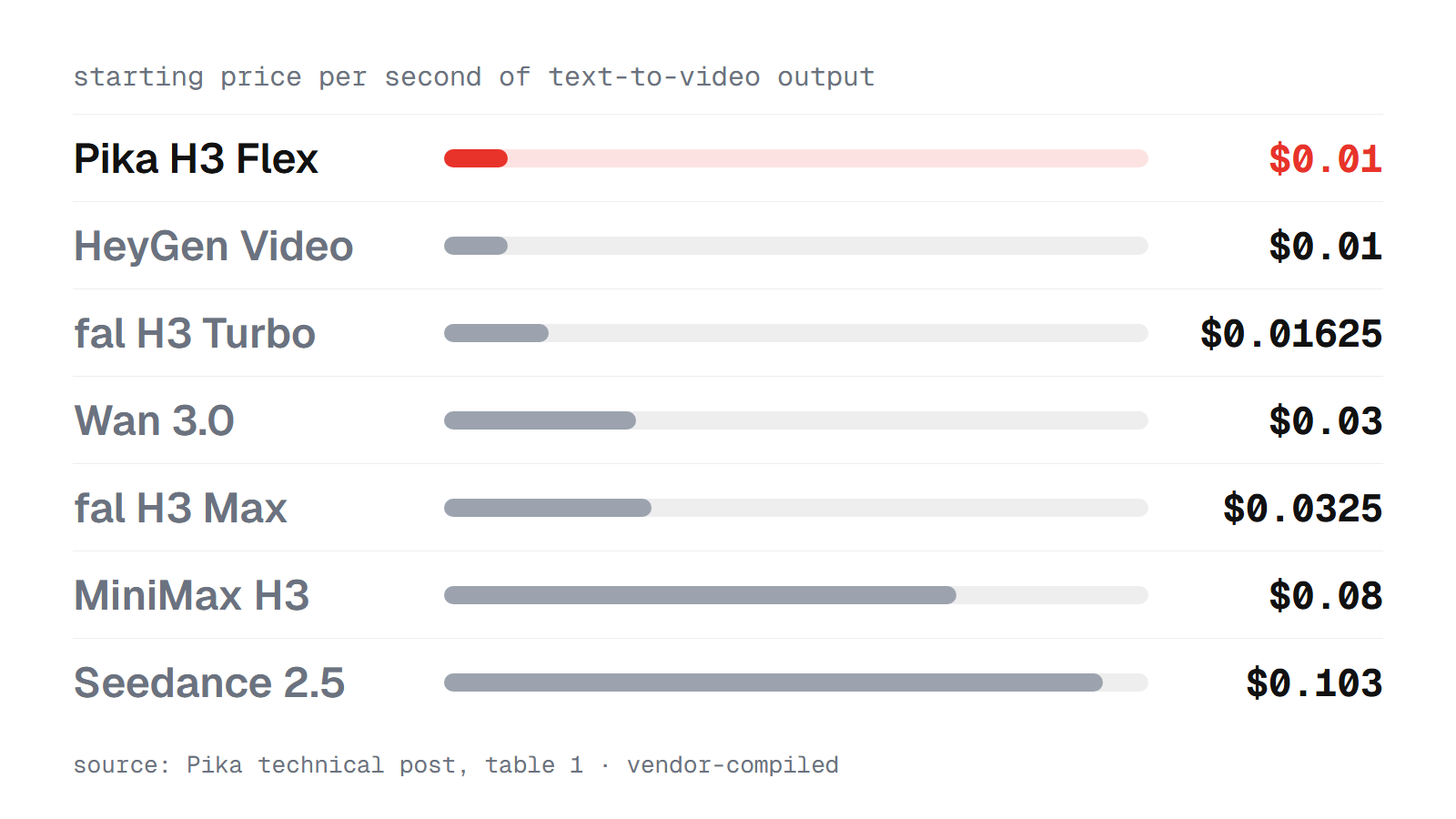
The table makes Flex look like the cheapest fast model on the market. The quality numbers behind that claim need a closer look.
Pika H3 Flex benchmarks are Pika's own
Every quality number in the launch comes from Pika's own evaluation on one prompt set at 768p. Against MiniMax H3, fal H3 Max and HeyGen Video, Flex scores highest on five visual and audio quality metrics. fal H3 Max wins the two alignment scores, audio-video and text-video. The research intro also says Flex beats rivals "by up to 91%", but the post does not say on which metric.
Pika's human-preference study is more balanced. Flex wins on human anatomy, complex composition and audio sync, plus visual style and camera framing in reference-to-video. Other systems win on physics, multi-scene narrative, lighting and materials, and action-heavy scenes. The ComfyUI guide adds that camera timing can land 0.2–0.3 seconds off, and "wide shot" often renders as a medium shot.
The only outside reference is DesignArena, an arena that ranks models by community votes. Pika's blog says Flex was #1 among open-weights models and #7 overall on the text-to-video board "at the time of writing". On the day of the launch, the published post still carried an "Editorial checks – remove before publishing" block. It listed confirming the final DesignArena ranking, the November 2 app date and the pricing as open items. We could not find a DesignArena post confirming the ranking.
That gap matters because Flex is the second post-train of the same base model in two months.
Pika H3 Flex vs fal H3 Max: the post-training race
On September 1, fal launched H3 Max, its own post-trained MiniMax H3. fal said it made a 5-second clip in about three seconds. It also took #1 on DesignArena's image-to-video board with an Elo of 1,341, ahead of base H3 at 1,333. Pika is now selling the same pitch in more detail: fewer steps, faster than real time, and a better score than the model underneath.
The difference is distribution. fal kept H3 Max's weights closed and sells it through its API. Pika published its adapters and code, which shows exactly what it did to the base model.
For Pika, Flex fits a year spent turning the company into a platform. In August it opened the Pika API Club, with access to 100+ models through one API, and launched its own audio models. In October it shipped a ChatGPT plugin. Its app already runs Seedance 2.5, MiniMax H3, Wan 3.0 and Gemini Omni as well as Pika 2.5. Flex is available in the API Club now and is due in the Pika app on November 2.
Licensing is the last thing to check. Both the adapters and the base fall under the MiniMax H3 Community License. Artificial Analysis says that license allows commercial use for organizations under $20M in revenue, with attribution. Only the inference code is Apache 2.0.
So is H3 Flex a flex? On speed, mostly yes. Pika publishes its method, its hardware and a 1.6x gain from its own kernel work, and it footnotes the seven seconds as compute time. On everything else, it is a well-documented fine-tune of MiniMax's model with the most marketable features, 4K and stems, kept on Pika's servers. The quality lead is self-measured, and the arena ranking was still unconfirmed on launch day. Until DesignArena publishes the board and outside testers run the adapters, Flex is the fastest H3 variant on paper and an unproven one in practice.
Sources
- Introducing Pika H3 Flex, Pika blog – launch post, seven-second footnote, DesignArena claim, availability
- Pika H3 Flex technical deep dive, Pika blog – PDMD distillation, ReFL and DPO, B300 latency, benchmarks, price tables
- Pika-H3-Flex, GitHub – inference code, H100 tests, 210 GB base, license split
- Pika H3 Flex ComfyUI workflows, ComfyUI docs – templates, single-card speed, known limits
- fal launches H3 Max, PR Newswire – rival H3 post-train, DesignArena image-to-video Elo
- What is MiniMax H3 (Hailuo 3.0), Hugging Face blog – base model launch, license terms per Artificial Analysis