 Yana Lialuke

Claude Opus 5.5 took a deadly open buggy, crashed it into a wall at 56 km/h and redesigned it until the crash-test dummy survived. It needed 7 iterations to go from 29 broken bones to none, in about 8 hours of agent work and $27.
How we built the crash lab
Before any crash, Opus 5.5 built the whole test from code. That means the car, the dummy, the physics and the renderer. We asked for every part to follow real crash-test data, and every number below comes from that build.
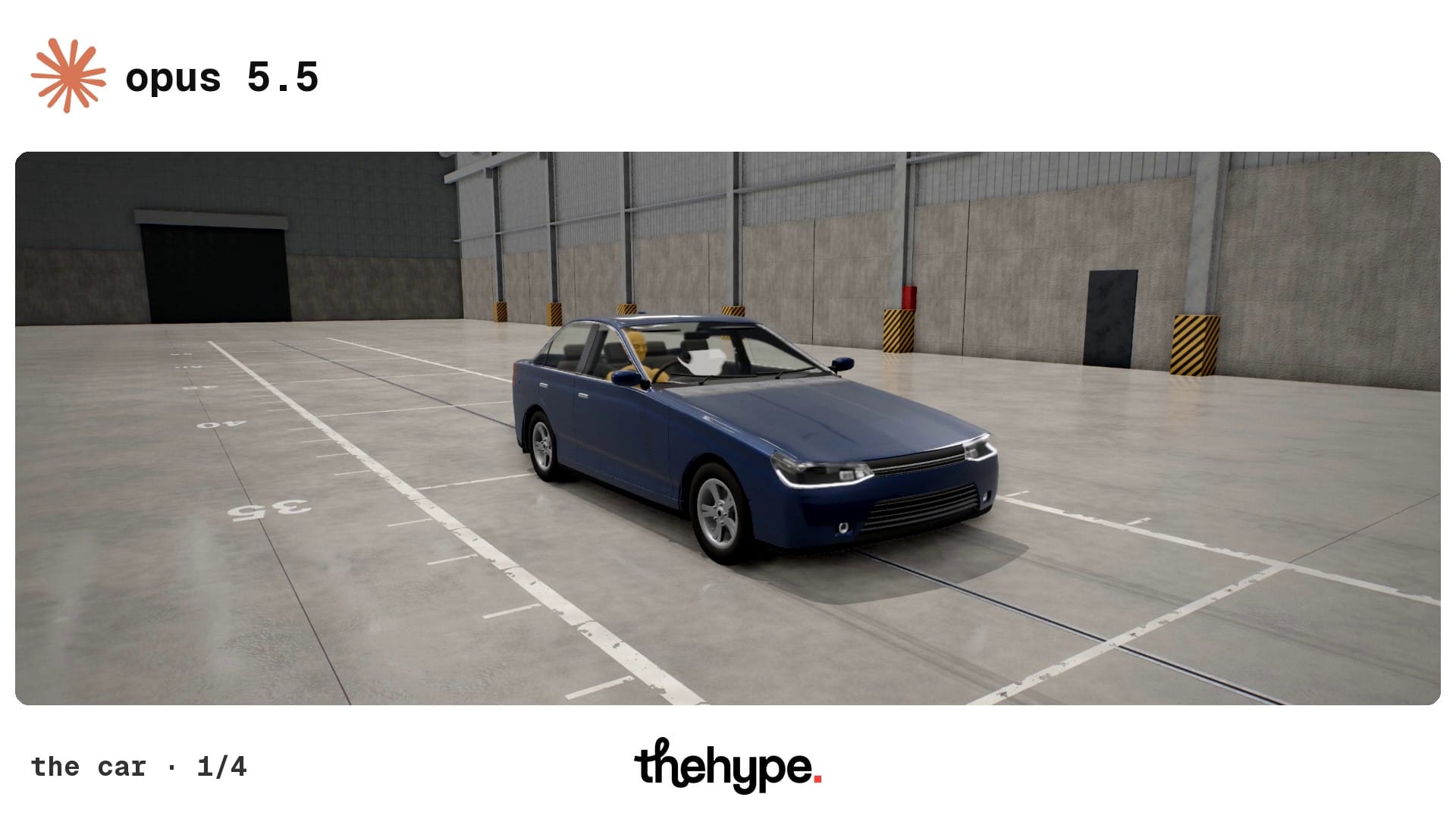
The car
The test car is a mid-size four-door sedan, close in size to a Toyota Camry or Honda Accord, with no brand on it.
- 1,300 kg, 4.40 m long, 1.80 m wide, 1.45 m high, 2.65 m wheelbase, 205/55 R16 tires
- 111 parts, each a separate named mesh with a material, a sheet thickness and a mass
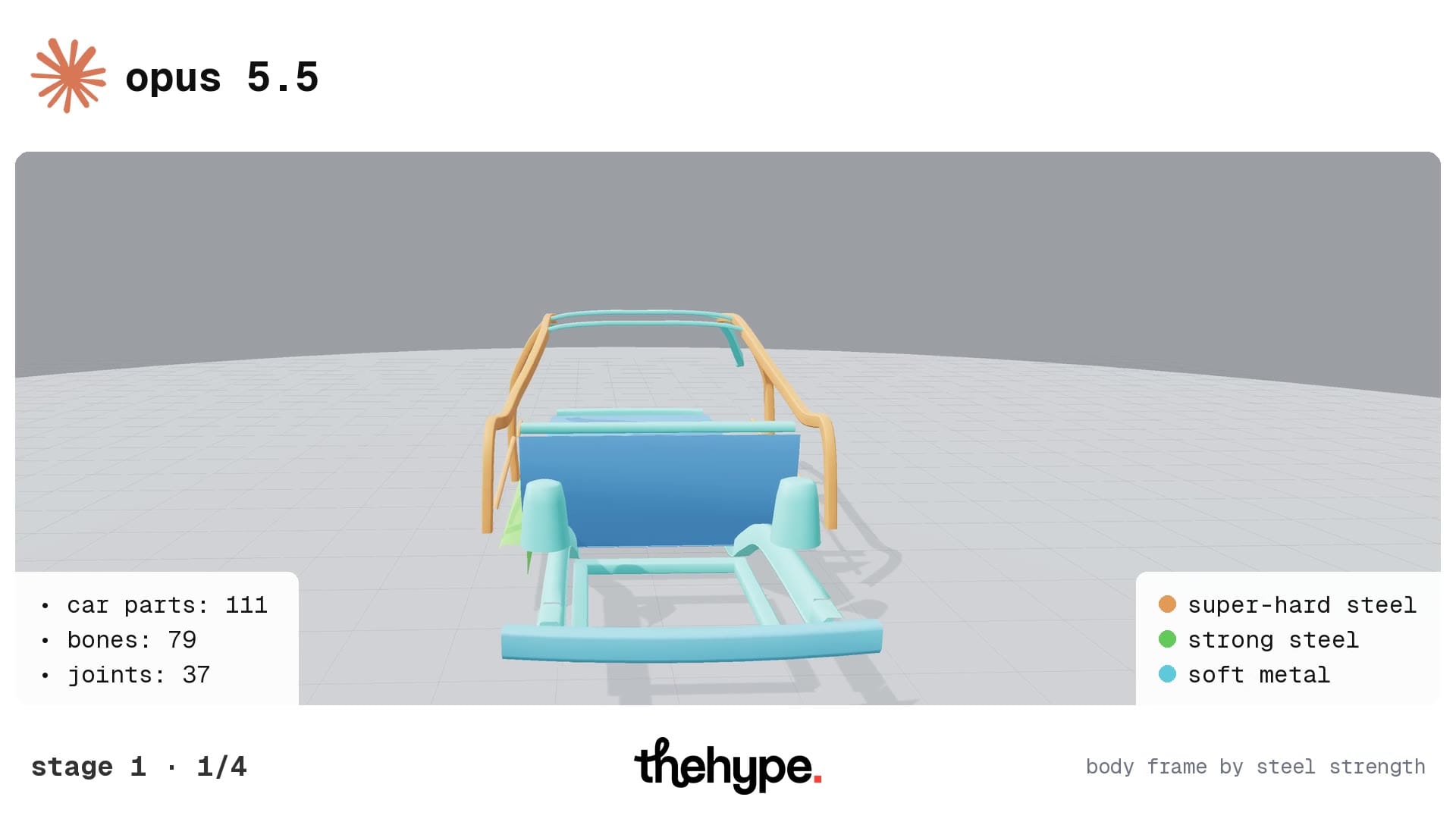
- A body-in-white like a real car: bumper beam, crash boxes, front rails, subframe, shock towers, firewall, A-, B- and C-pillars, roof rails, sills, floor pan, door beams
- Engine and gearbox, radiator, suspension, seats, a collapsible steering column, dashboard, knee bolster and pedals inside
- A materials database of 14 materials, each with density, stiffness, yield strength, ultimate strength, elongation and the handbook or standard it comes from
- The front parts also carry crash data: how far each one can crush and with what mean force
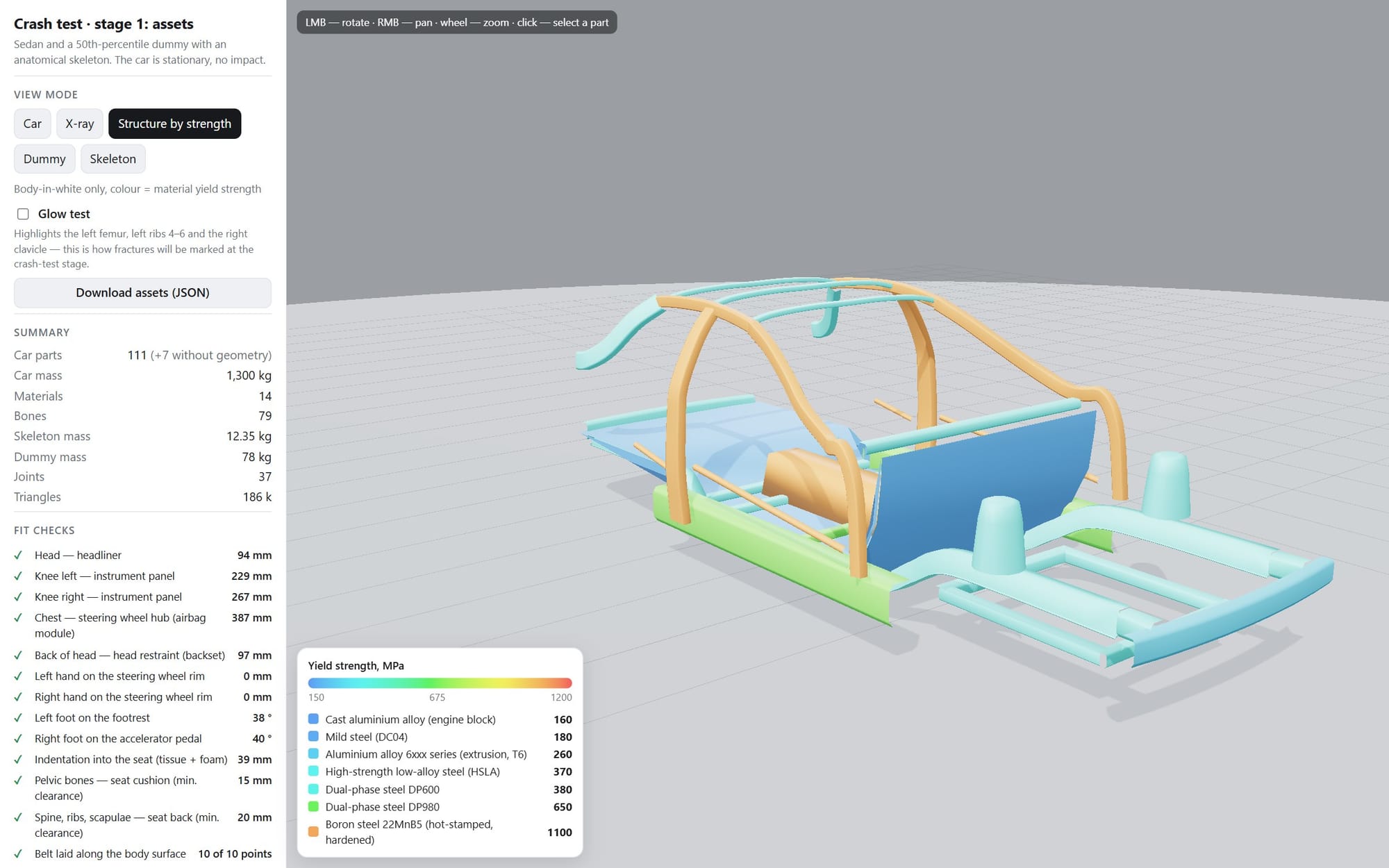
The steel follows the split real cars use. A soft front folds and absorbs the energy, and a hard cage keeps the cabin intact.
| Area | Material | Yield strength |
|---|---|---|
| Cabin cage: pillars, roof rails, sills | Boron steel 22MnB5, hot-stamped | 1,100 MPa |
| Floor sills and reinforcements | Dual-phase steel DP980 | 650 MPa |
| Front rails and crash boxes | DP600 / HSLA steel | 370–380 MPa |
| Bumper beam | Aluminum 6xxx extrusion | 260 MPa |
| Outer panels | Mild steel DC04 | 180 MPa |
| Engine block | Cast aluminum | 160 MPa |
The dummy
The driver is a copy of the Hybrid III 50th male, the standard dummy of frontal crash tests: 1.75 m and 78 kg.
- 79 bones, each its own mesh: skull, jaw, all 24 vertebrae, sacrum, 12 pairs of ribs, sternum, collarbones, shoulder blades, arm and leg bones, hands and feet
- Every bone has a mass, a share of hard and spongy tissue and a fracture limit from published biomechanics data
- 37 joints at the real joint centers: 25 between the vertebrae and 12 in the arms and legs
- In the crash it moves as 17 rigid segments with Hybrid III masses, inertia, joint stiffness and range of motion
- Load cells sit where a real dummy has them: upper neck, lower back, both thighs and both shins. A separate plate on a spring measures how far the chest is pushed in
These are the same readings a real crash lab takes from its dummy.
The physics
The crash runs in the browser on the Rapier 3D physics engine, 20,000 steps per simulated second. A run gives the same result every time.
- Car front – a chain of masses from the bumper to the firewall. Every link crushes along its own force curve, springs back a little and goes solid when it runs out of length
- Cabin – when the force through the firewall beats the cage, the footwell, the steering column and the dashboard move back into the cabin
- Seat belt – a 3-point belt through the shoulder loop and the buckle. The webbing stretches 8–10% at 10 kN, the pretensioner pulls it tight at impact, the load limiter lets it out at a set force
- Airbag – a gas model: the inflator pumps gas into the bag, the pressure follows the gas law, the gas leaks through vent holes and the fabric, and the bag pushes on the head and chest with pressure times contact area
- Injuries – the criteria crash labs use: HIC15 for the head, Nij for the neck, chest deflection, femur and tibia loads, lumbar force. A bone breaks when its load passes its fracture limit
- Calibration – we gave the model the ranges real 56 km/h wall tests produce: 0.55–0.80 m of crush and 35–55 g for a modern car, HIC15 of 250–700 for a belted driver with airbags
It is not a finite-element model, but every force in it has a real-world counterpart.
The asset viewer
Opus also built a viewer to check all of this before the first crash. It shows the car and the dummy in 3D, and every part and bone opens a card with its data. Every number in it carries its source.
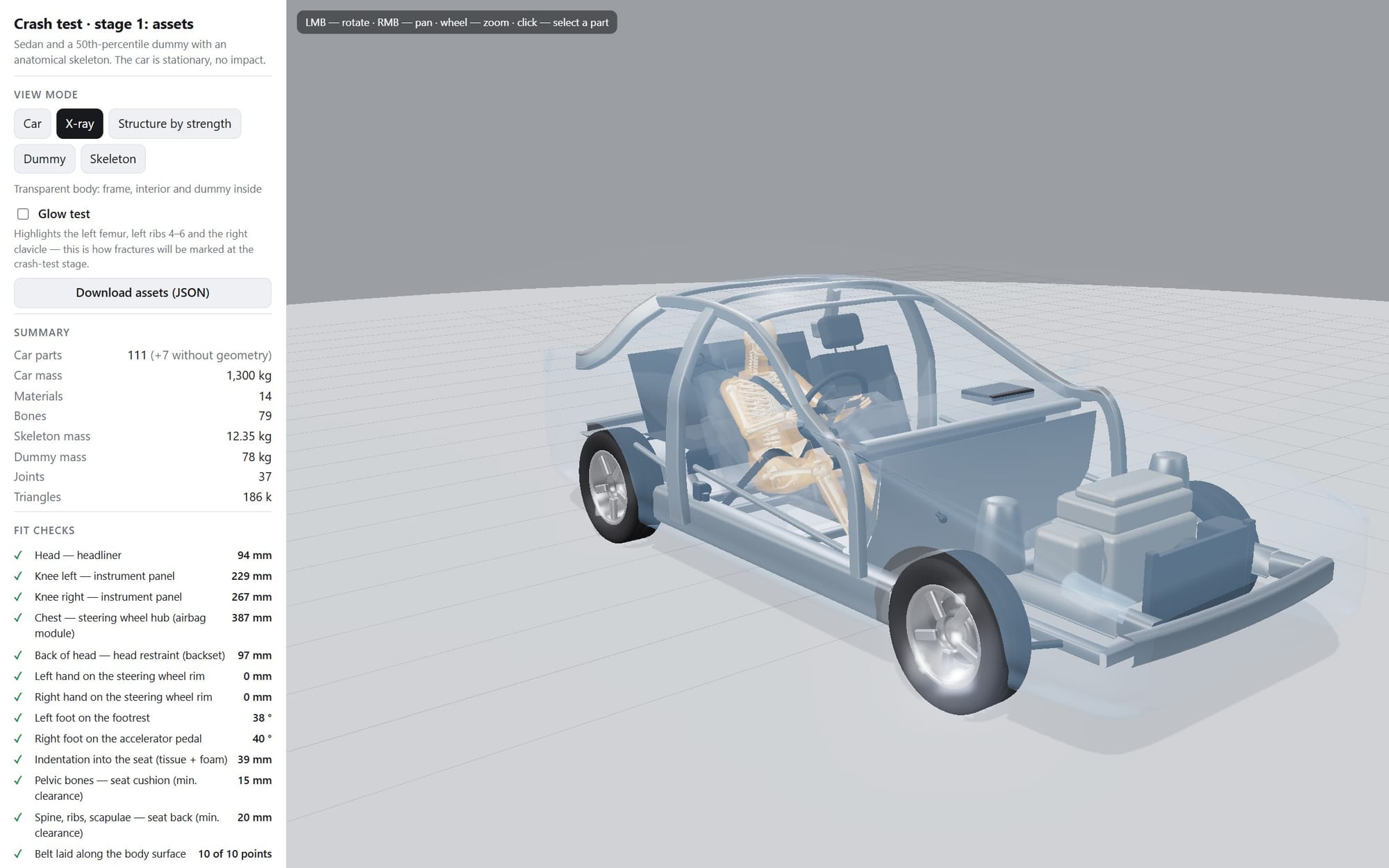
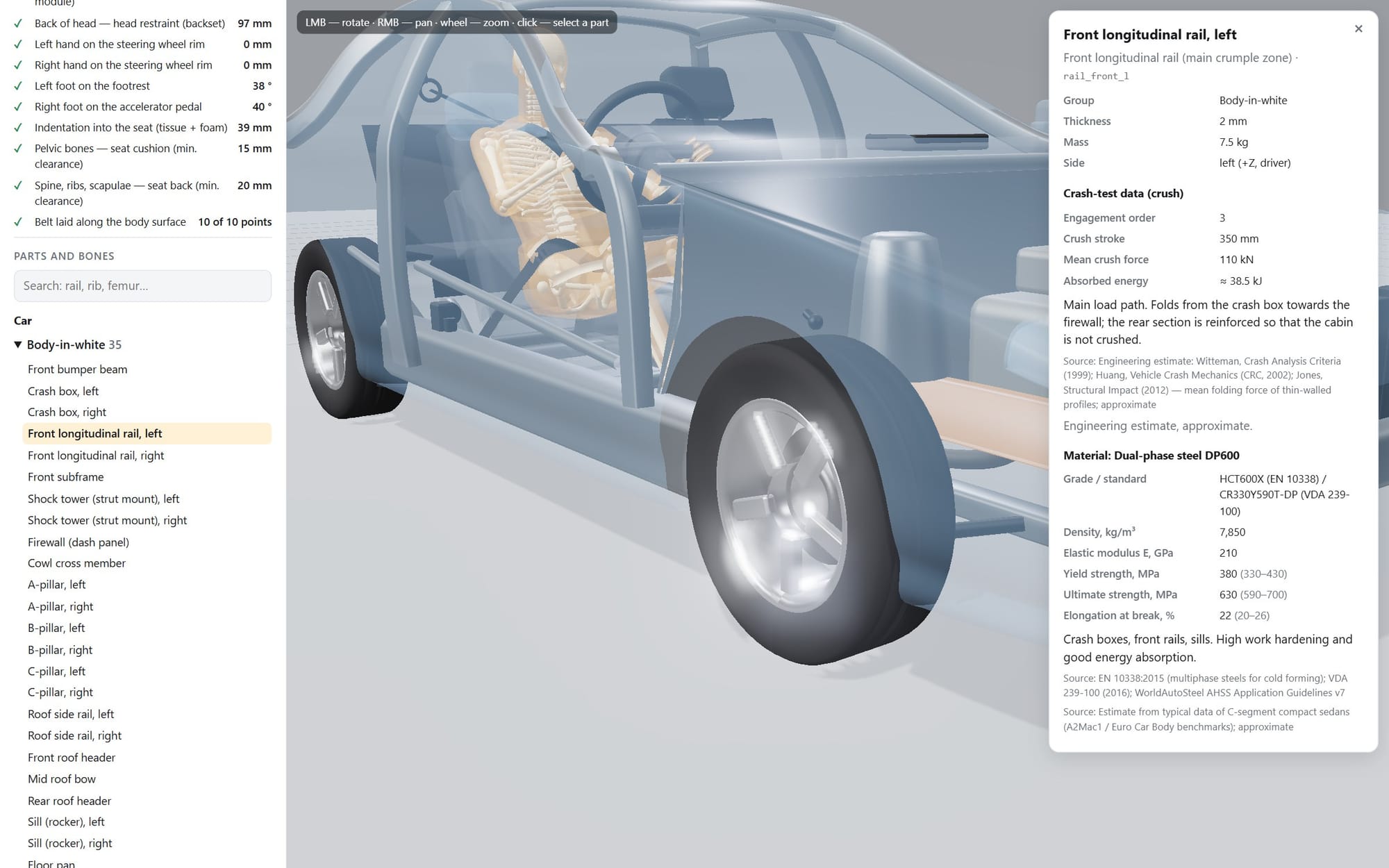
- Summary – 111 parts with geometry plus 7 without, 1,300 kg, 14 materials, 79 bones, a 12.35 kg skeleton in a 78 kg dummy, 37 joints, 186k triangles
- Five view modes – the whole car, X-ray, the structure colored by strength, the dummy with translucent skin, and the bare skeleton
- 13 fit checks – head to headliner 94 mm, head to head restraint 97 mm, chest to the airbag hub 387 mm, both hands on the wheel rim, both feet on the pedals, 39 mm of sinking into the seat, and the belt lying on the body at 10 of 10 points
- A searchable list of every part and bone, grouped like a real parts catalog: body-in-white, closures, glazing, lights, wheels, powertrain, suspension, interior and restraints
A part card lists the part's thickness, mass and side of the car, and for the front structure its crash data. The left front rail, for example, is 2 mm DP600 steel and weighs 7.5 kg. It is third in line to crush, folds over 350 mm at a mean force of 110 kN and absorbs about 38.5 kJ. Under that sits the material: grade and standard (HCT600X, EN 10338), density, stiffness, yield and ultimate strength with their ranges, elongation at break, and the sources.
A bone card works the same way. The left femur weighs 750 g, is 43 cm long and is 80% cortical bone, with the tissue's stiffness and strength from biomechanics papers. Its injury tolerance comes from the crash rules: an axial force of up to 10 kN under FMVSS 208, with the Euro NCAP grades next to it. The safety goal for the iterations below uses a stricter 8 kN.
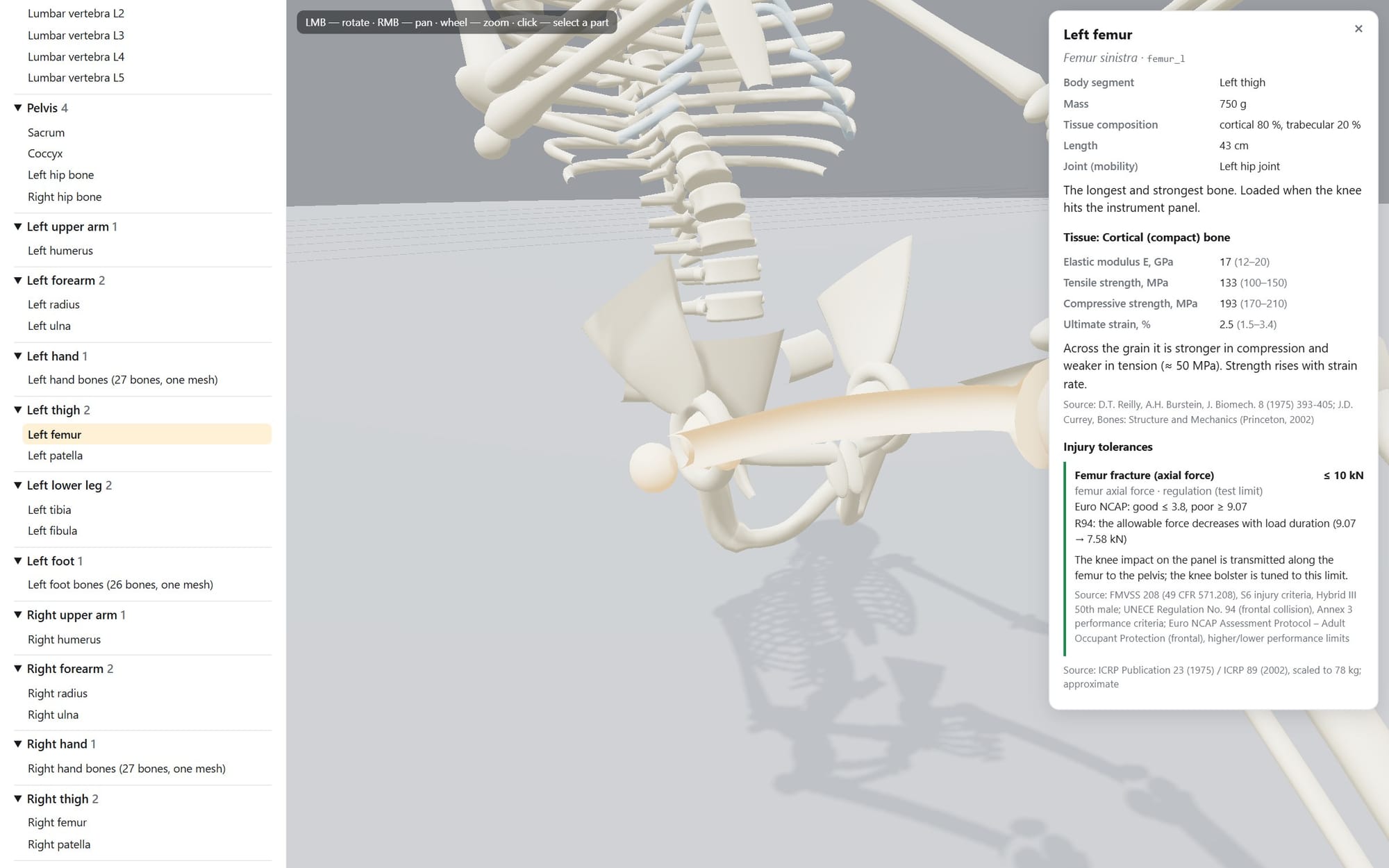
Where a value is an engineering estimate rather than a standard, the card says so: the crush data of the rails is marked approximate.
The render
The video is a separate photoreal renderer that replays each run frame by frame. The physics records the car, the crush, every dummy segment and the airbag every 0.5 ms for 150 ms after impact. The renderer draws it in a crash-test hall. Every texture, the car paint and the concrete included, is made in code – nothing was downloaded.
| What Opus wrote | Lines of code |
|---|---|
| Car and dummy models with their databases | 4,738 |
| 3D crash physics | 3,663 |
| Photoreal renderer | 8,129 |
That lab is what every iteration below runs in.
The starting car
The test starts with a car nobody should drive. It is an open tube-frame buggy with a flat bench, a tiller instead of a steering wheel, no body, no belt and no airbag. It accelerates from a standstill and hits a rigid concrete wall at 56 km/h, the speed of the standard full-frontal crash test.
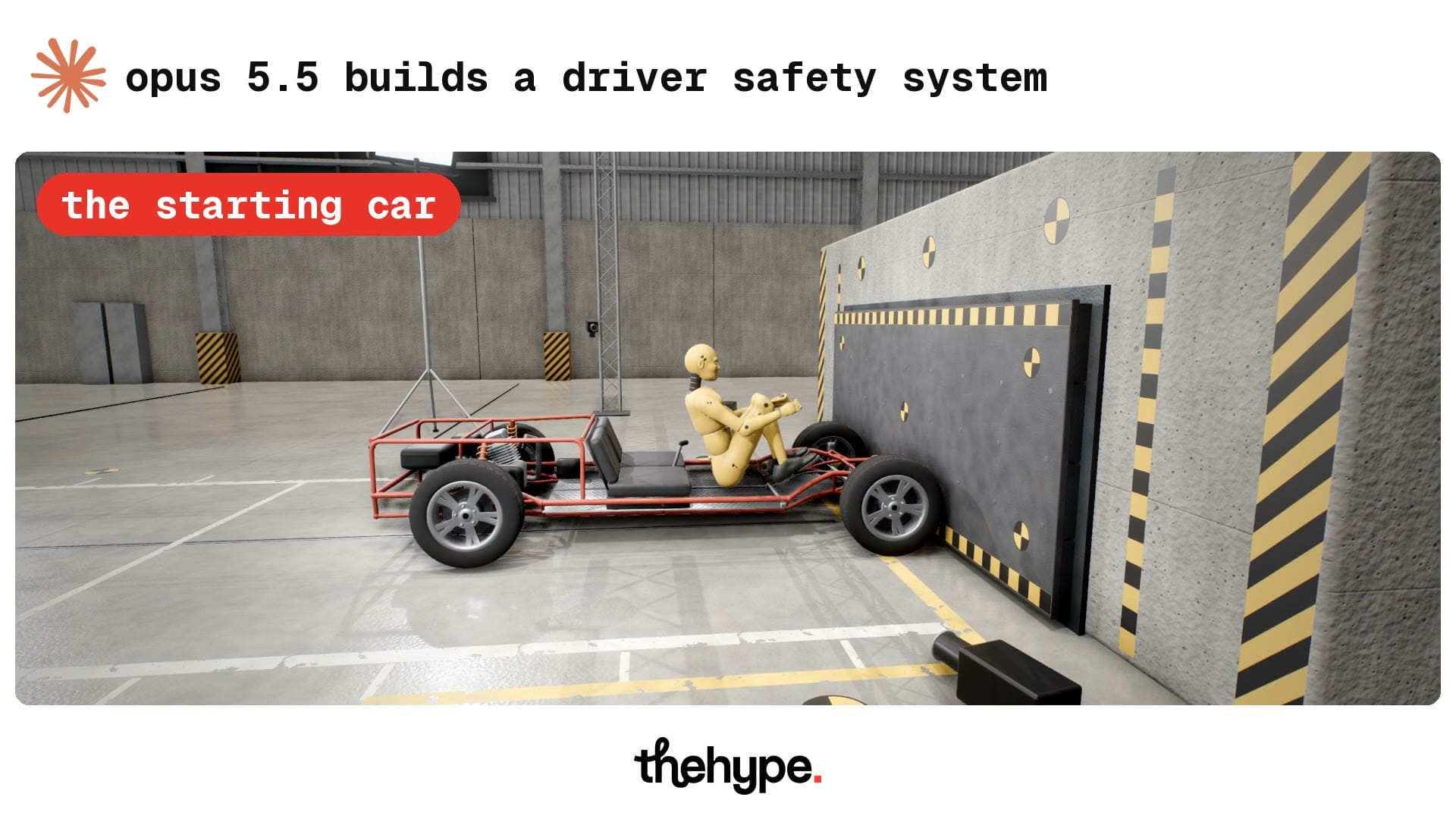
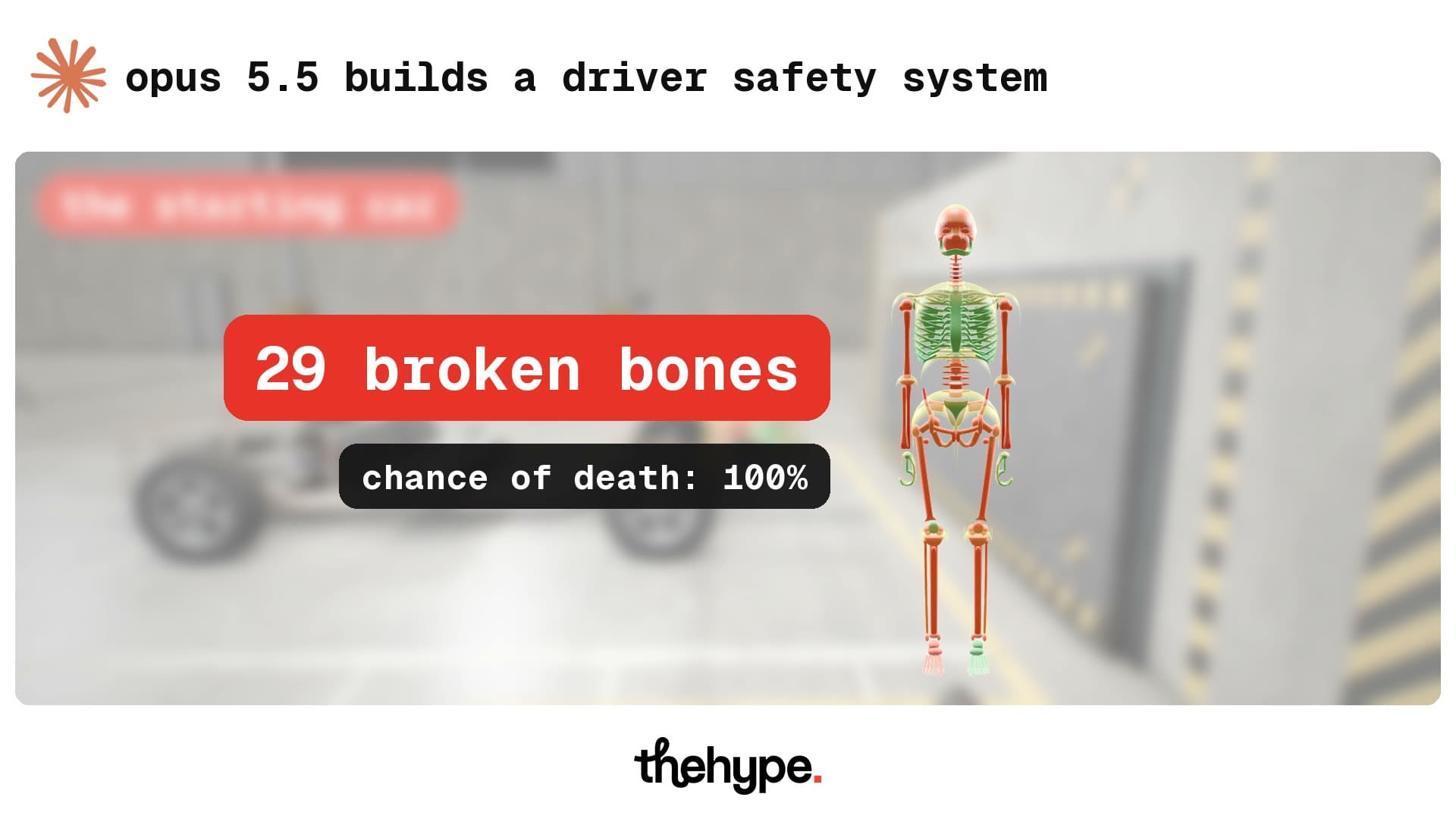
Nothing holds the driver in. The dummy slides off the bench, flies over the nose into the wall and lands on the floor with 29 broken bones, including the skull, the whole neck and the lower back. The video calls this a 100% chance of death – what that number means is explained below.
The rules
Opus 5.5 could add parts from a catalog and tune each one within real-world ranges. Every iteration is a full 3D crash simulation of that design. Opus reads the result and decides what to change next.
| Part | What it does | What Opus can tune |
|---|---|---|
| Car body | Closes the cabin; its front is a crumple zone that crushes like an accordion | Crumple zone 0.2–0.75 m, nose stiffness 50–300 kN |
| Steering wheel | Comes with the body, holds the airbag | – |
| Seat belt | Holds the body in the seat | Auto-tighten at impact (on/off, pull-in 3–12 cm), force limit 0–8 kN |
| Driver airbag | Catches the head and chest | Size 35–80 L, gas 20–70 g, vent holes 0–60 mm |
| Seat with headrest | Supports the back and head | Back height |
| Roll cage, soft steering column, knee pad, knee airbag | Extra protection | Strength, stroke, size |
A car counts as safe when the driver survives with no broken skull, spine or pelvis and every injury measure stays under its limit. It also has to be road-legal – body, steering wheel, pedals, windscreen – and the parts plus their weight must cost at most $8,000. The budget is what makes it hard: Opus cannot simply add everything.
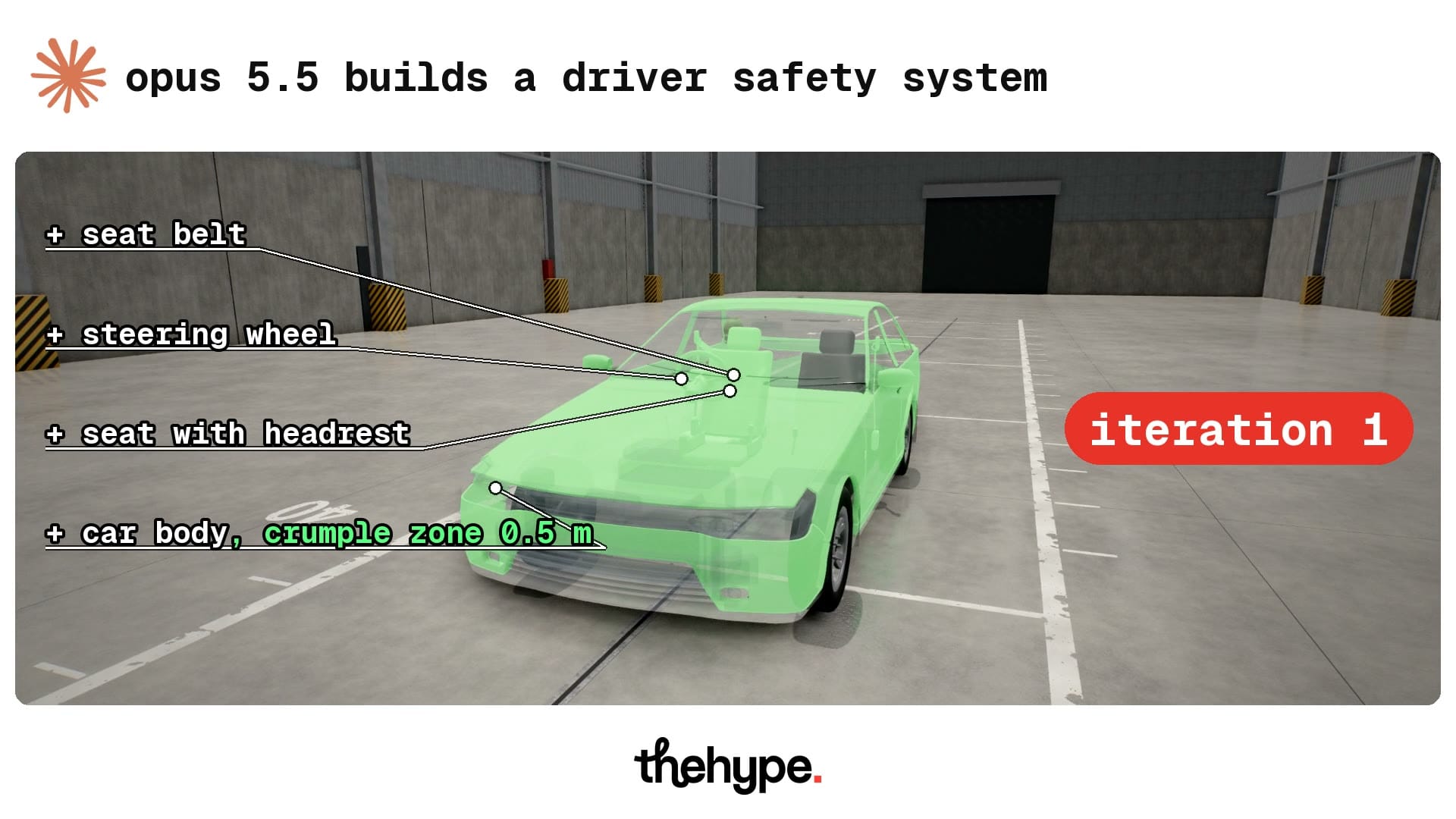
The 7 iterations
The driver died in iterations 1 to 6 and survived in iteration 7. Each iteration changes a few things against the one before.
| Iteration | What Opus changed | Front crushed | Peak deceleration | Broken bones | Chance of death* |
|---|---|---|---|---|---|
| Start | Open buggy | – | – | 29 | 100% |
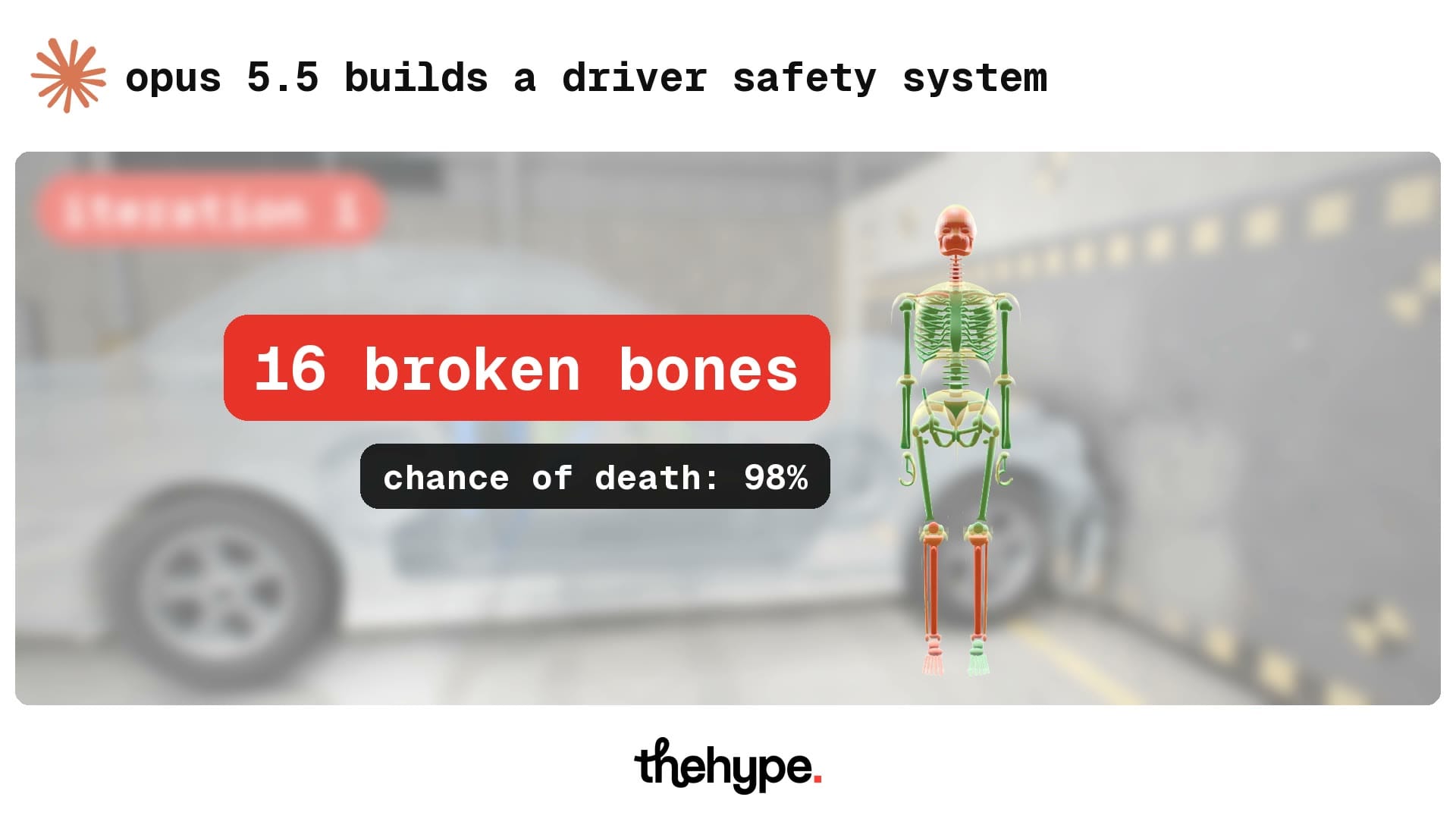
| 1 | + Car body (0.5 m crumple zone), steering wheel, seat belt, seat with headrest | 0.57 m of 0.5 m | 112 g | 16 | 98% |
| 2 | + Airbag 60 L; seat with headrest removed | 0.57 m of 0.5 m | 113 g | 21 | 90% |
| 3 | Crumple zone 0.5 → 0.75 m, softer nose, belt force 4 → 3 kN, seat back | 0.81 m of 0.75 m | 108 g | 11 | 80% |
| 4 | Airbag 60 → 70 L, belt pull-in 9 → 12 cm, seat removed | 0.80 m of 0.75 m | 109 g | 14 | 53% |
| 5 | Crumple zone 0.75 → 0.45 m, seat back, less airbag gas | 0.54 m of 0.45 m | 114 g | 20 | 96% |
| 6 | Crumple zone back to 0.75 m, softest nose, belt auto-tighten off | 0.82 m of 0.75 m | 112 g | 14 | 79% |
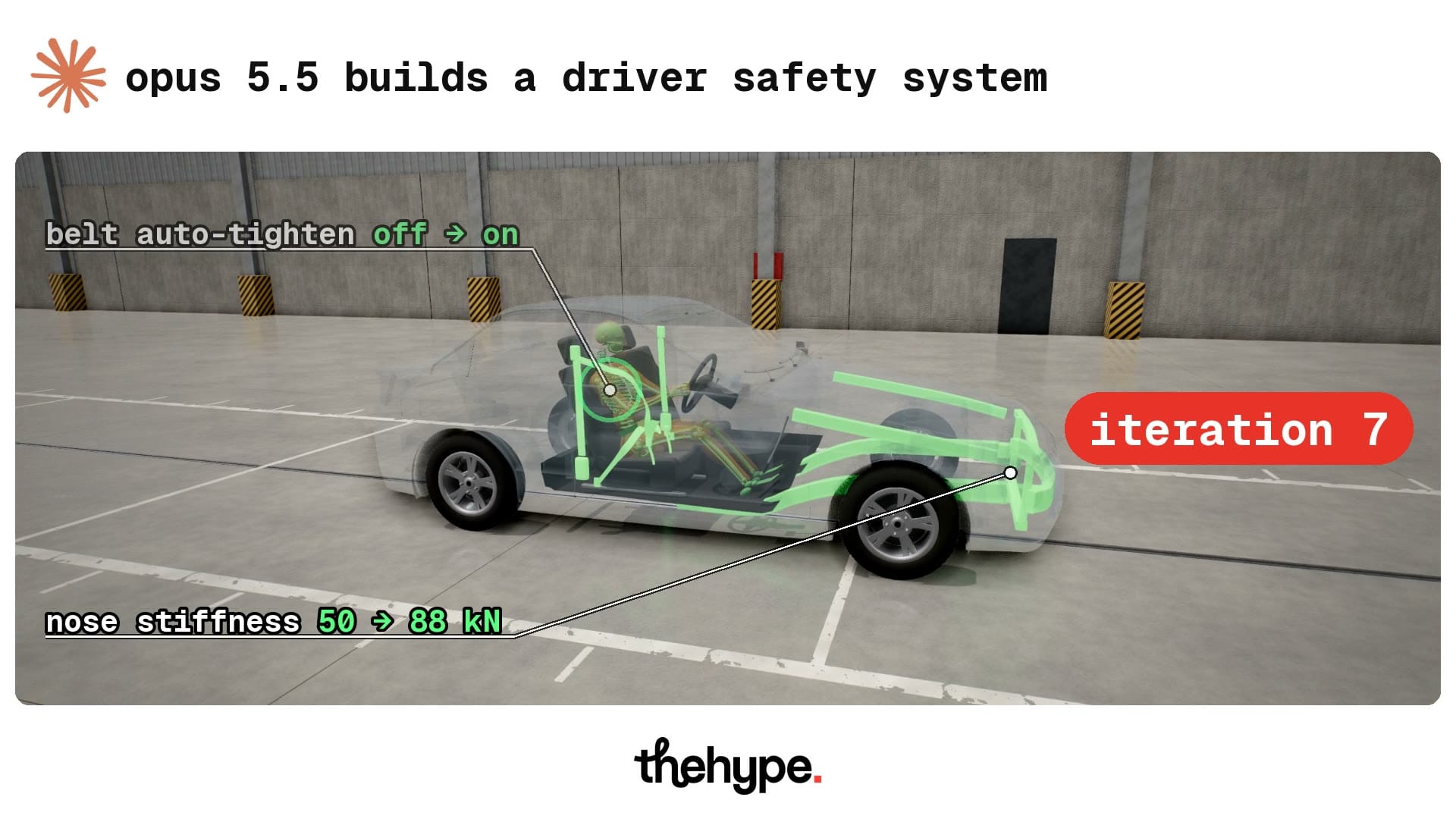
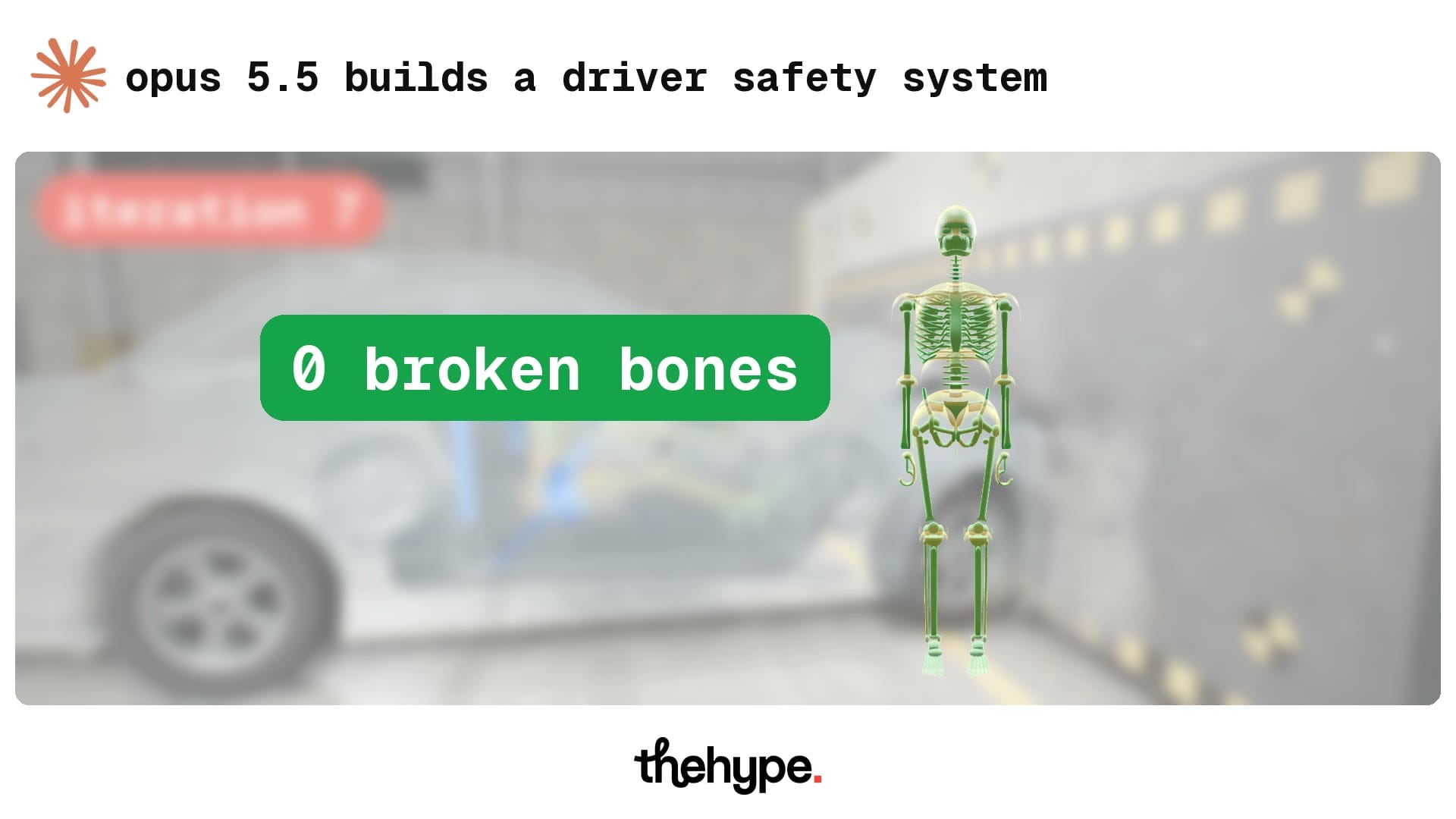
| 7 | Nose stiffness 50 → 88 kN, belt auto-tighten back on, seat removed | 0.71 m of 0.75 m | 29 g | 0 | 13% |
In iterations 1 to 6 the nose was too soft for its length. The car crushed past the end of its crumple zone and hit the hard cabin, so the driver felt more than 100 g. In every one of them the dummy broke its skull, its neck and its left collarbone, where the belt pulled with 8–13 kN. Iteration 7 made the nose stiff enough to stop inside its 0.75 m: the peak fell to 29 g and every injury dropped under its limit.
What saved the driver
The winning car is simple: a body with a long, firm crumple zone, a belt that tightens itself at impact and an airbag. Opus left the seat with a headrest out to stay inside the budget.
| Part | Final setting |
|---|---|
| Crumple zone | 0.75 m long, nose stiffness 88 kN |
| Seat belt | Auto-tighten on, 12 cm pull-in, force limit 4 kN |
| Driver airbag | 70 L, 50 g of gas, 30 mm vent holes |
| Also fitted | Steering wheel, pedals, windscreen |
| Total | 105 kg and $5,802 of parts; with the weight penalty, $7,900 of the $8,000 budget |
The firm nose slows the cabin over 0.71 m instead of slamming it into a wall of metal. The belt catches the body early and lets go gently at 4 kN, so the collarbone holds. The airbag takes the head before it reaches the wheel. In the final crash the head score is 211 against a limit of 700.
How injuries are scored
The dummy follows the Hybrid III, the standard crash-test dummy, with 79 bones. Its sensors give the same numbers a real crash lab measures.
| Measure | What it checks | Limit |
|---|---|---|
| HIC15 | How hard the head is shaken | 700 |
| Nij | Neck bending and pulling | 1.0 |
| Chest deflection | How far the ribcage is pushed in | 50 mm |
| Femur force | Load on the thigh bones | 8 kN |
| Lumbar force | Load on the lower back | 5.5 kN |
A bone breaks when its load passes the strength of real bone tissue. The driver survives when no skull, spine or pelvis bone breaks and every measure stays under its limit.
*What "chance of death" means: in the video and in the table above it is short for the risk of a serious or fatal injury – level 3 or worse on the medical injury scale (AIS 3+), combined over head, neck, chest and legs. It uses the risk curves of the US government's crash rating, NHTSA NCAP. So it is not strictly the probability of dying: it also counts injuries that need a hospital and could kill. For the starting buggy it is 100%, for the final car 13%. The curves never reach zero: in iteration 7 the neck still adds 8.6% and the chest 4.3%, with every measure far under its limit.
Time and cost
Everything in the video was built by Opus 5.5: 8 hours 16 minutes of work and about $27.
| What Opus built | Work time | Tokens |
|---|---|---|
| Photoreal renderer: car body, test hall, crash damage, dummy, airbags | 3h 16m | 2.0M |
| 3D crash physics: world, car, 79-bone dummy, belt, airbag, injuries | 3h 08m | 3.4M |
| Car and dummy model | 50m | billed $1.55 |
| Crash physics, first version | 24m | 290k |
| Renderer for the buggy and the thrown-out driver | 22m | 308k |
| Airbag design | 15m | 258k |
| The 7 iterations | 3m | 64k |
| Total | 8h 16m | 6.3M, about $27 |
Work time is the sum of the agents' run times; some ran in parallel, so less wall-clock time passed. Cost is a rough figure: reported tokens at Opus's list input price of $4 per million, plus the $1.55 bill for part of the car model. Rendering the video on our computer is not counted.
Earlier test: Opus 5.5 alone vs a Haiku 5.5 team
Before the 7 iterations, we had Claude build the same crash test twice: once with Opus 5.5 alone, once with Opus 5.5 leading Haiku 5.5 sub-agents. Both sides got the same sedan, the same 79-bone dummy and the same spec, then wrote their own crash physics and designed an airbag over three iterations.
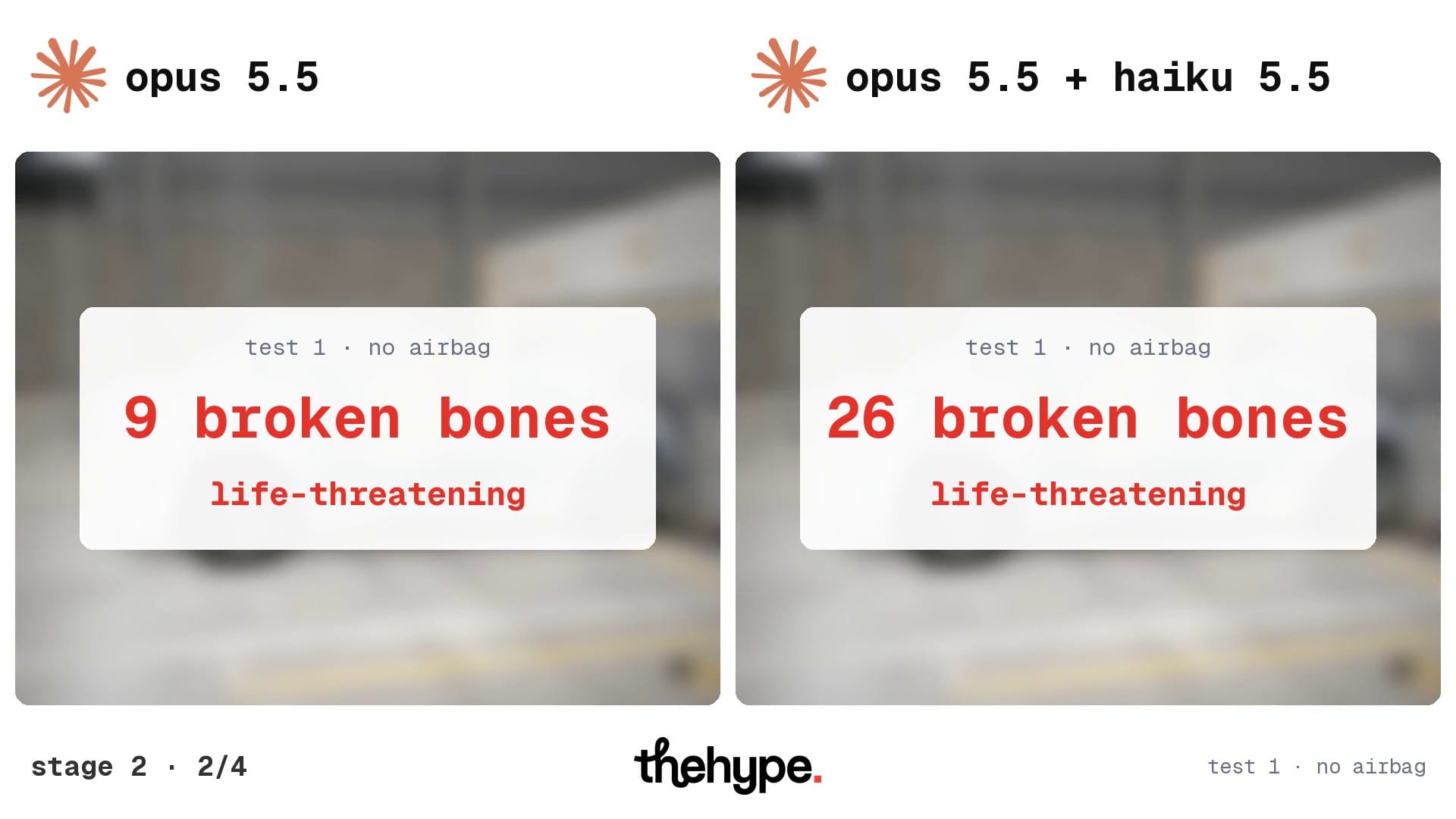
- Crash without an airbag – Opus alone 9 broken bones, the team 26: its planner's physics pushed large loads through the lower back
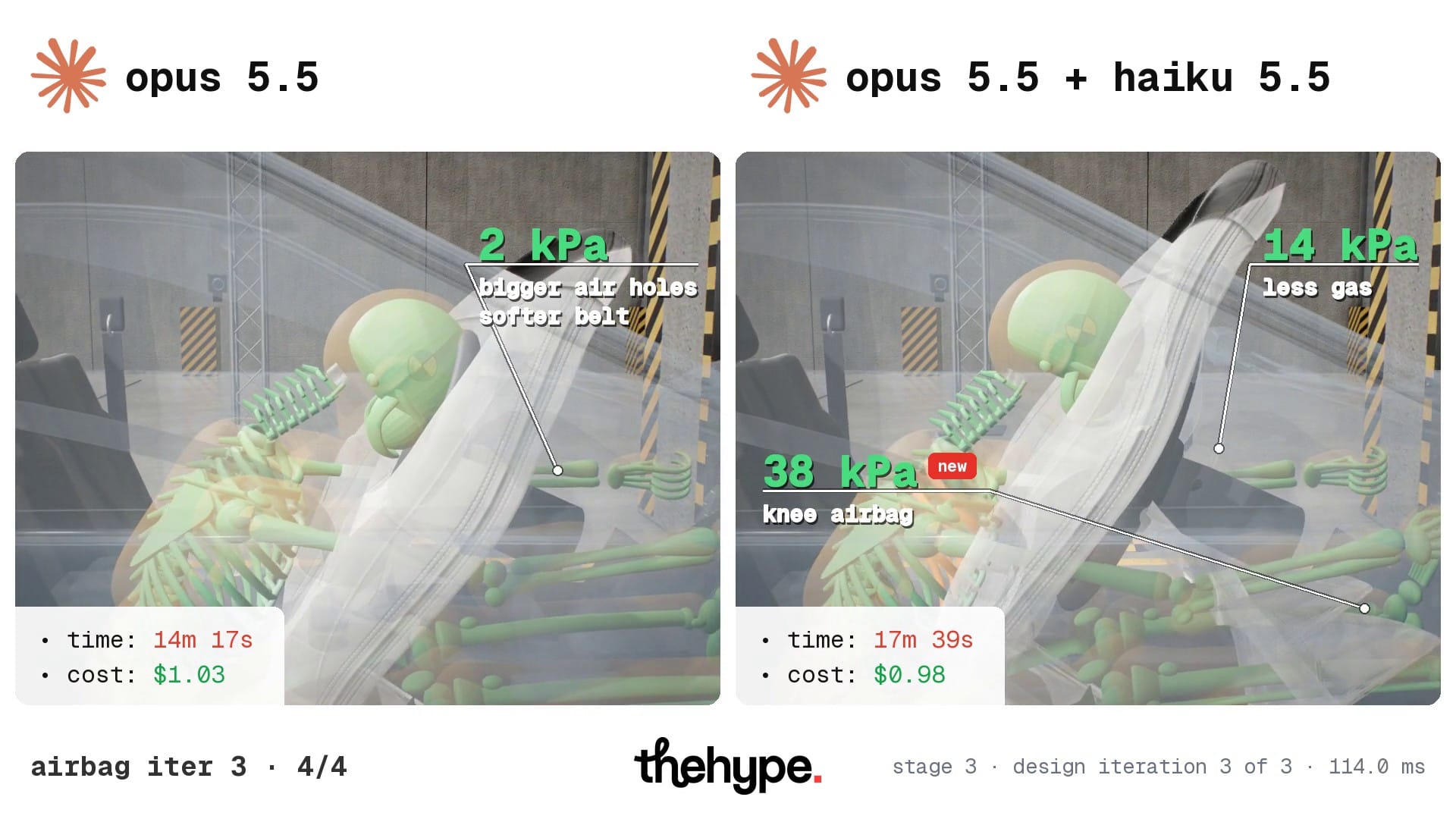
- Airbag – both got to zero broken bones in three iterations. Opus finished with no bone at risk, the team with 13 bones near their limit
- The Haiku designer added a knee airbag that was not in the spec – the lower back broke before the driver bag took the load, and the knee bag fixed it
- Cost – the team was 21% cheaper without the planning step: $2.81 against $3.56. With planning counted it cost $5.87 and took 1h 40m against 57m
The team won only one round of four, when Opus wrote short per-file briefs and 14 Haiku agents wrote every file in parallel. One strong model was still better for tightly coupled physics, and that is why the 7 iterations above were run by Opus alone.
Limits
This is a physics simulation, not a certified crash test. Its numbers are good for comparing designs, not for judging a real car.
- The car's front is a chain of masses and crush springs, not a finite-element model of every panel
- The dummy is made of rigid segments with real masses and joint stiffness; soft tissue and organs are not modeled
- One test only: 56 km/h straight into a rigid wall, driver's seat, average adult male dummy
- In the video the buggy driver rests his hands on his thighs while driving – the simulated pose held a wheel the buggy does not have. From the moment of impact the arms follow the simulation
- The sedan body is a visual shell over the simulated chassis; the seat with a headrest is drawn even in iterations where the simulation has the flat bench
The injuries, crush and timings on screen come from the runs.
Sources
- Claude Opus 5.5 on OpenRouter – list price $4 per 1M input tokens
- Claude Haiku 5.5 on OpenRouter – the sub-agent model in the earlier test
- Hybrid III 50th male, Humanetics – the dummy the model follows
- FMVSS 208, occupant crash protection (49 CFR 571.208) – the US standard behind HIC15, Nij and the other injury criteria
- Claude Code sub-agents, docs – how the Haiku sub-agents ran in the earlier test
- Runs, timings, token counts and logs: our test, Oct 8–14, 2026