
 Addy Crezee

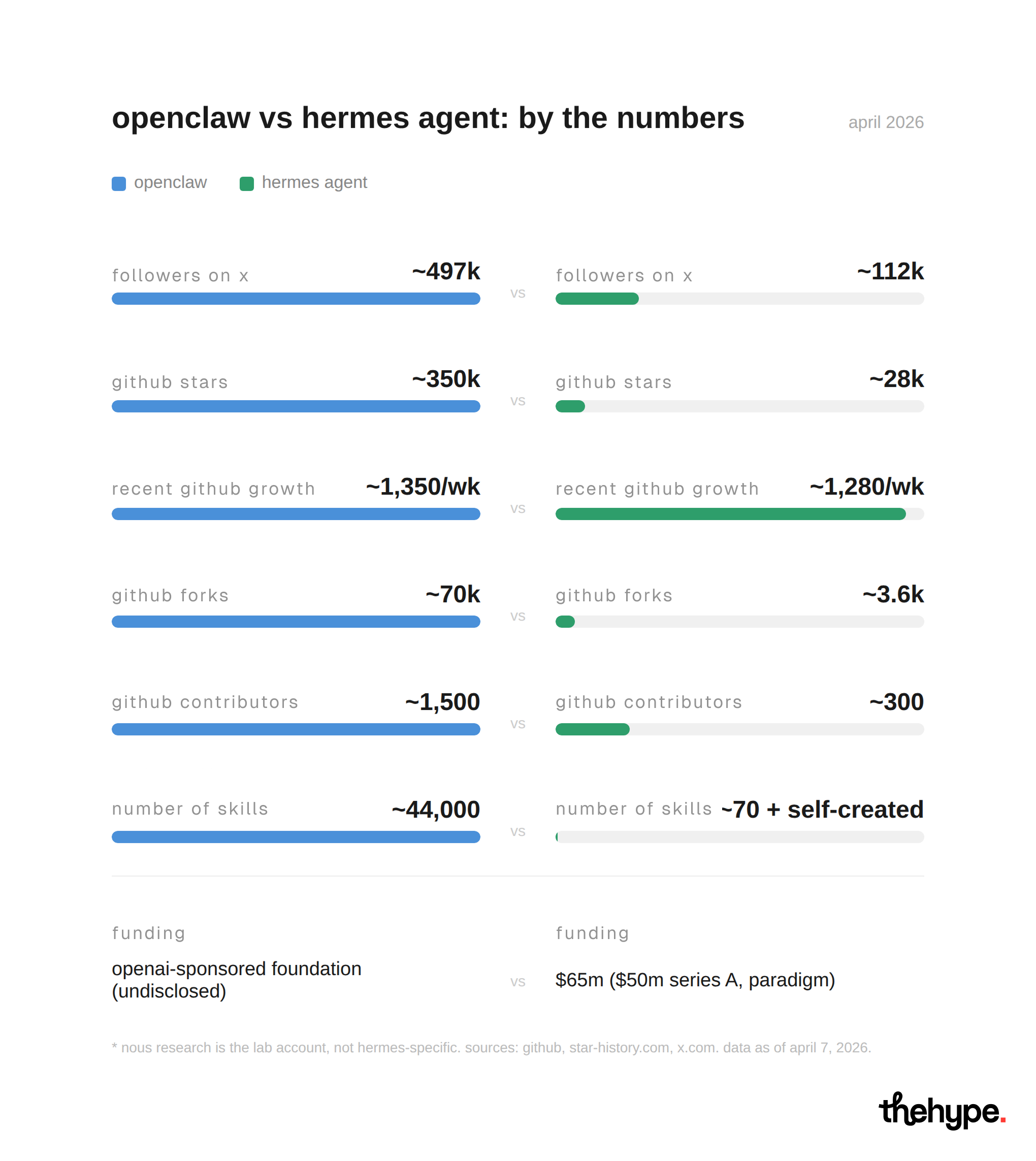
openclaw is the most popular AI agent ever built – 350,000 github stars, half a million running instances¹, and an ecosystem that’s become its own industry. if you’ve tried an open-source agent, it was probably openclaw.
hermes agent wants to take that crown. built by nous research, launched in february 2026, 28,000 stars and growing fast. smaller community, but a fundamentally different bet: an agent that gets smarter the longer you use it.
openclaw is built to do things – fast, everywhere, right now.
hermes is built to learn things – your patterns, your workflows, your preferences – and compound that knowledge over time.
choosing between them depends on what you actually need and how long you’re building for.
here’s how they compare.
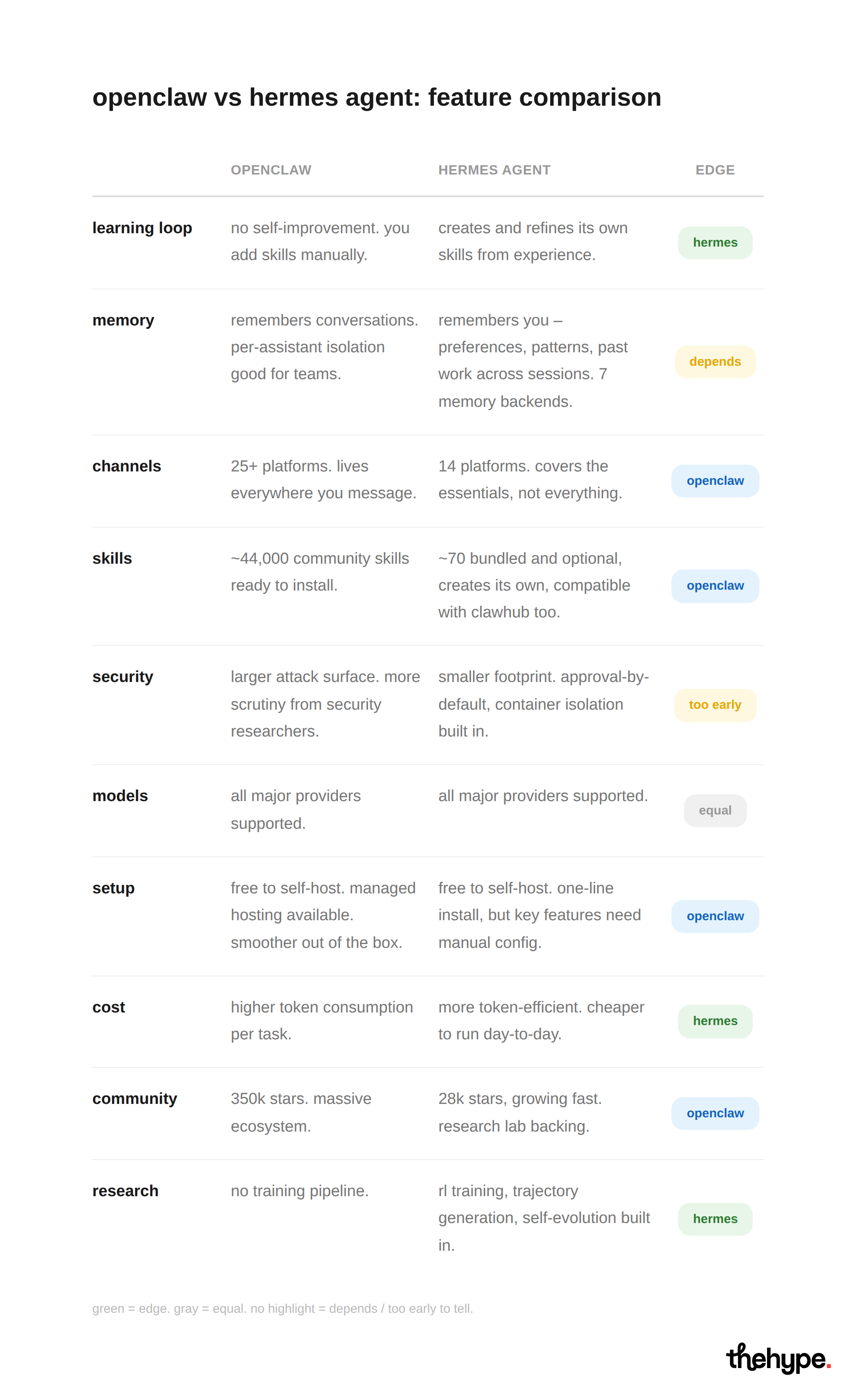
learning loop – hermes wins. this is the clearest difference between the two. openclaw executes tasks well, but every task starts from the same baseline. you can add skills manually, but the agent doesn’t teach itself.
hermes runs what nous research calls a closed learning loop: after completing a complex task, it evaluates what happened, packages the workflow into a reusable skill, and refines that skill every time it runs again. if you run the same reporting workflow every monday, hermes gets faster and more reliable at it without you touching anything.
memory – depends on use case. openclaw remembers your conversations and keeps memory isolated per assistant – useful when you run separate agents for sales, support, and ops and don’t want data leaking between them.
hermes takes a different approach with a four-layer system²: environment facts, user preferences, full-text searchable conversation history, and optional deep user modeling through honcho. as of v0.7.0, it supports seven pluggable memory backends³. which is better depends on whether you care more about team data separation or personal depth of recall.
one note: honcho is off by default in hermes, which confuses a lot of new users⁴. turn it on.
channels – openclaw wins. openclaw supports 25+ messaging platforms – whatsapp, telegram, discord, slack, imessage, irc, line, matrix, wechat, and more.
hermes covers 14, including the ones most builders actually use: telegram, discord, slack, whatsapp, signal, and email. if you need your agent on imessage or wechat or twitch, openclaw is your only option. if you’re fine with the main platforms, both work.
skills – openclaw wins. openclaw has ~44,000 community-built skills on clawhub⁵. need a crm integration, a lead gen workflow, or a content pipeline? it probably exists.
hermes ships with ~70 bundled and optional skills⁶ and a growing community library – but its real advantage is that it creates skills autonomously from your work and shares them through the agentskills.io open standard. it’s also compatible with clawhub, so you’re not locked out of openclaw’s library. the tradeoff: openclaw gives you everything on day one. hermes compounds over time.

security – too early to tell. openclaw’s massive scale (350k stars, 500k+ running instances) made it a target – cisco found data exfiltration in third-party skills, microsoft warned against running it on standard workstations, and china restricted it in state agencies.
hermes has had its own bugs (credential exposure, path traversal)⁷, but its architecture defaults to asking permission before dangerous commands and supports container isolation out of the box. the honest answer is that hermes hasn’t been stress-tested at openclaw’s scale yet. both require careful setup.
models – equal. both support claude, gpt-4o, gemini, deepseek, qwen, and local models through ollama. hermes also connects through nous portal (400+ models)⁸ and openrouter (200+). neither locks you in. pick your provider, switch anytime.
setup – openclaw wins. both are free and open-source. openclaw’s setup is smoother out of the box, and managed hosting through oneclaw exists for people who don’t want to touch a terminal.
hermes has a one-line bash installer that handles everything, but you need to be comfortable with a command line, and key features like honcho memory need manual configuration after install. if you’re technical, both are straightforward. if you’re not, openclaw has more options.
cost – hermes wins. both got hit equally by anthropic’s april 4 subscription cutoff – claude api rates now apply to both. and both can burn through tokens fast if misconfigured.
the difference is architectural. hermes uses cache-aware memory, progressive skill loading (only names and descriptions until needed), and hot/cold storage separation¹⁰ – all designed to keep token costs down over time.
openclaw resends the full conversation history and a 5,000-10,000 token system prompt with every api call, with context accumulation accounting for 40-50% of typical token usage¹¹.
hermes also runs better on smaller and local models. multiple users on r/localllama confirmed it works well with 30B-class models where openclaw struggles¹². if you’re paying per token – and after april 4, everyone is – that flexibility matters.
community – openclaw wins. openclaw is the biggest open-source agent project in history – 350,000 stars and a massive ecosystem of tutorials, templates, and managed services.
hermes is at 28,000 stars and growing fast, with an active discord where the nous research team answers questions daily¹³. openclaw has scale. hermes has momentum.
research – hermes wins. openclaw is a consumer agent framework – it doesn’t include any model training or reinforcement learning tools.
hermes has batch trajectory generation, atropos rl integration, and a self-evolution pipeline using dspy and gepa. if you care about training your own models or contributing to open-source ai research, hermes is the only option. if you don’t, this row doesn’t matter to you.
so which one should you use?
if you need an agent running across many channels this week, with thousands of pre-built skills and managed hosting that doesn’t require a terminal – use openclaw. it’s the mature choice. the ecosystem is massive, the community knowledge base is deep, and for most standard automation tasks, it just works.
if you’re a builder who runs repetitive workflows and wants an agent that gets better over time – use hermes. the learning loop is real. the token efficiency matters now that everyone’s paying per-token. and the research lab behind it is shipping at a pace that’s hard to ignore.
openclaw is the safer bet today, but hermes might be the smarter bet for the next six months. the learning loop changes the math – an agent that compounds its knowledge is fundamentally more valuable than one that doesn’t, even if it starts smaller. the people setting up hermes now are making the same bet early openclaw adopters made in january. if you’re building for longer than next week, that’s worth paying attention to.

sources
¹ openclaw running instances: openclawvps.io/blog/openclaw-statistics, april 2026 update reporting 500k+ instances. [link]
² hermes four-layer memory system: aicybr.com/blog/hermes_agent_guide, describing MEMORY.md, USER.md, FTS5 search, and honcho layers. [link]
³ seven pluggable memory backends: teknium on x, april 3, 2026, announcing honcho, mem0, openviking, hindsight, holographic, retaindb, and byterover. [link]
⁴ honcho off by default causing user confusion: virtualuncle.com, noting “the biggest Reddit complaint: memory features not working out of the box because Honcho is disabled by default.” [link]
⁵ openclaw 44,000+ clawhub skills: openclawvps.io/blog/openclaw-statistics, april 2026 update. [link]
⁶ hermes ~70 bundled and optional skills: hermes agent v0.2 release notes, reporting “70+ bundled and optional skills across 15+ categories.” [link]
⁷ hermes credential exposure and path traversal bugs: hermes agent v0.5 release notes, the “hardening release” with 50+ security fixes. [link]
⁸ nous portal 400+ models: hermes agent v0.5 release notes. [link]
⁹ hermes user reporting 4m tokens in 2 hours: cited in getopenclaw.ai, quoting reddit user u/Typical_Ice_3645. [link]
¹⁰ hermes cache-aware memory and hot/cold architecture: lushbinary.com. [link]
¹¹ openclaw system prompt size and context accumulation: apiyi.com cost optimization guide. [link]
¹² hermes running well on 30B local models: virtualuncle.com, citing reddit user reports. [link]
¹³ nous research team answering discord questions daily: getopenclaw.ai, noting teknium personally answers questions in chat. [link]