
 Felix Laurent

OpenAI published LifeVal on November 2, 2026. It is an internal benchmark that measures how well AI handles everyday tasks: finding childcare, using government services, planning a budget or ordering groceries. GPT-6 Astra scores 80.6% on it, up from 49.3% for GPT-5.2 less than a year earlier.
The benchmark is part of a bigger shift. OpenAI wants ChatGPT to act as a personal assistant that gets things done, not just a chat that gives advice. LifeVal is how the company says it tracked that progress over the past year.
What OpenAI LifeVal measures
OpenAI started from two large studies of how people spend their time: the American Time Use Survey and the Multinational Time Use Study. Together they list everyday tasks across ages, times of day and seasons.
To find where people want AI help most, OpenAI ran its own survey of 3,995 people, built to be demographically representative. The resulting tasks cover caregiving, health, education, household paperwork, personal finance, shopping and government services.
OpenAI says it used LifeVal over the past year to "track and drive improvement" in its models. In practice, that means browser use, computer use and connectors, which let ChatGPT act inside websites and apps. The scores show how fast that work paid off.
How GPT-6 Astra scores on LifeVal
The benchmark reports an unweighted average reward for each model. The chart below shows the five OpenAI models in the order they were released.
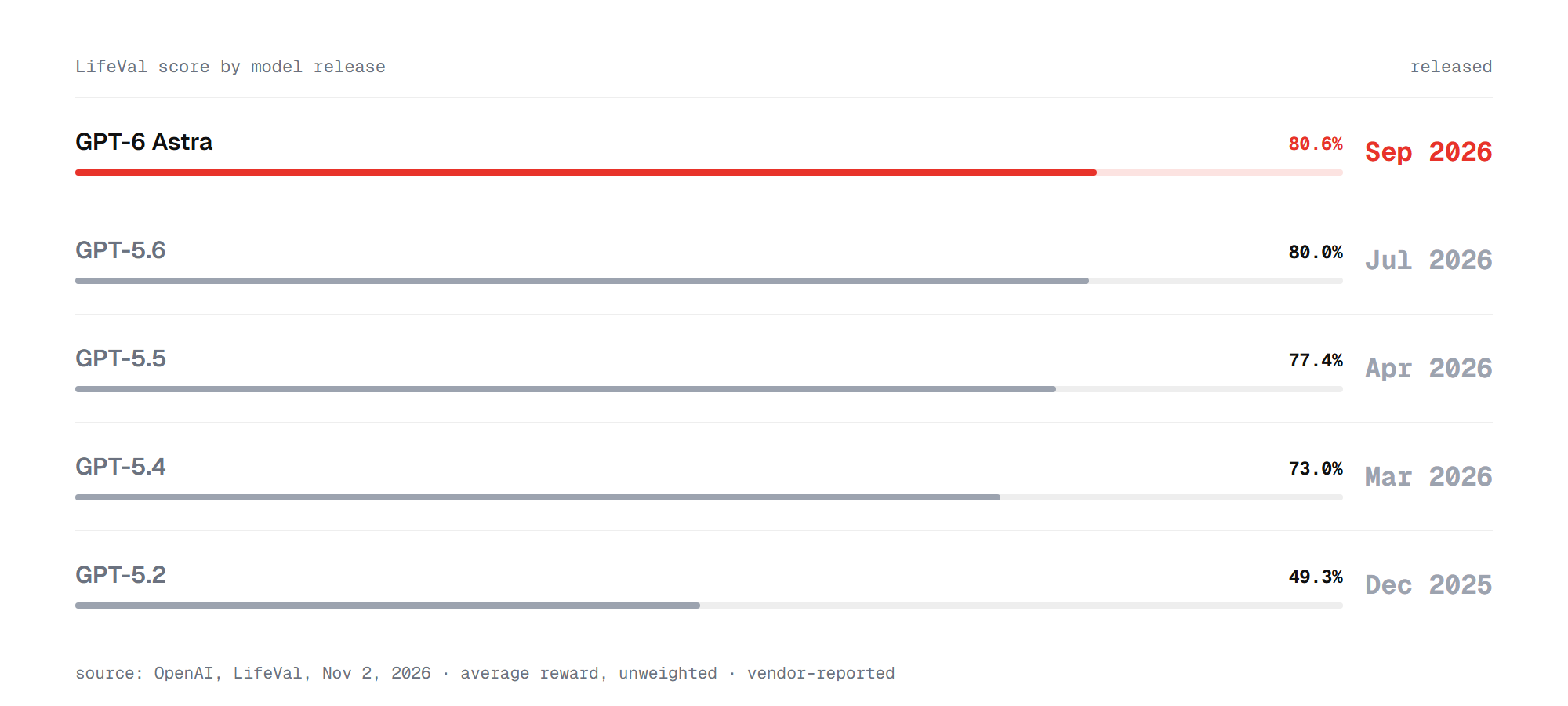
The biggest jump came early. GPT-5.4, released in March 2026, scored 73.0%, almost 24 points above GPT-5.2. After that, gains slowed: GPT-5.5 reached 77.4%, GPT-5.6 80.0% and GPT-6 Astra 80.6%.
The gap between the last two models is less than one point. OpenAI's own charts make the trade-off clear. Through the API, GPT-5.6 delivers similar results to GPT-6 at roughly half the estimated cost. GPT-6 is about 23% faster on these tasks.
So for everyday tasks, the newest model mostly saves time, not mistakes. The task examples show what those scores look like in practice.
Everyday tasks OpenAI showed
OpenAI published five example tasks with the scores of its current models. Each is a real chore with several steps, not a quiz question.
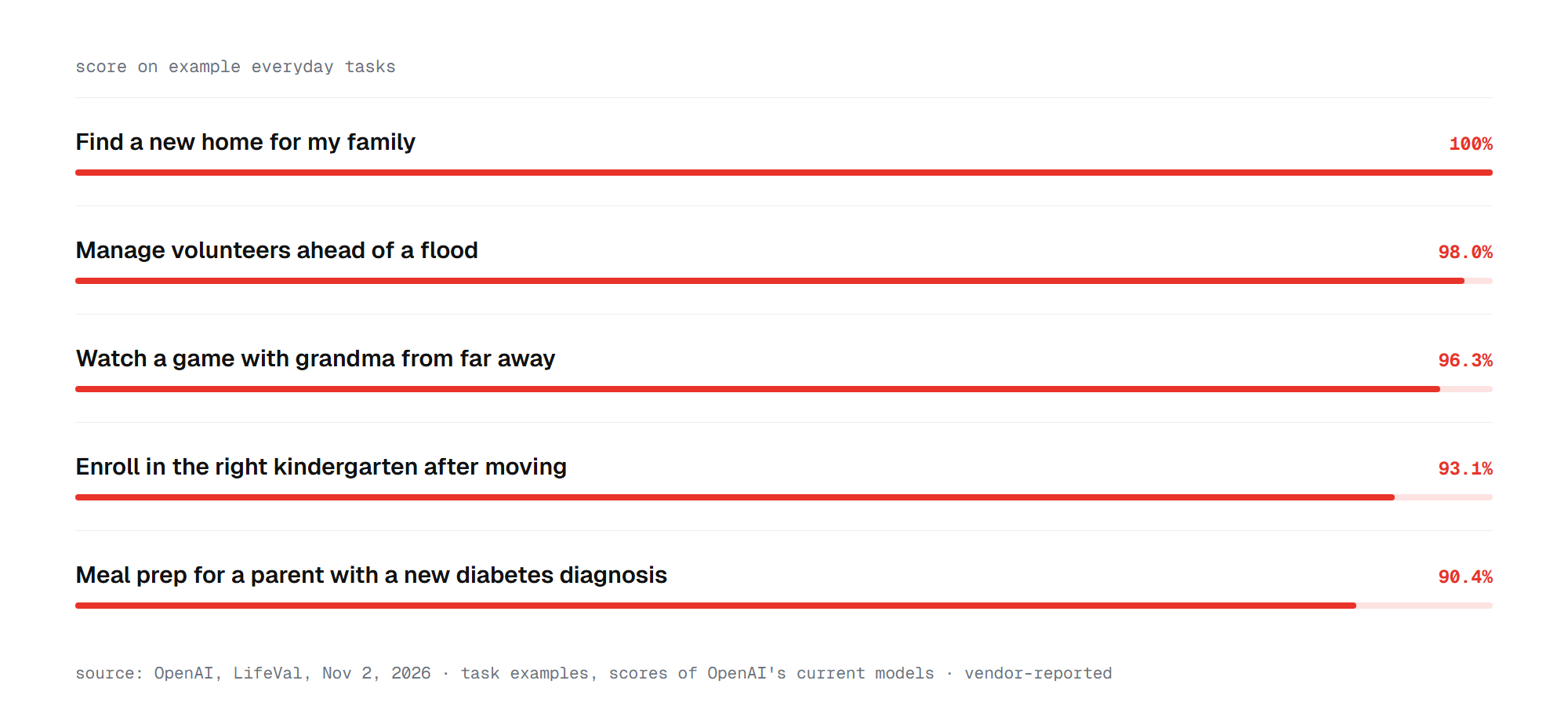
In the home search, the model finds a house in Luzerne County that fits a budget. It needs a separate living unit and a short commute after school drop-off. It then adds the deed to a county records cart for the user to review, and scores 100%.
The lowest of the five, at 90.4%, is a first-week care and meal plan for a parent with a new diabetes diagnosis. In the kindergarten task, the model shortlists three options and leaves two choices to the parent.
These are OpenAI's chosen examples, and the company does not say how typical they are. That points to what the release leaves out.
What LifeVal does not show
LifeVal is a company benchmark, and the release has clear gaps:
- no count of the tasks in the benchmark;
- no public dataset or grading service;
- no definition of how "average reward" is scored;
- no models from other labs, only OpenAI's own.
There is also a built-in tension. OpenAI used LifeVal to drive model improvement, then reports its models' progress on the same test. That makes it a useful internal compass, but a weak independent measure.
OpenAI has done this differently before. Its GDPval benchmark for work tasks, published in October 2025, covers 44 occupations. OpenAI open-sourced a gold subset of 220 tasks with a public grading service, so other labs and researchers could check results.
Can AI already handle everyday life
For many common chores, OpenAI's data says yes. Its best models score about 80% on average, and above 90% on every published example. The rise from 49.3% to 80.6% in under a year shows how fast agents learned to act in browsers and apps.
But the curve has flattened, and the numbers cannot be checked yet. The last two models differ by less than one point, so cost and speed now matter more than raw scores. Until OpenAI releases LifeVal tasks the way it did with GDPval, the 80.6% stays a vendor claim, not a measure anyone else can test.
Sources
- LifeVal: measuring AI progress on the tasks that matter in everyday life, OpenAI – November 2, 2026
- GDPval: evaluating AI model performance on real-world economically valuable tasks, arXiv – OpenAI researchers, October 5, 2025