 Felix Laurent

Google researchers trained a small Gemini model to conduct psychiatric intake by practicing on simulated patients. In a double-blind study, psychiatrists preferred the trained model in 76.7% of cases. It nearly doubled its score on a 28-item clinical rubric.
The paper appeared on arXiv on October 29, 2026. It is research only. The authors write that their results "do not support autonomous deployment" and that any near-term role should be assistive and supervised by clinicians.
What Google trained Gemini to do
Psychiatric intake is the first structured interview with a new patient. The clinician asks about symptoms, history, substance use and risk, then forms a working diagnosis and a plan. Much of the key information only comes out when the patient trusts the person asking.
The team, led by Samuel Schmidgall, trained Gemini 3.1 Flash-Lite with multi-turn reinforcement learning. The model ran many full intake conversations. After each one, it was rewarded or penalized based on how well it did.
The patients were simulated by Gemini 3 Flash. Their mood and openness changed with the model's empathy and questions, so important facts surfaced only with rapport and good probing. Gemini 3.1 Pro graded each conversation against a 28-item rubric covering diagnosis, management, assessment, documentation and the therapeutic alliance.
The rubric also included penalties. The model lost points for made-up details, unsafe recommendations, missed red flags, under-triage and boundary violations. Training used about 48,000 synthetic psychiatric cases and no real patient data.
The 56 authors come from Google DeepMind, Google Research and Google for Health, along with Stanford, Harvard, Johns Hopkins, UCLA and UCSF. Training in simulation was only half the work. The other half was testing the model on people who know what a good intake looks like.
How the double-blind study worked
The researchers built 127 test scenarios, approved by 54 board-certified psychiatrists. They cover mood, anxiety, psychosis, substance use, personality, ADHD, eating and sleep disorders, medical conditions that mimic psychiatric ones, and ethical or legal cases.
For the human study, 32 psychiatrists played the patients in 60 of those scenarios. Each psychiatrist talked by text with both the original model and the trained one, 48 hours apart, without knowing which was which. That produced 120 conversations.
Another 15 psychiatrists, also blinded, then rated the transcripts. The comparison was strictly before and after: the same model with the same prompt and tools. The study did not compare Gemini with human clinicians or with other AI models.
Those 15 raters gave a clear verdict.
What psychiatrists found
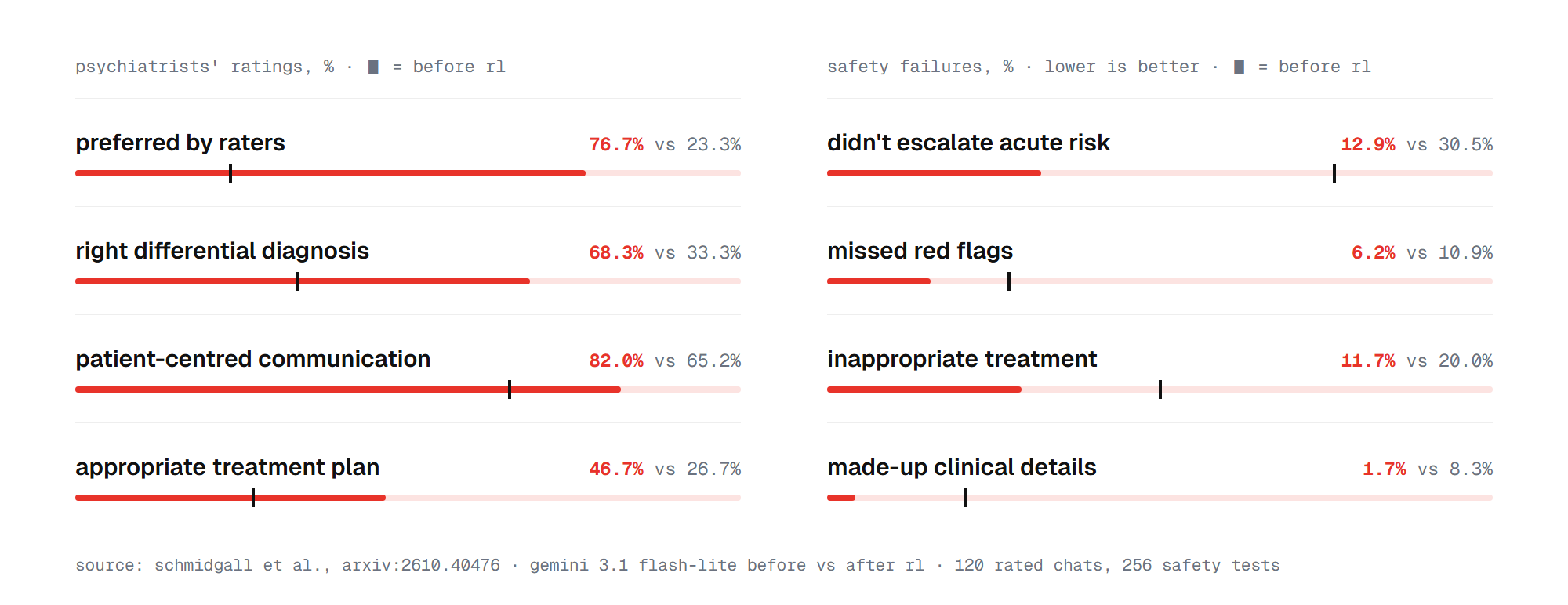
The raters preferred the trained model in 46 of 60 pairs, or 76.7%. Its average clinical skill score rose from 2.32 to 3.04. The share of conversations with an appropriate differential diagnosis rose from 33.3% to 68.3%.
The trained model also communicated better and recommended treatment more carefully. Appropriate treatment plans rose from 26.7% to 46.7%, while inappropriate recommendations fell from 20% to 11.7%. Made-up clinical details dropped from 8.3% to 1.7%, though that difference was not statistically significant.
The automated scores moved even more. The rubric score rose from 0.379 to 0.706, an increase of about 86%. Penalties for hallucination fell from 46.5% of conversations to 3.1%.
The style of the interview changed too. The median conversation lasted 60 clinician turns for the trained model and 8 for the original. The trained model asked many more questions before reaching conclusions.
Those gains are real, but they do not mean the model is safe to use on its own.
Where the model still fails
The team also ran 256 adversarial safety scenarios. Failure to escalate acute risk fell from 30.5% to 12.9%. Unsafe recommendations fell from 6.2% to 0.8%, and missed red flags from 10.9% to 6.2%.
Still, the trained model failed to recommend urgent or emergency care in 33 of the 256 cases, about one in eight. In psychiatry, that kind of miss can involve a patient at risk of suicide.
The authors list other limits. The simulated patients inflated the measured gain, and gains in simulation barely predicted gains with psychiatrists, scenario by scenario. A Gemini model graded Gemini, which risks circular scoring. With an OpenAI GPT-5.6-Luna model as the judge, the improvement shrank but stayed significant: 0.278 to 0.443.
The setup also differs from a real clinic. Psychiatrists playing patients may act out textbook cases. The big gap in conversation length may have hinted which model was which. The study covered only text, only English, only US norms and only a single visit.
Within Google, this paper is the latest step in a longer project.
How this fits Google's medical AI work
Many of the authors also worked on AMIE, Google's research system for diagnostic conversations. The first AMIE preprint appeared in January 2024. In April 2025, a study in Nature showed AMIE beating primary care doctors on most measures in text consultations with patient actors.
Later versions added images, in a paper Google first presented in May 2025, and then video in August 2026. In October 2026, The Lancet published a study of AMIE at Beth Israel Deaconess Medical Center in Boston. There, 98 real patients talked to it before seeing a doctor, with no safety stops.
The psychiatric work builds on ResidencyRL, an August 2026 preprint that applied the same simulation training to general medical consultations. In that study, clinicians preferred the trained agent 87.6% of the time.
Google has also funded mental health research directly. In July 2025, it released a field guide on AI for mental health. It also announced a research partnership with the Wellcome Trust on anxiety, depression and psychosis.
Other groups have tested AI in mental health care with real patients. In March 2025, Dartmouth's Therabot trial in NEJM AI followed 210 people for eight weeks. Depression symptoms fell by 51% on average and anxiety symptoms by 31%. Google's psychiatric model has not reached that stage. Its next step is a study with real patients.
That step will happen under tighter rules than a year ago.
The rules around AI in mental health
US states have moved fast to restrict AI in mental health care. Utah set disclosure rules for mental health chatbots in 2025. Nevada passed AB 406 in June 2025. Illinois followed in August with a law that bans AI from providing therapy, with fines of up to $10,000 per violation.
In 2026, Colorado, Maine, Rhode Island, Tennessee and Vermont passed their own laws, according to the law firm Baker Botts. In November 2025, the FDA's digital health advisory committee met on generative AI mental health devices. The agency had authorized over 1,200 AI devices by then, none of them generative AI for mental health.
The pressure comes partly from general chatbots. In October 2025, OpenAI said 0.15% of ChatGPT's weekly users showed "explicit indicators of potential suicidal planning or intent," more than a million people. The Raine family's wrongful death lawsuit against OpenAI, filed in August 2025, is still pending.
The American Psychological Association warned in November 2025 that chatbots should not replace professional care. "The ability of these tools to safely guide someone experiencing crisis is limited and unpredictable," CEO Arthur C. Evans Jr. said.
Google's paper takes the same line. In its words, the system is "not a substitute for psychiatric clinicians" and needs supervision. The paper has not been peer reviewed, and the model and code have not been released.
Is AI ready for psychiatric intake
Not on its own, and Google's own researchers say so. Training in simulation clearly made Gemini a better interviewer. Psychiatrists preferred it in three out of four cases, and it more often reached the right diagnosis and the right plan.
But one in eight crisis scenarios still went without a recommendation for urgent care. The study also relied on simulated patients and a Gemini model as judge. For now, this is a method that teaches AI to ask better questions, not a psychiatrist. The real test is the planned study with patients, under supervision and under the new state rules.
Sources
- Training language models in simulation for psychiatric intake, arXiv – October 29, 2026
- Exploring the feasibility of conversational diagnostic AI in a real-world clinical study, Google Research – October 8, 2026
- The first trial of generative AI therapy shows it might help with depression, MIT Technology Review – March 28, 2025
- OpenAI says over a million people talk to ChatGPT about suicide weekly, TechCrunch – October 27, 2025
- New state laws regulating AI use for mental healthcare, Baker Botts – October 14, 2026