Felix Laurent

Anthropic's models are improving about twice as fast as they did before October 2025. That is the main finding of METR's independent assessment of AI acceleration at Anthropic, published on November 5, 2026. The evaluator estimates that AI itself drives most of that speed-up. Its data includes four Anthropic models that have never been released. The newest, which METR calls Model 4, finished training only weeks ago.
METR is a nonprofit that measures what AI systems can do. Anthropic asked it to answer one question: how much is AI already speeding up AI research inside the company?
What METR measured at Anthropic
METR's team worked on the assessment from August 12 to October 29, 2026. METR says Anthropic gave it "unprecedented access to internal data" for the work. That included benchmark scores for internal models, training compute figures, headcount, internal surveys and about 15 interviews with staff.
There were limits. METR could not run the unreleased models itself, and Anthropic kept the right to redact any non-public information. According to METR, Anthropic redacted "a majority of the evidence we found most informative" in the public version. Anthropic says the cuts remove details that could help other AI developers.
The core measure is AECI, Anthropic's version of the Epoch Capabilities Index. It combines many benchmarks into one score of overall capability. Most of the benchmark names are redacted in the public report.
Anthropic models improve 1.9x faster
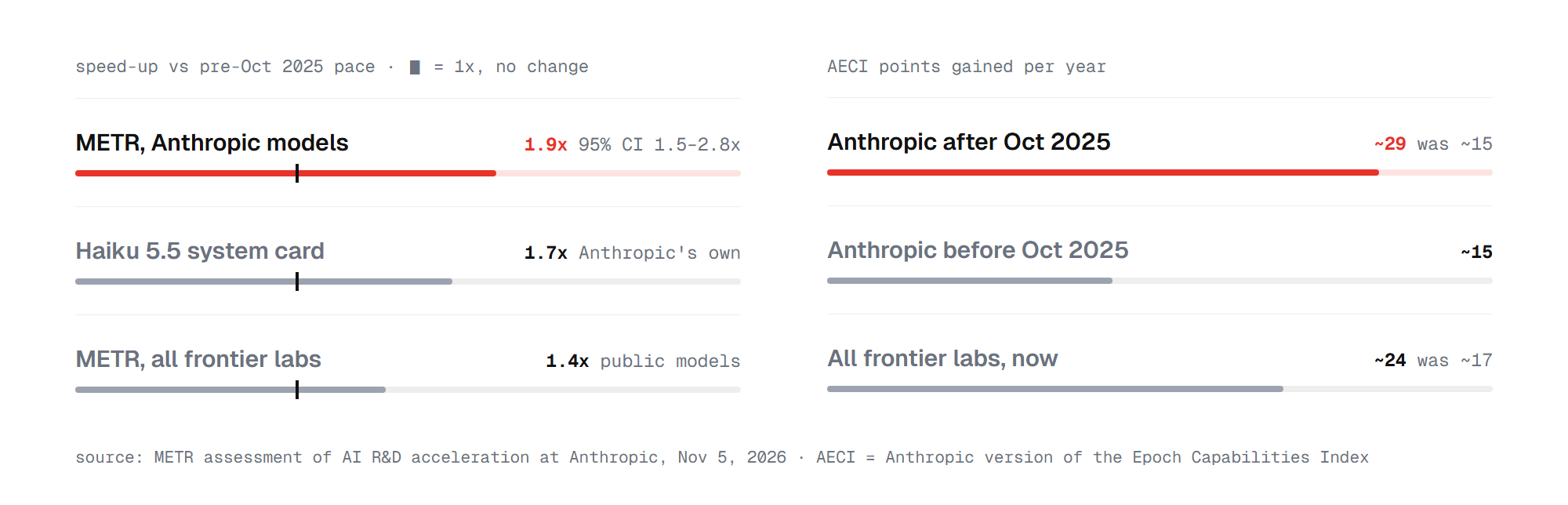
METR found that AECI scores for Anthropic's models have grown 1.9 times faster since October 2025. The 95% confidence interval runs from 1.5x to 2.8x. In points, the trend went from about 15 a year to about 29 a year.
METR puts it in plain terms. Anthropic made as much benchmark progress in the past year as it did between October 2023 and October 2025. That is roughly the distance from Claude 2.1 to Sonnet 4.5.
The estimate is not settled. Different statistical methods give anything from 1.1x to 2.9x. METR says it "would not be surprised" if the real figure were closer to 1.3x or 3x.
A second comparison cuts the number down. Across public models from all frontier developers, METR measures a 1.4x speed-up, from about 17 to about 24 points a year. METR offers two readings. If Anthropic was behind the frontier in 2025, its 1.9x partly reflects catching up, and 1.4x is closer to the truth. If Anthropic's models are tuned to benchmarks less than rivals' models, then 1.9x is the better figure. METR does not pick one.
Anthropic's own number was lower. The Haiku 5.5 system card put the speed-up at 1.7x. METR says the gap comes mainly from data on newer models that Anthropic has not released.
Model 4 and the other unreleased models
METR's data includes four internal-only models. METR uses labels Anthropic shared with it. The company uses different codenames internally:
- Unreleased 2022 finished training in 2022.
- Model 2 finished training in July 2026.
- Model 3 finished training in August–September 2026.
- Model 4 finished training in September–October 2026.
Model 4 is the strongest model in METR's set, with an AECI score of 178.6. It scored above 50% on all 15 benchmarks it was tested on, while Opus 4.6 fell below 50% on many of them. Anthropic staff self-reported an average uplift of about 12x from using it. METR calls that figure "very loose evidence" of real speed-up.
Neither METR nor Anthropic says what Model 4 will be called. The public models in the report include Mythos Preview, Claude Mythos 5, Haiku 5.5 and Opus 5.5, all of them older than Model 4. Labels like Fable 5.5 or Mythos 5.5 floating around on X are guesses. METR also wrote a forecast for a future model, but Anthropic redacted it.
The strength of Model 4 creates a measurement problem. METR says the lack of benchmarks that are hard for Model 4 makes it "somewhat nervous" about measuring progress from here on. The bigger question for users is whether Model 4 will ever leave the lab.
Will Anthropic release Model 4
No model with one of these labels has been released under it. The labels exist only for reports, and Anthropic has never said which public model, if any, a "Model N" became.
Model 2 shows how this works. Anthropic first disclosed it in its August 2026 Risk Report. According to coverage of that report, Model 2 was only slightly more capable than Claude Mythos 5. It had also not finished the full set of pre-deployment checks, and Anthropic said it had no current plans to release it externally.
Claude Fable 5.1 and Mythos 5.1 launched on September 1. Yet in October, METR still listed Model 2 as internal-only, which suggests it is a different model. Anthropic has not confirmed either way.
The company's track record points to a different path. Capabilities from a closed model reach the public later, under a new name and with extra safeguards:
- Mythos. The name leaked on March 26, 2026, through draft blog posts left in a public database. Anthropic announced Claude Mythos Preview on April 7 for a small group of Project Glasswing partners. It said it had no plan to release the model publicly.
- Fable 5. Two months later, on June 9, Anthropic launched Claude Fable 5, which it called "a Mythos-class model that we've made safe for general use." Claude Mythos 5, the same model with fewer safeguards, stayed restricted.
- Fable 5.1. The September 1 release repeated the split. Fable 5.1 went to everyone, while Mythos 5.1, the same model with fewer safeguards, went only to approved partners.
The pattern goes back to the first Claude. It launched in March 2023 after months of closed testing with partners such as Notion, Quora and DuckDuckGo. Claude 2, in July 2023, was the first Anthropic model open to the general public. METR's list also includes a model called Unreleased 2022. It finished training in 2022, and METR does not tie it to any public release.
If Model 4 follows this path, it will get a new name. A limited group would see it first, and a public version with safeguards would follow. What makes models like it so much stronger is the next question METR tried to answer.
How much of the speed-up comes from AI
METR guesses that about 80% of the current acceleration comes from AI. It labels the estimate as highly uncertain. It is confident the speed-up does not come from faster growth in training compute.
Interviews point the same way. About a dozen researchers gave a wide range of answers, centered on a 2x speed-up. Staff told METR that the speed-up comes mainly from AI assisting human researchers. METR still sees "some signs" that fully autonomous work will play a larger role soon.
METR found no bottleneck that would stop progress in the next 12 months. Neither algorithms, training compute, experiment compute nor data looks like a hard limit. METR adds that its view of the bottlenecks "changed several times" during the work, so it is not confident in this conclusion.
What it means for Anthropic's safety rules
The finding touches a line in Anthropic's own safety policy. Its Responsible Scaling Policy has a "2x Acceleration" threshold for AI research, and crossing it triggers stricter safeguards. Anthropic's position is that no current model meets it.
In a separate review published the same day, METR said Anthropic's argument that the threshold had not been crossed was "overstated" in its risk report. It said it is plausible the line was crossed by July 15, 2026. It also noted that most relevant researchers at METR and Anthropic lean toward it not having been crossed by then.
METR agrees the risk from models available in July was low. It warned that it cannot rule out "a substantial further acceleration" in the next six months, which could quickly lead to high risks.
Is AI research already accelerating itself
On METR's numbers, the answer is a cautious yes. Anthropic's models now improve about twice as fast as two years ago, and AI help for researchers looks like the main reason. The caveats are serious. The range runs from 1.1x to 2.9x, most of the evidence is redacted, and the benchmarks are close to their ceiling. Still, an outside evaluator with access to unreleased models now says the speed-up is real. Model 4 shows where it leads next.
Sources
- Independent Assessment of AI R&D Acceleration at Anthropic in October 2026, METR – November 5, 2026
- Review of the AI R&D section of Anthropic's August 2026 Risk Report, METR – November 5, 2026
- Claude Fable 5 and Claude Mythos 5, Anthropic – June 9, 2026
- Claude Fable 5.1 and Claude Mythos 5.1, Anthropic – September 1, 2026
- Claude Haiku 5.5 system card, Anthropic
- An update on independent evaluators, Anthropic – October 15, 2026