 Felix Laurent
OpenAI published BioBasicsBench on November 6, 2026. The new benchmark tests how well AI agents interpret raw data from everyday wet-lab work, such as gel images, colony plates and microscopy. GPT-6 Astra earned 66.7% of the available credit at its highest common reasoning setting. GPT-5.6 Sol, the previous generation, earned 43.8%.
OpenAI built the benchmark with Ligo, a startup that designs enzymes with AI. The goal is narrow on purpose. Before an agent can help with biology research, it has to read ordinary lab results correctly, including failed experiments and blurry images.
What BioBasicsBench tests
Existing science benchmarks often rely on charts and images picked for published papers. OpenAI argues that this misses the messy part of lab work, where data is ambiguous and experiments fail. BioBasicsBench uses raw evidence instead.
It has 100 tasks across five areas: protein methods, imaging and cytometry, quantification and assays, nucleic acid methods, and molecular cloning. Some tasks are simple, such as reading the size of a DNA sample on a gel. Others ask for a full assay analysis. All of them are routine work a wet-lab scientist should handle reliably.
The inputs look like real lab files. A single task can mix several of them.
| Kind of data | Tasks | Examples |
|---|---|---|
| Gels and blots | 31 | DNA gels, SDS-PAGE gels, Western blots |
| Protocols, notes and specs | 27 | SOPs, lab notebooks, photos of handwritten notes |
| Tables and instrument exports | 20 | CSV and Excel exports, raw flow cytometry files |
| Bench and reagent photos | 18 | Gel rigs, culture tubes, a PCR plate, pH strips |
| Microscopy | 14 | Fluorescence images, z-stacks, time-lapse movies |
| Sequencing files | 12 | Raw long-read FASTQs, plasmid maps |
| Protocol videos | 7 | Streaking, serial dilution, weighing on a balance |
Scientists wrote each task from data of their own experiments, with an expert grading rubric. Every task then went through three reviews. A Ligo scientist who had not written it checked it first, then an outside PhD-level wet-lab scientist, then OpenAI's team again.
Answers earn partial credit against the rubric. A model can get the conclusion right and still lose points on the numbers or the reasoning. Some tasks reward the model for saying that the evidence is not enough.
How GPT-6 Astra and other models scored
OpenAI tested seven of its own models across 37 model and reasoning-effort settings. Each setting ran all 100 tasks five times, for 18,500 results in total. The table below shows the xhigh setting, the highest one reported for all seven models.
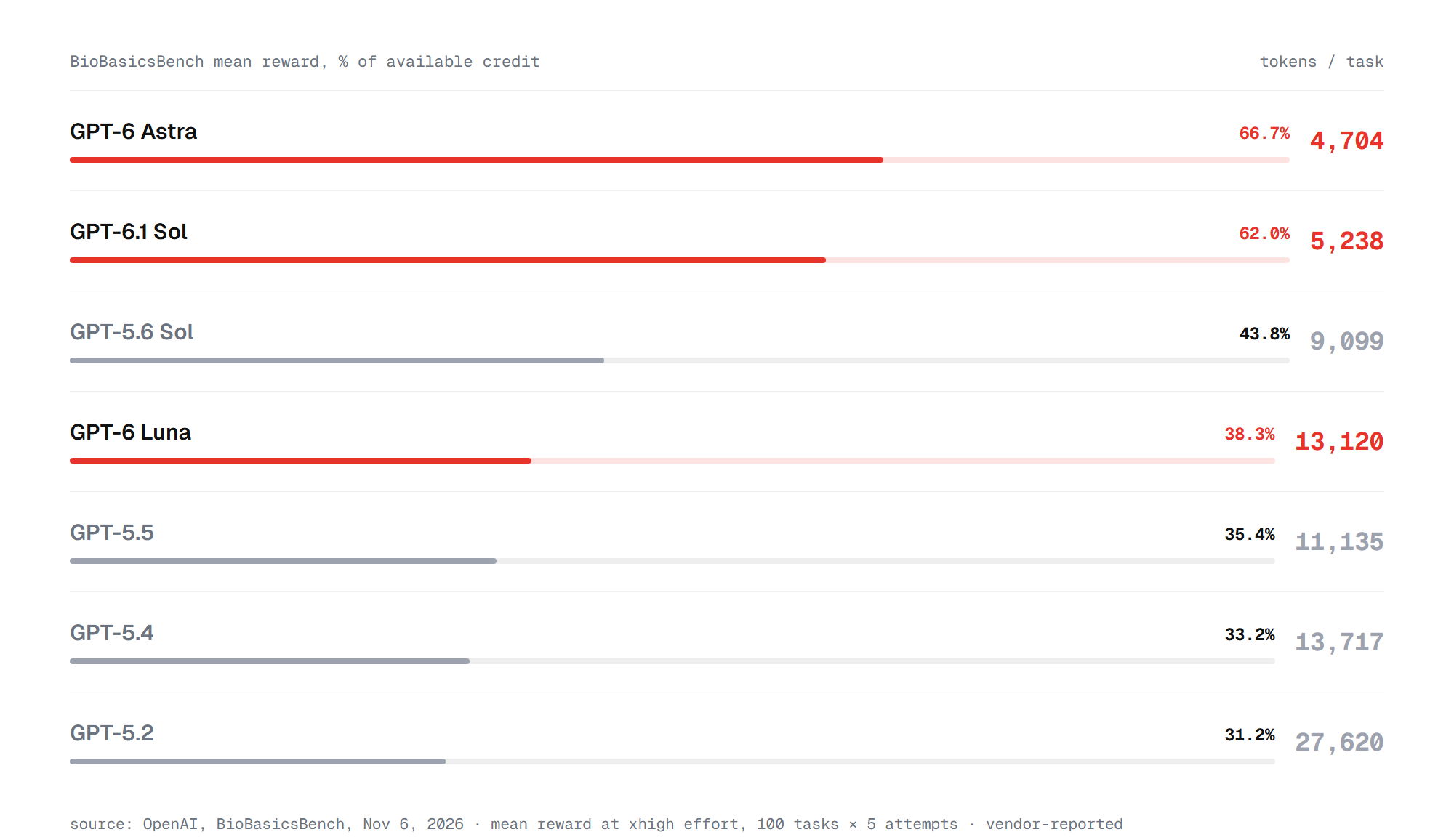
Two details stand out. GPT-6 Astra used 4,704 output tokens per task, while GPT-5.2 needed 27,620 to score less than half as much. And GPT-6 Luna, the smaller model of the new generation, landed below GPT-5.6 Sol.
OpenAI says Astra beats GPT-5.6 Sol even at low reasoning effort. The company links the gain to stronger native multimodal skills, meaning the model reads images and video better. The examples in the paper show what that looks like in practice.
What GPT-6 Astra gets right
OpenAI highlights three kinds of improvement.
- Knowing what the data cannot show. GPT-5.6 Sol labeled cells as dead because of a bright stain signal. Astra noticed that the detector also picked up light from a second dye. It asked for better controls before drawing a conclusion.
- Seeing small details in photos. In a cloning task, GPT-5.6 Sol trusted a negative control plate with no colonies. Astra read the label on the plate's rim, "LB Kan50", and saw the wrong antibiotic. The experiment used ampicillin, so the control was useless.
- Keeping the lab context in mind. Cells in a microscope video seemed to vanish and reappear. GPT-5.6 Sol looked for a biological reason. Astra recognized a z-stack, a series of images taken at different depths.
Each of these is a mistake a junior scientist might make. The paper is just as direct about the mistakes Astra still makes.
Where Astra still fails
OpenAI writes that "higher benchmark scores do not yet mean models can make reliable judgments in the lab." Its examples show three kinds of failure.
In one cloning check, Astra split the colony samples into two groups correctly. It then assumed the larger PCR product meant successful cloning and picked lanes 4, 6, 7 and 8. The controls pointed to lanes 5, 9 and 10. A scientist who followed that answer would purify the wrong plasmid.
In a microscopy task, Astra concluded that vacuoles look darker than the rest of the cell. Some vacuoles in the same image looked lighter, because focus can reverse the contrast. Astra had looked at those regions and even noted that contrast varies with focus, then left them out of its answer.
On a colony plate, Astra merged close neighbors, skipped visible colonies and counted empty agar. It overcounted by about 12%. That error flows straight into the estimate of how efficiently DNA entered the cells.
These failures share a pattern: the answer sounds confident and is wrong in a way that is hard to spot.
OpenAI's push into lab biology
BioBasicsBench is OpenAI's second new benchmark this week. On November 2, it published LifeVal, where GPT-6 Astra scored 80.6% on everyday life tasks. Both benchmarks are internal, and OpenAI has not said whether the BioBasicsBench tasks will be released.
The lab work started earlier. In December 2025, OpenAI and Red Queen Bio reported that GPT-5 had improved a cloning protocol's efficiency 79-fold. Scientists ran every experiment, and the model proposed the changes. A Red Queen Bio scientist told Axios that the model mostly combined known molecular biology ideas.
OpenAI also notes that tracking these skills helps it judge their biosafety and biosecurity impact. A model that reads lab results well can speed up research. Risk teams watch the same skill closely.
Can AI agents handle wet-lab science yet
Not on their own. A score of 66.7% means Astra loses about a third of the available credit on tasks that OpenAI calls routine. Its wrong answers look like right ones.
The progress is real, though. In under a year, OpenAI's best score rose from 31.2% to 66.7%, and Astra gets there with fewer tokens. The near-term use is a second reader. Such an agent checks a gel, flags a mislabeled plate or questions a control before a scientist moves on. Until scores rise and the tasks can be checked independently, the scientist still makes the call.
Sources
- Measuring how AI agents handle everyday wet-lab science, OpenAI – November 6, 2026
- OpenAI's announcement of BioBasicsBench on X – November 6, 2026
- Accelerating biological research in the wet lab, OpenAI – December 2025
- GPT-5 demonstrates ability to do novel lab work, Axios – December 16, 2025
- Ligo Biosciences: generative enzyme design for the chemical industry, Y Combinator