Felix Laurent

NVIDIA has introduced the DGX Spark HPC Developer Kit, a cluster of four DGX Spark mini computers for researchers' desks. The company announced it on November 16, 2026, at SC26, the annual supercomputing conference in Chicago. The kit is aimed at scientists who now wait in line for time on a shared GPU cluster.
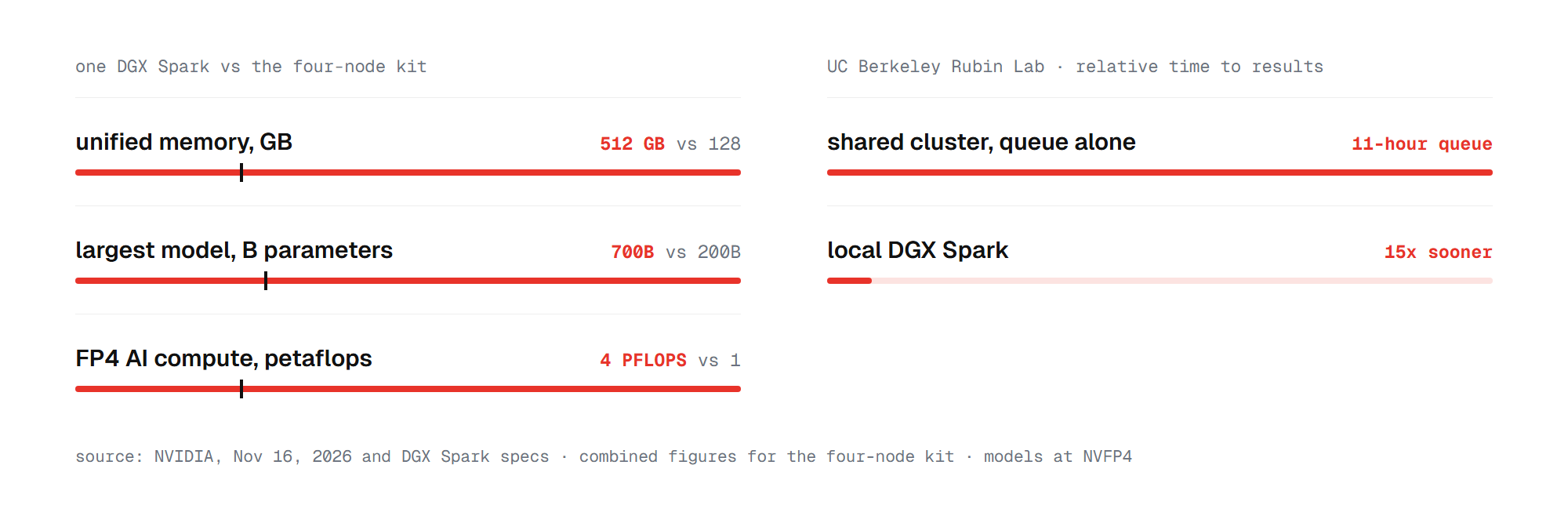
Linked together, the four systems give 512GB of memory and can run AI models with up to 700 billion parameters locally. The kit is on sale now, but NVIDIA has not named a price for the bundle.

What the DGX Spark HPC Developer Kit is
DGX Spark is NVIDIA's small desktop AI computer, first released in October 2025. Each unit runs on a GB10 Grace Blackwell Superchip, which pairs a Blackwell GPU with a 20-core Arm CPU. One Spark has 128GB of unified memory and delivers up to 1 petaflop of AI compute at FP4 precision.
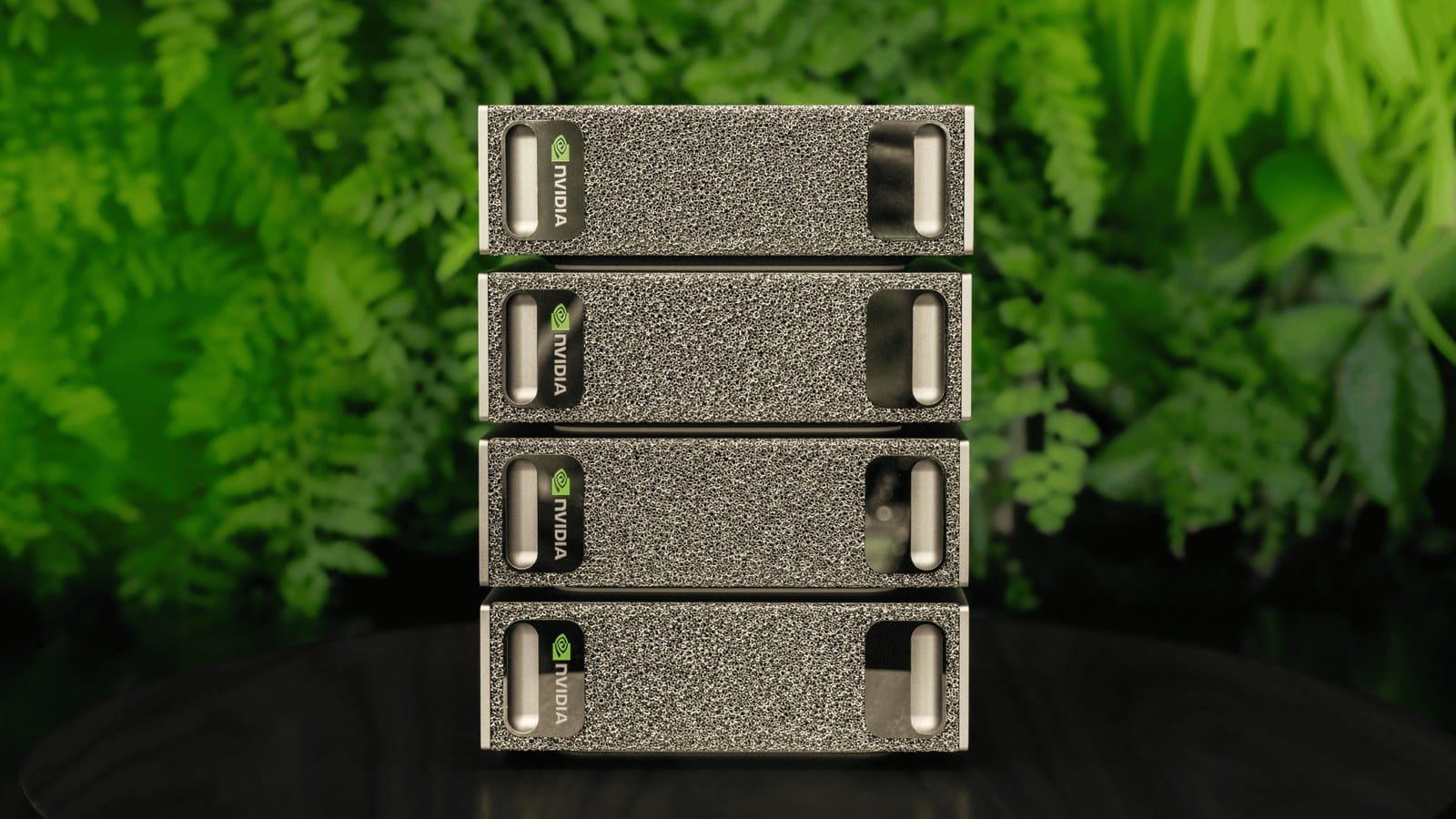
The new kit is four of these systems wired together. Each node connects directly to its two neighbors over ConnectX-7 networking, forming a ring, so no network switch is needed. Researchers can start with one node and add more, up to four.
At full size, the kit has:
| Spec | One DGX Spark | Four-node kit |
|---|---|---|
| Chip | GB10 Grace Blackwell | 4x GB10 Grace Blackwell |
| Unified memory | 128GB | 512GB |
| NVMe storage | 4TB (Founders Edition) | 20TB |
| AI compute, FP4 | 1 petaflop | 4 petaflops combined |
| Largest model, NVFP4 | about 200B parameters | up to 700B parameters |
NVIDIA names DeepSeek V4.1 as an example of a model the full kit can run. The 20TB storage figure is NVIDIA's own and is more than four standard 4TB units add up to. The company has not said which drives the kit nodes use. According to Borncity, the package includes four DGX Spark units, four cables, a quick-start guide and 90 days of NVIDIA AI Enterprise.
The hardware is only part of the offer. NVIDIA is also bringing its supercomputer software stack to the desk.
Supercomputer software at a researcher's desk
NVIDIA says a playbook for installing its HPC SDK on the cluster is coming soon. The SDK includes GPU-accelerated C, C++ and Fortran compilers, math libraries and message passing interface (MPI) tools. These are the same tools used on NVIDIA-powered supercomputers.
The point is to test code before moving it to a big machine. Teams can check how computation and data are split across the four nodes and debug communication problems locally. They only spend their supercomputer hours on production runs.
NVIDIA has shown the kit running several scientific applications across all four systems:
- LAMMPS with Kokkos, for materials simulation;
- NAMD, for molecular dynamics;
- GROMACS, OpenFOAM and WRF, validated by the wider DGX Spark community for molecular dynamics, fluid dynamics and weather modeling;
- NIM microservices such as OpenFold3 and Boltz-2, for predicting biomolecular structures.
The kit also runs AI models and agents. NVIDIA released a new open dataset and post-training recipes for Nemotron 3.5 Super VL. They help researchers adapt the model for life sciences and chemistry. Data and unpublished results stay on hardware the lab controls.
Several labs already use DGX Spark for this kind of work.
Who already uses DGX Spark for science
NVIDIA listed early users, mostly running a single Spark:
- Rubin Lab at UC Berkeley predicts bacterial traits from genome sequences with NVIDIA's Evo 2 model. Without an 11-hour cluster queue, results arrived 15 times sooner.
- Hartwig Group at UC Berkeley is fine-tuning the 120-billion-parameter Nemotron 3 Super with LoRA for chemistry prediction. With NVFP4 the model fit on one Spark, so the lab skipped multi-day queues and ran 8 to 24-hour training jobs back to back.
- Kvantify says it simulated quantum chemistry circuits with up to 70 qubits and 975 gates on a single Spark using cuQuantum.
- CYRAN AI, a spin-out from IIT Delhi, uses its PixelFlux library to speed up JPEG 2000 decoding of large satellite images for local geospatial analysis.
NVIDIA also describes uses like agents that prepare simulation inputs and summarize results, and AI models that stand in for slow simulations in wing design.
These examples explain the pitch, but buyers will also look at the price.
DGX Spark HPC kit price and availability
The kit is on display at SC26 and available to buy through NVIDIA Marketplace and OEM partners. The partners are Acer, ASUS, Dell, GIGABYTE, H3C, HP, Lenovo, MSI and xFusion.
NVIDIA has not published a price for the four-node bundle. A single 128GB DGX Spark now lists at $6,950 after an October 2026 increase tied to higher memory costs. It launched at $3,999 in October 2025 and rose to $4,699 in February. At the current list price, four units alone would cost about $27,800. A 64GB model starts at $4,999 and is sold only through partners.
That price puts the kit closer to a small server budget than a desktop purchase.
Is the DGX Spark HPC kit worth it for researchers
For labs that lose days in cluster queues, it likely is. The Berkeley examples show that the real gain is time. Jobs that wait 11 hours or several days on a shared system start at once on the desk. Testing multi-node code locally also saves scarce supercomputer hours.
The limits are clear, too. Four Sparks make a small development cluster, and the ring design stops at four nodes. The HPC SDK playbook has no release date yet, and the bundle has no list price. At close to $28,000 in hardware, the kit makes most sense as a test bench for code that will later run on bigger GPU systems.
Sources
- NVIDIA DGX Spark Developer Kit Turns a Desk Into a Supercomputing Lab, NVIDIA Blog – November 16, 2026
- Nvidia unveils DGX Spark HPC Dev Kit with 512 GB of memory, Notebookcheck – November 17, 2026
- DGX Spark HPC Kit, Borncity – November 17, 2026
- Scaling Autonomous AI Agents and Workloads with NVIDIA DGX Spark, NVIDIA Technical Blog – March 16, 2026
- NVIDIA adds 64GB DGX Spark at $4,999 as 128GB model climbs to $6,950, Implicator – October 4, 2026
- NVIDIA DGX Spark product page, NVIDIA