 Nick Trenkler

meta didn't build a mind-reading ai. here's what actually happened
a paper dropped today from meta's fair lab and it's making rounds with headlines like "ai reads human thoughts" and "meta decodes the brain." let's be precise about what actually happened
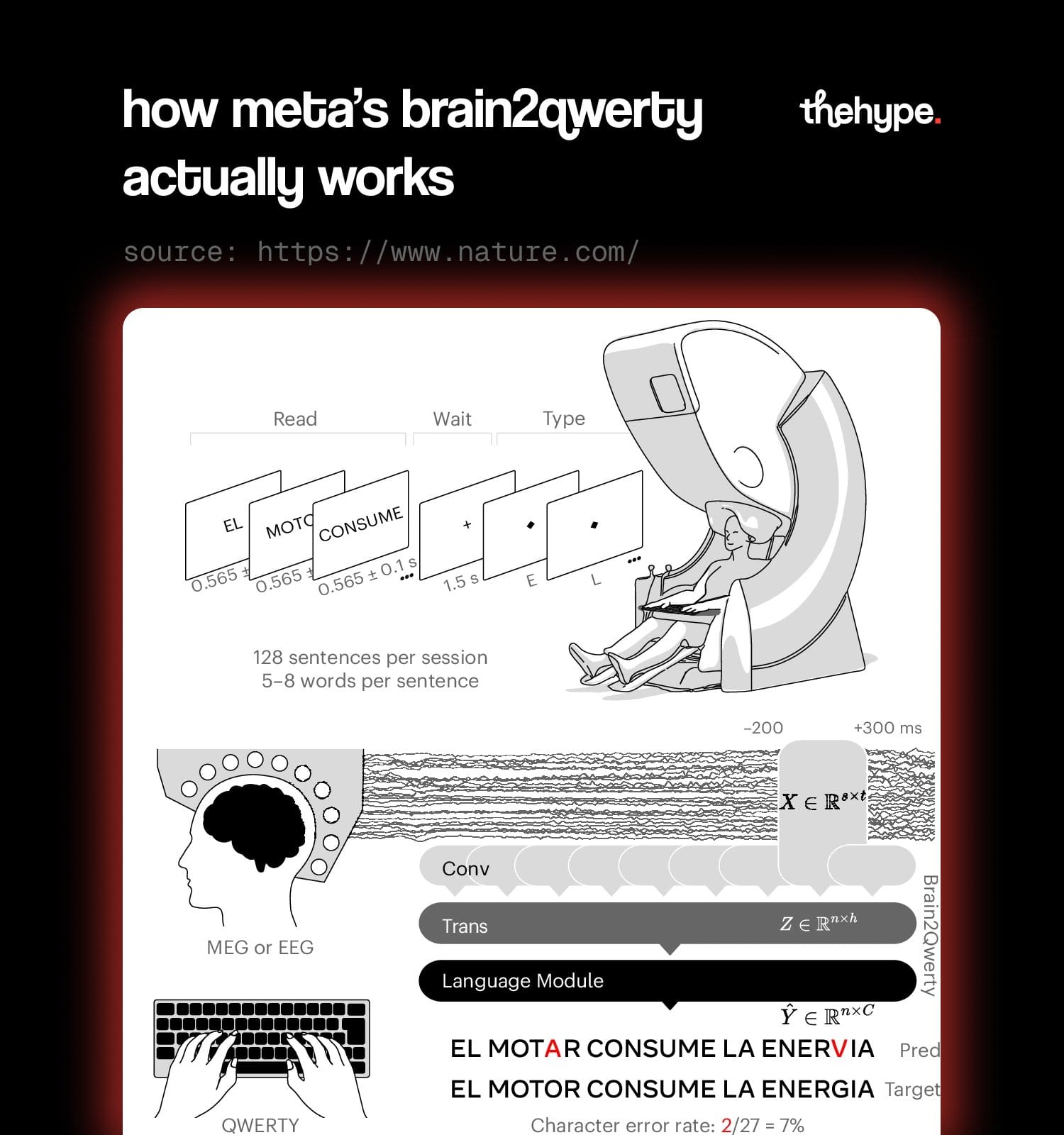
35 people sat in a lab and typed sentences on a keyboard. while they typed, their brain activity was recorded with a meg (magnetoencephalography) scanner – a room-sized machine that measures magnetic fields from the cortex. an ai model called brain2qwerty then tried to figure out which keys they pressed by watching their motor cortex fire
that's it. no thoughts. no intentions. no inner monologue
the model reads hand movements through the skull. its errors aren't linguistic – they cluster around physically adjacent keys on the keyboard. it confuses 'e' with 'r', not 'e' with 'a'. because it's decoding where your fingers are going, not what you mean
the results are genuinely interesting – 29% character error rate with meg, some sentences decoded perfectly. real progress for brain-computer interfaces, especially noninvasive ones. for people who can't speak but can still type, this is meaningful work
but "reading thoughts" requires none of the above. you have to physically type. on a keyboard. in a hospital. inside a machine that costs thousands and fills an entire room