Felix Laurent

Meta is rolling out Muse Realtime Avatar, a live animated face for its Muse personal agent. The avatar reacts while you talk and speaks with expressions and gestures that match the conversation. It arrived in the Muse app in the US on November 5, together with real-time voice.
Meta first showed the feature at its Connect conference in September. Its research team says raters preferred it over avatars from Runway and HeyGen in live calls. Those results come from Meta's own test, and no independent comparison exists yet.
What Muse Realtime Avatar does in the Muse app
Voice and the avatar work on mobile, the web and Mac. To start a call, you tap the phone icon in the top-right corner of the Muse app. You can then pick how present the agent is: voice only, the avatar next to the chat, or full screen.
Meta offers hundreds of voices, from a New York accent to a pirate. You can switch voices at any time and interrupt the agent mid-sentence. While you talk, Muse keeps working on tasks in the background, like planning a trip.
The model can animate many kinds of characters from a reference image:
- portraits: a photo responds with subtle facial expressions;
- illustrations: a full-body drawing gestures and shifts posture;
- animals and objects: they become expressive and keep their look.
Meta notes that the examples in its research blog show what the model can do. Not all of those avatars are available in the app. Muse is for users aged 18 and over, and the rollout covers the US to start.
Keeping a face in sync with speech in real time is the hard part. Meta's research blog explains how it solved that.
How Meta made the avatar run in real time
Muse Realtime Avatar and Muse Realtime Voice share one stream of speech tokens. These tokens carry both the words and the way they are said. An audio decoder turns them into speech, and the avatar model turns the same stream into video. That keeps voice, lip motion and expression in sync.
The avatar model is a diffusion transformer that generates video in short chunks. Each finished chunk becomes context for the next one. This keeps the character consistent and lets a call run as long as the conversation does.
To make it fast, Meta distilled a large teacher model into a small student. The teacher needs 120 model passes per chunk, and the student needs two, a 60x reduction. In Meta's test, raters split almost evenly between the two, at 45% and 55%.
The numbers Meta reports for the live system:
| Spec | Muse Realtime Avatar |
|---|---|
| Video | 448x768 portrait, 25 frames per second |
| Response latency | about 870 ms from the end of your turn |
| Generation speed | 8 frames in 20 ms on one Nvidia GB200 |
| Concurrent sessions | 12 per GB200, 8x the baseline |
Meta says it rebuilt its real-time inference stack and worked with Nvidia on the model. It also uses 4-bit quantization-aware training to cut serving costs. Speed alone does not make an avatar feel real, so Meta also ran a comparison with rivals.
Muse Realtime Avatar vs Runway Characters and HeyGen LiveAvatar
Meta picked the two commercial live avatars it calls the market leaders: Runway Characters and HeyGen LiveAvatar. Raters held two- to three-minute calls with each product, using matched avatar identities. They then compared the experiences across several dimensions.
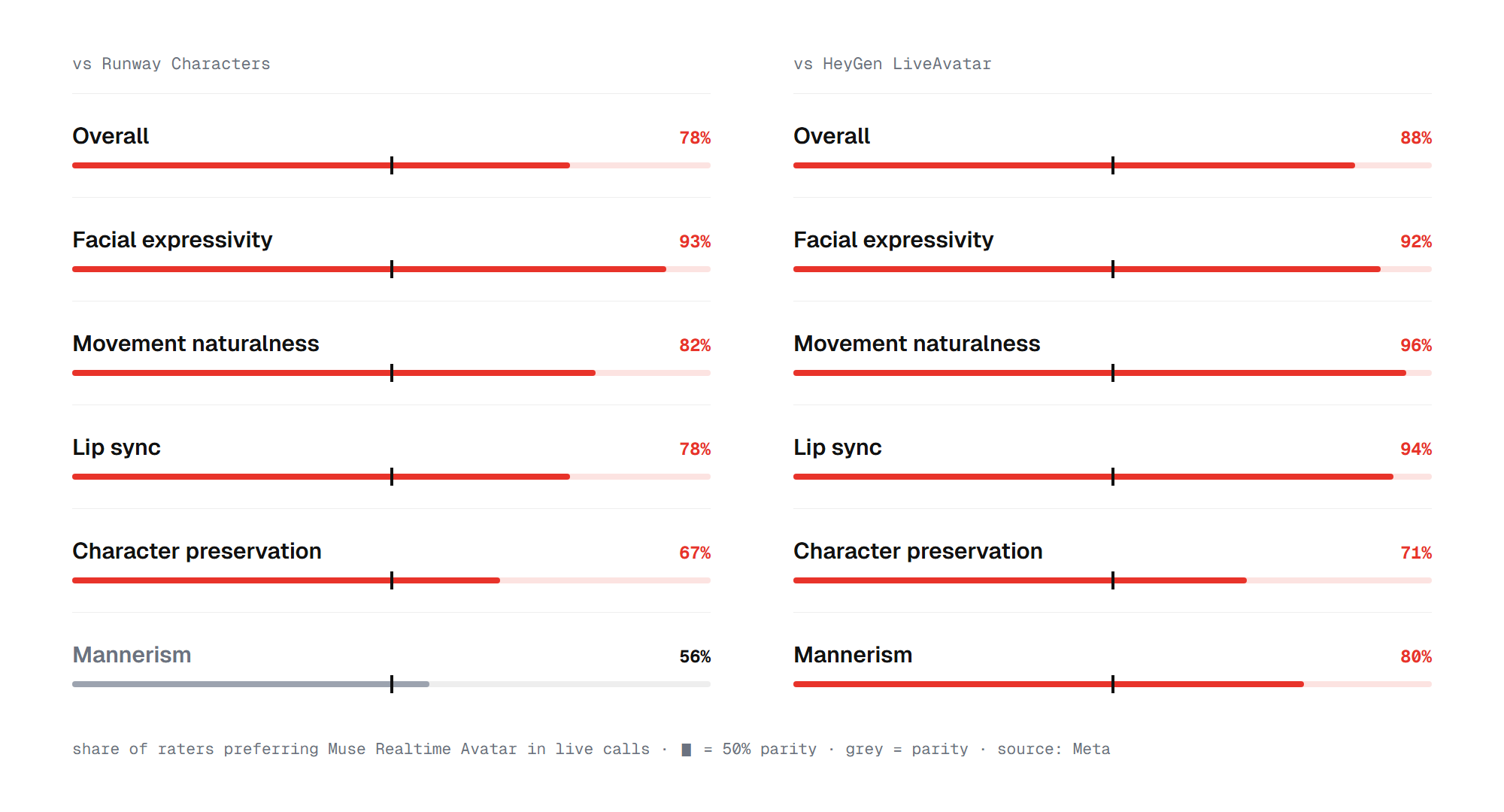
Overall, 78% of raters preferred Muse over Runway Characters, and 88% preferred it over HeyGen LiveAvatar. The table shows each dimension.
The biggest leads are in facial expressivity and movement. The smallest are in keeping the character consistent and in mannerisms. Against Runway, the mannerism result was statistically indistinguishable from a tie, Meta says.
Meta has not published how many raters took part, and it ran the test itself. Runway Characters launched in March 2026 as a developer API that builds a live character from a single image. Until someone repeats the test, the results show how Meta rates its own avatar.
Beyond the test results, the avatar plays a clear role in Meta's plans for its agent.
Why Meta gives its agent a face
Muse is Meta's personal AI agent, launched in the US on September 8. It can send emails, book travel and shop on a user's behalf. More than 10 million people in the US and Canada set it up within about six weeks. In October, Mark Zuckerberg said shopping is its top use. The voice and avatar models join a growing Muse family, which already includes the Muse Wonder models for agents.
Voice turns Muse into something you can use on a walk or with your hands full. The avatar adds a sign that the agent is listening. Meta is also bringing voice to its AI glasses and to Muse Charm, a pocket device shown at Connect. Both are "coming soon," without a date.
A face that can be generated from any photo raises obvious risks. Meta says every avatar video carries an invisible watermark from its Video Seal tool. The watermark makes generated video traceable and adds no delay to the call.
Is Muse Realtime Avatar worth trying
For Muse users in the US, yes, since trying it takes one tap. The avatar is the most polished live avatar Meta has shown, with sub-second replies and synced lip motion. Its rival comparison looks strong, but only Meta has run it so far. The weak spots are the same ones Meta admits: keeping a character consistent and matching its mannerisms. Users outside the US will have to wait, and Meta has not said for how long.
Sources
- Give Your Muse a Voice, Meta Newsroom – rollout in the US, November 5, 2026
- Bringing Your Muse to Life, Meta AI Research – architecture, latency and live evaluation, September 23, 2026
- AI at Meta on X – rollout announcement, November 5, 2026
- The Biggest News From Connect 2026, Meta Newsroom – Muse on glasses and Muse Charm, September 24, 2026
- Introducing Runway Characters, Runway – March 9, 2026