
 Nick Trenkler

with one week left to apply for cohort 007 (deadline: may 17th), we took a close look at who made it into the last batch – and what patterns emerge.
60 companies. a few clear bets
cohort 006 has 60 companies. and when you look at the data, the picture that emerges isn't random – it's a pretty deliberate thesis about where the next wave of value is being built.
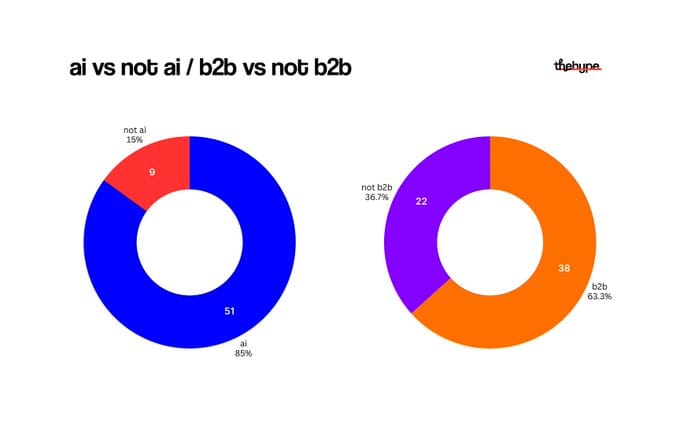
85% are ai companies. that's 51 out of 60. this isn't a surprise, but the scale of it is still striking. ai isn't a category in this cohort — it's the default. the 15% that aren't ai are the outlier.
63% are b2b. the cohort skews heavily toward selling to businesses, not consumers. of the 38 b2b companies, the vast majority are also ai. the message is clear: a16z is betting on ai that solves real enterprise problems, not just cool demos.
the two biggest categories: enterprise software and fintech – tied at 11 each
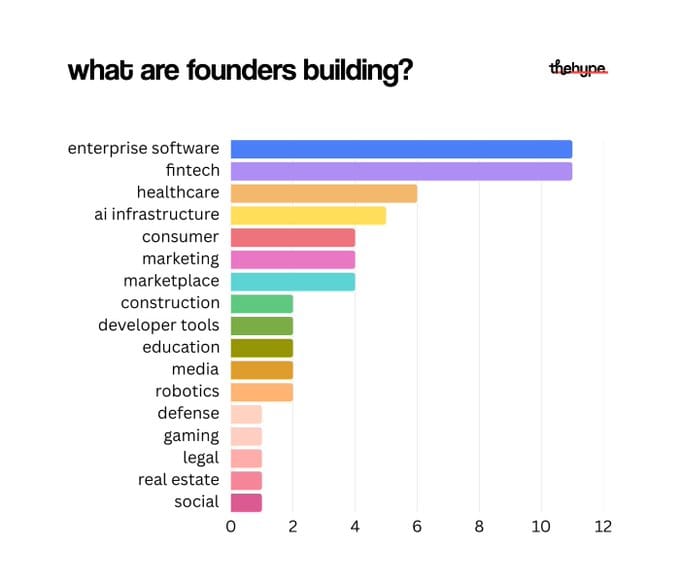
enterprise software and fintech together account for 37% of the entire cohort. these aren't adjacent bets – they're the core of the thesis. followed by healthcare (6 companies) and ai infrastructure (5), the top four categories alone cover nearly half the batch.
the long tail is interesting too: construction, developer tools, education, marketing, marketplace – each with 2–4 companies. robotics makes an appearance. so does defense. gaming and media show up, but barely.
teams are tiny
the most common team sizes are 2 and 3 employees – 11 companies each. 10 companies have 4 people. these are not scaled businesses. they're bets on founders. the median team size across the cohort sits around 4-5 people, with a handful of outliers pushing toward 12-20.
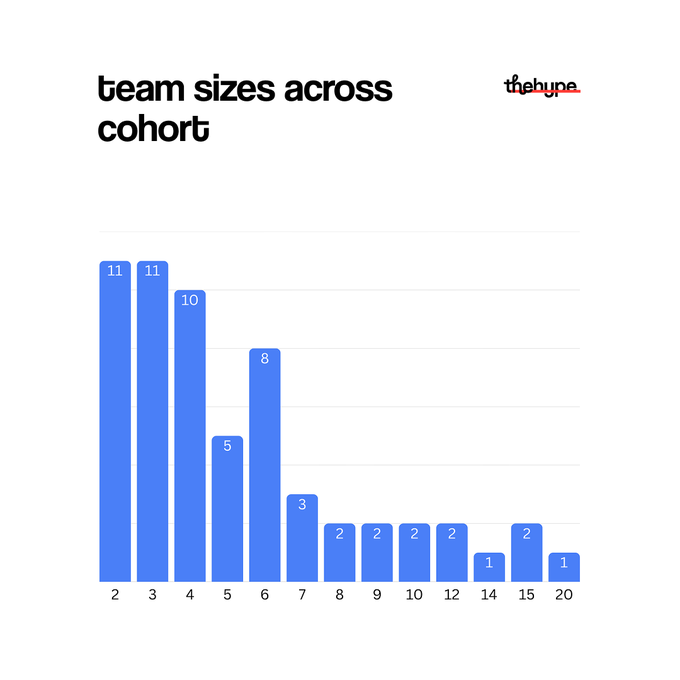
only one company (smart bricks) has 20 employees. only two have 15. the overwhelming majority are pre-scale.
geography: it's still san francisco's world
35 out of 60 companies are based in san francisco. new york is a distant second at 11. after that, palo alto (3), brooklyn (2), mountain view (2), tel aviv (2) – and then a handful of singletons: barcelona, bogota, los angeles, oakland, rio verde.
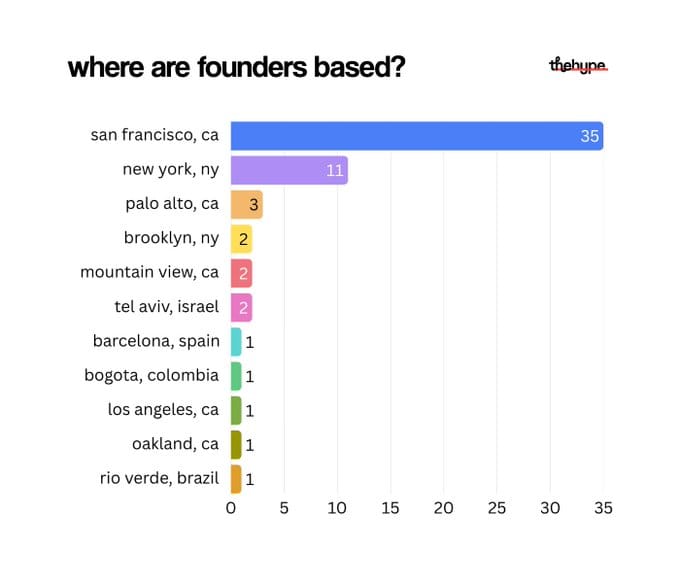
roughly 60% of the cohort is in the bay area. new york accounts for another 20%+ if you include brooklyn. the international presence is minimal – three companies outside the us total.
the revenue numbers: fast, and getting faster
this is perhaps the most striking part of cohort 006. across the batch, companies aren't just building – they're already selling. and the timelines are almost absurd:
- bilrost (ai for commercial loan processing) hit $680k ARR in 5 weeks.
- bota (bridging ai agents to the real world) went from $0 to $710k cARR in the same timeframe.
- straia (agentic ai for higher education) reached $4.5M cARR in 4 weeks.
- pluvo (ai decision engine for enterprises) hit $430k ARR in 3 months.
- variantnow (ai infrastructure for the adaptive web) hit $600k ARR in 3 months.
- cascade (ai for construction wins) went from $0 to $201k cARR in 3 months with a two-person team.
zoom out and the picture is consistent: nearly every company in the cohort that shares a revenue figure is doing so in weeks, not years.
- smart bricks (applied ai for real estate) is running at $12M annualized revenue.
- sirius technology (ai retention platform for subscription companies) is at $3M ARR.
- acceler8 (ai for workforce intelligence) has $700k in live ARR.
- cedar (ai for professional networking) has $2.5M in contracted revenue.
even the earlier-stage companies are showing momentum:
- idilio (serialized storytelling platform) went from $0 to $32k/mo since january with roughly one-day ROAS breakeven.
- snag (ai sublet marketplace for gen z) is processing $6.5M in requests per month, growing 40% month-on-month.
- zerodrift (ai compliance for messaging) is at $150k ARR with 50%+ month-on-month growth.
the pattern isn't just "startups with revenue." it's startups compressing the timeline between zero and meaningful traction to a matter of weeks. ai is doing something real here — it's collapsing the time it takes to go from idea to first dollar.
what the numbers say about the 2026 playbook
put it all together and a16z cohort 006 reads like a very specific bet: small ai-native teams, selling to businesses, mostly in san francisco, moving fast on revenue. the traction stats peppered across the cohort profiles aren't decoration – they're the point. the bar has shifted. it's not enough to have a good idea. you need proof, and you need it fast.
the new standard seems to be: raise on traction you built last month, not projections you made last year.