Felix Laurent

OpenAI released GPT-6.1 Terra on October 26, 2026. It costs $1 per million input tokens and $5 per million output tokens, half the price of GPT-6.1 Sol. Independent tests from Artificial Analysis put it 4 points behind Sol and 10 points behind Claude Opus 5.5. It is a cheaper workhorse, not a new frontier model.
What OpenAI announced
OpenAI calls GPT-6.1 Terra a fast, efficient model for visual reasoning, computer use and writing. Its examples are drafting proposals, reading technical drawings, filling out forms and editing videos.
The model replaces GPT-5.6 Terra as the middle tier of the lineup. GPT-6.1 Sol and GPT-6 Astra stay on top for the hardest work. OpenAI says Sol and Astra remain the better choice for the most complex coding tasks.
GPT-6.1 Terra is live in ChatGPT Work and Codex for Plus, Pro, Enterprise and Edu users. Developers get it in the API as gpt-6.1-terra.
GPT-6.1 Terra pricing and API specs
The API page lists one snapshot and these limits. The prices are per million tokens, standard tier.
| spec | GPT-6.1 Terra |
|---|---|
| input | $1 |
| cached input | $0.05 |
| output | $5 |
| cache write | $1.25 (30-minute retention), $2.50 (12-hour) |
| context window | 1,050,000 tokens (922,000 input max) |
| max output | 128,000 tokens |
| knowledge cutoff | June 1, 2026 |
| input / output | text and images in, text out |
| reasoning effort | none, low, medium (default), high, xhigh, max |
Prompts over 272,000 input tokens cost more for the whole request. Input and cache rates double, and output costs 1.5x. Batch and Flex are 50% cheaper than standard.
The model works in Chat Completions, Responses and Batch. Tools such as computer use, web search, code interpreter, hosted shell and MCP run through the Responses API. Fine-tuning, Realtime and audio are not supported.
GPT-6.1 Terra vs GPT-6.1 Sol and GPT-5.6 Terra on price
All three models have a 1.05 million token context, and Terra is the cheapest of them. GPT-6.1 Sol costs $2 for input and $10 for output, GPT-5.6 Terra $2 and $12. The chart uses the standard prices from each model's API page.
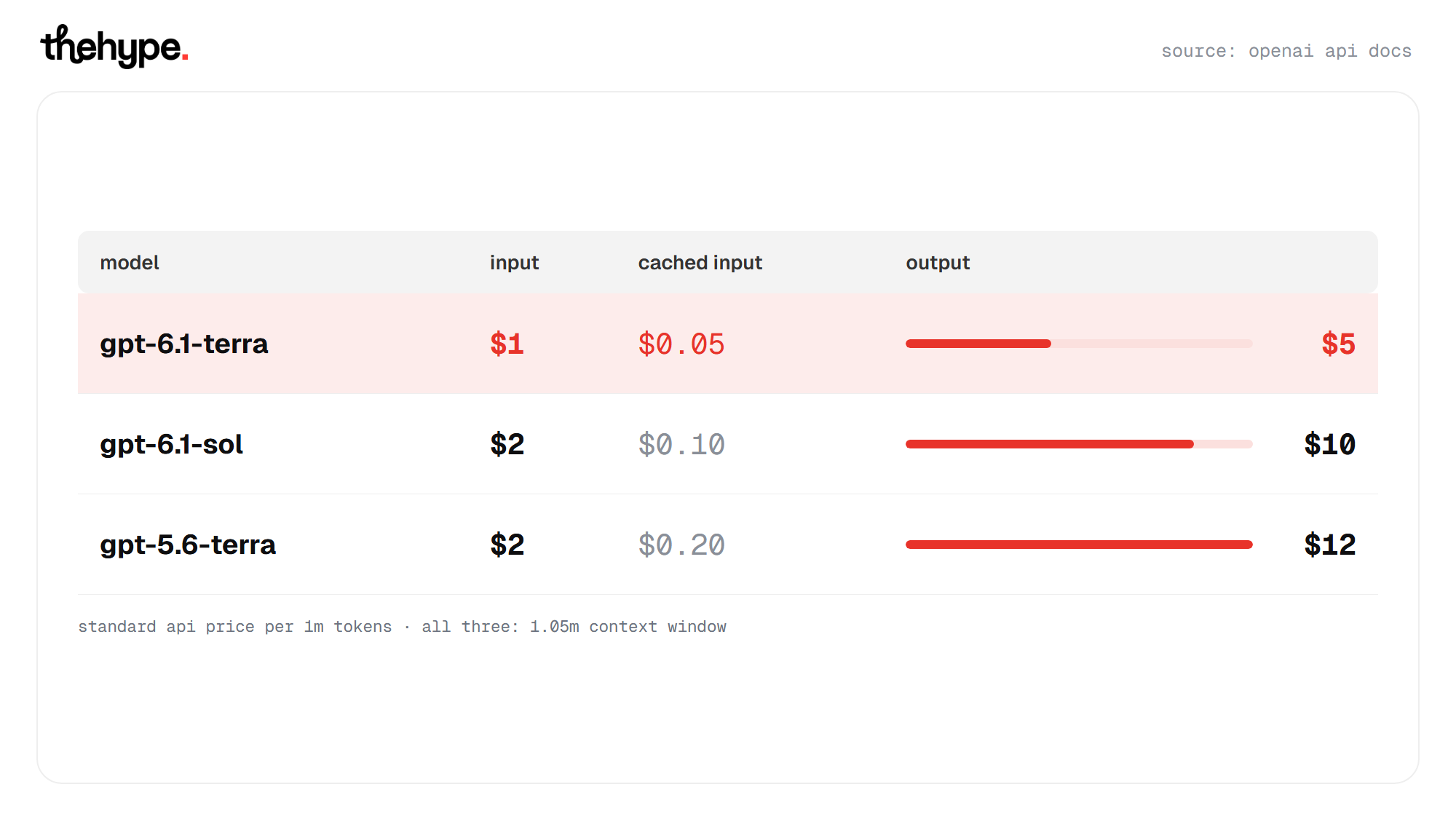
Output on GPT-6.1 Terra is 2.4x cheaper than on GPT-5.6 Terra. Cached input costs a quarter of the old rate.
GPT-6.1 Terra computer use and error rate, per OpenAI
The launch post leads with computer use. On Agents' Last Exam, a set of professional tasks, Terra at medium effort scores 15 points over GPT-5.6 Terra. OpenAI says it costs about a third as much and matches GPT-6 Astra.
At max effort, OpenAI says Terra uses a third of the tokens Claude Opus 5.5 needs. With a quarter of the price per token, that comes to about 9x lower cost per task. OpenAI also says Terra finishes tasks over 3x faster than GPT-6 Astra and GPT-6.1 Sol.
On OpenAI's internal test of error-inducing prompts, the error rate at low effort fell from 53.6% to 16.7%. At max effort it fell 18 points to 4.3%.
On Terminal-Bench 4.0, OpenAI reports 50.3% at max effort. That is more than double the 21.5% it published for GPT-5.6 Terra. These are OpenAI's own runs.
GPT-6.1 Terra benchmarks from Artificial Analysis
Artificial Analysis tested the model on launch day. Its Intelligence Index combines 10 evaluations, including Terminal-Bench 4.0, Humanity's Last Exam and AA-Omniscience. GPT-6.1 Terra scores 48 at max effort. Claude Opus 5.5 leads at 58, followed by Kimi K3.1 Pro at 55, Gemini 4 Argon at 53 and GPT-6.1 Sol at 52.
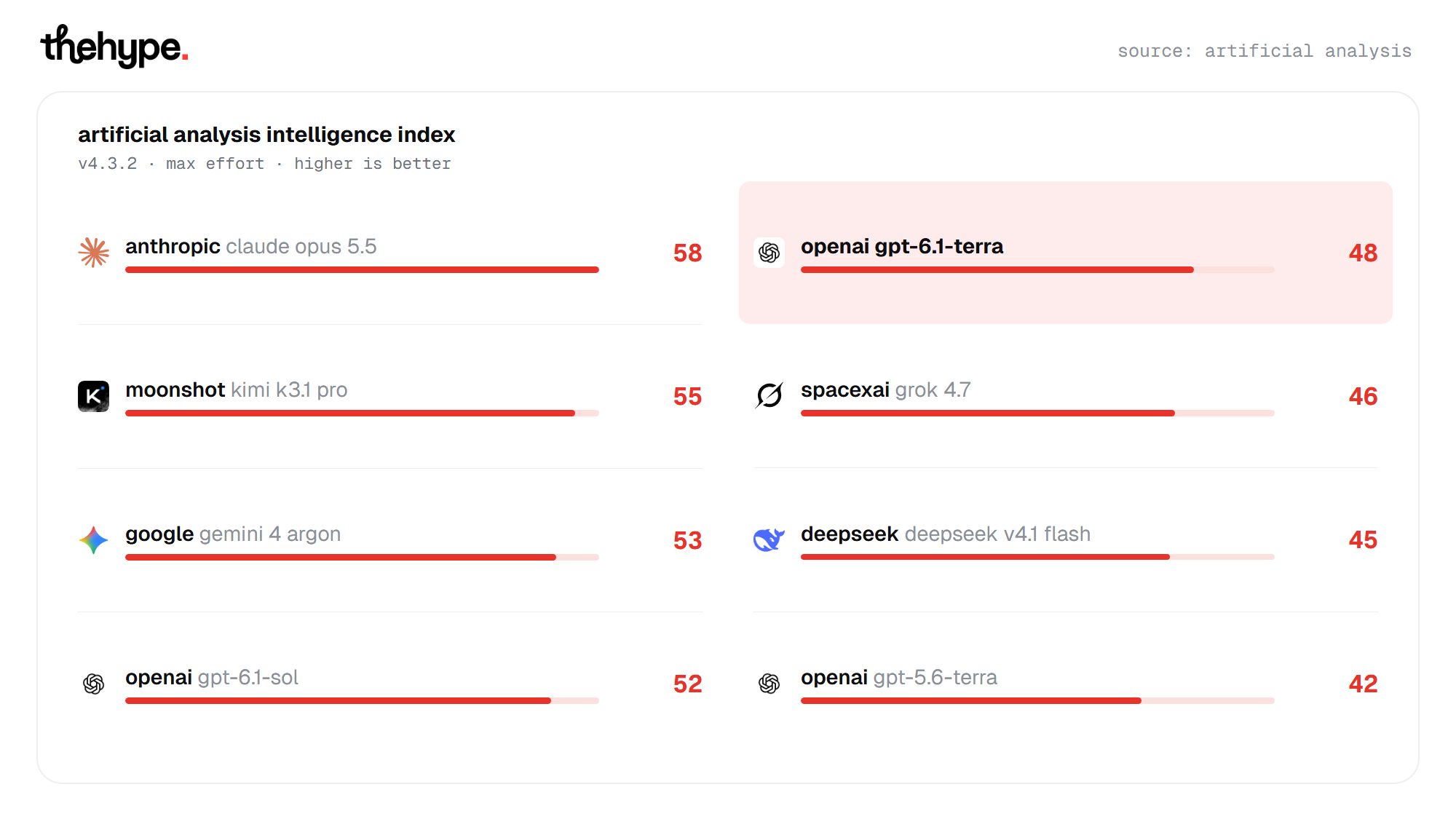
Terra gains 6 points over GPT-5.6 Terra. Artificial Analysis puts the cost of running its index at $0.40, against $1.40 for the old model.
At low and medium effort, Artificial Analysis places Terra on its intelligence-versus-cost frontier. The higher effort settings sit behind that line.
Where GPT-6.1 Terra moved the most
The biggest change is the hallucination rate. On AA-Omniscience, Terra answers wrongly 38% of the time when it should decline. GPT-5.6 Terra did so 88% of the time.
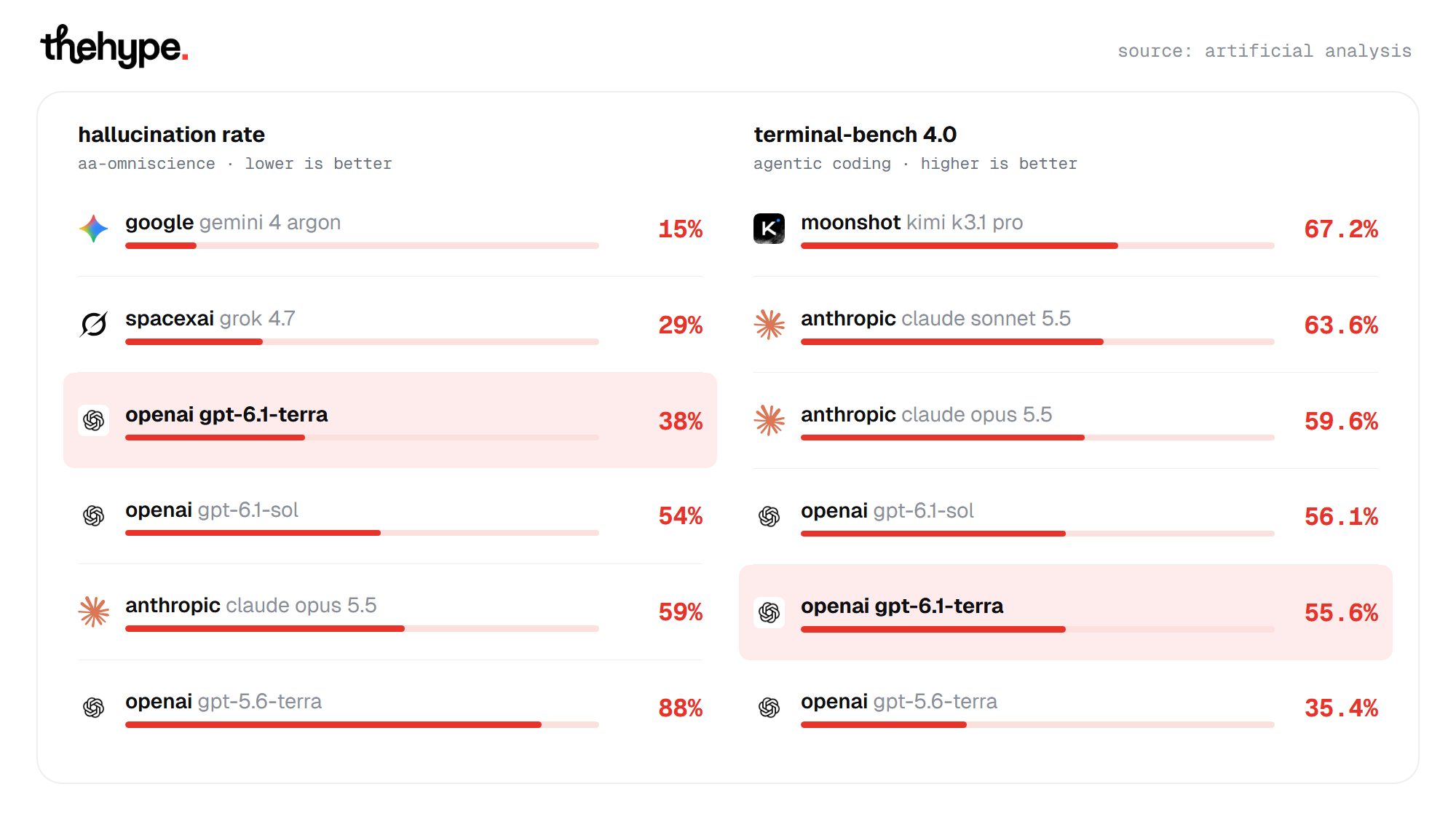
That rate is below GPT-6.1 Sol at 54% and Claude Opus 5.5 at 59%. Gemini 4 Argon is still lower at 15%. Accuracy on the same test rose from 47% to 49%.
On Terminal-Bench 4.0, Artificial Analysis measured 55.6%, up from 35.4%. Sol scored 56.1%, and Kimi K3.1 Pro leads at 67.2%. The figure differs from OpenAI's 50.3% because the two runs use different setups.
GPT-6.1 Terra vs Claude Opus 5.5: where it trails
Terra does not close the gap with the top models. It sits 10 points behind Claude Opus 5.5 on the Intelligence Index and 4 points behind GPT-6.1 Sol.
The same holds for coding agents. On the Artificial Analysis Coding Agent Index v2.0, Terra scores 48 against 54 for Sol and 62 for Claude Code with Opus 5.5. Gains on most other evaluations are small, such as 5 points on GDP.pdf.
Our take
Anyone waiting for OpenAI's answer to Claude Opus 5.5 will not find it here. It is a faster, cheaper Terra with far fewer hallucinations.
For high-volume work, such as reading invoices or filling forms, the price matters more than the last 10 points. For the hardest coding and reasoning, OpenAI itself still points to Sol and Astra.
Sources
- Introducing GPT-6.1 Terra – OpenAI, October 26, 2026
- GPT-6.1 Terra model page – OpenAI API docs
- GPT-6.1 Sol model page – OpenAI API docs
- GPT-5.6 Terra model page – OpenAI API docs
- Artificial Analysis on GPT-6.1 Terra – independent evaluations, October 26, 2026