Felix Laurent
Radian Simulations, the small studio behind the tank sim Gunner, HEAT, PC!, has banned generative AI from the game's official subreddit. Anything made "in whole or part" with AI is out. That covers text summaries, image edits, animated clips, video thumbnails, game mods and links to any site that uses or promotes gen AI. There are no exceptions.
The game has been in early access since September 6, 2022. A post about the ban passed 60,000 views on X within a day. It reopens the old fight over AI in game development.
What Radian Simulations banned
The rule went up on r/GunnerHEATPC as rule 6, in a locked post from the official moderator account. As the post lists it, no content created fully or partly by generative AI is allowed, including:
- text summaries
- image edits and AI "art"
- animated clips and video thumbnails
- game mods
- anything that feeds the studio's proprietary work into AI services
- links to sites that use or promote gen AI
The studio says a version of the rule has been on its Discord server for some time. Now it covers every forum the studio runs. The post ends by telling AI fans to go elsewhere: "They have no place in our world, and we have no respect for them."
Part of this is a fair ask. A studio has every right to keep its own assets out of training sets and to moderate its own community. The rest of the rule goes much further. A mod is banned because of the tools used to make it, not because of what it does in the game.
Why the reaction looks out of proportion
Gunner, HEAT, PC! is a niche game. Its Steam page shows 91% positive out of 5,037 English reviews. That is a loyal audience, but a small one, and the game is still in early access four years after launch. Projects like this should be the most interested in cheaper tools. They have a small team, a long roadmap and a community that already builds things for the game.
Instead, the studio drew a line through the whole technology. The ban also hits uses that touch nobody's art: a text summary of patch notes, a thumbnail for a gameplay video, a fan tool.
Slop is a people problem
Generative AI does produce slop. Stores and feeds are full of low-effort games, art and videos generated in bulk. The people behind them want to ship something fast and cheap. That is a real problem for players and for moderators.
But the slop comes from developers who don't care, not from the technology. A camera doesn't make bad photos, and a game engine doesn't make asset flips. A blanket ban punishes the modder who used AI to write a script faster. It treats that modder and a spammer with a hundred generated thumbnails as the same person.
Game development costs since 2000
The other side of the argument is money. Games are expensive and slow to make, and the bill keeps growing. Leaked and court documents show what single AAA games cost:
| Game | Budget | Source |
|---|---|---|
| Ratchet & Clank: Rift Apart (2021) | $81M | Insomniac leak, 2023 |
| Marvel's Spider-Man: Miles Morales (2020) | $156M | Insomniac leak, 2023 |
| Horizon Forbidden West (2022) | $212M | FTC v. Microsoft documents |
| The Last of Us Part II (2020) | $220M, excluding marketing | FTC v. Microsoft documents |
| Marvel's Spider-Man 2 (2023) | $315M | Insomniac leak, 2023 |
| Marvel's Wolverine (planned) | $305M | Insomniac leak, 2023 |
| Marvel's Spider-Man 3 (planned) | $385M | Insomniac leak, 2023 |
The leaked figures come from an internal Insomniac slide. The Rhysida ransomware group published it in December 2023, and the planned budgets were projections at the time. In March 2026, Jason Schreier said AAA budgets at US and Canadian studios are "$300 million or more." That counts salaries and overhead.
Hushcrasher, which estimates budgets for games on Steam, puts the growth of AAA costs at 224% since 2015. By its count, the combined development spend on Steam reached $27B in 2025, against $10B in 2019. That is 2.7x in six years, or 2.2x after inflation.
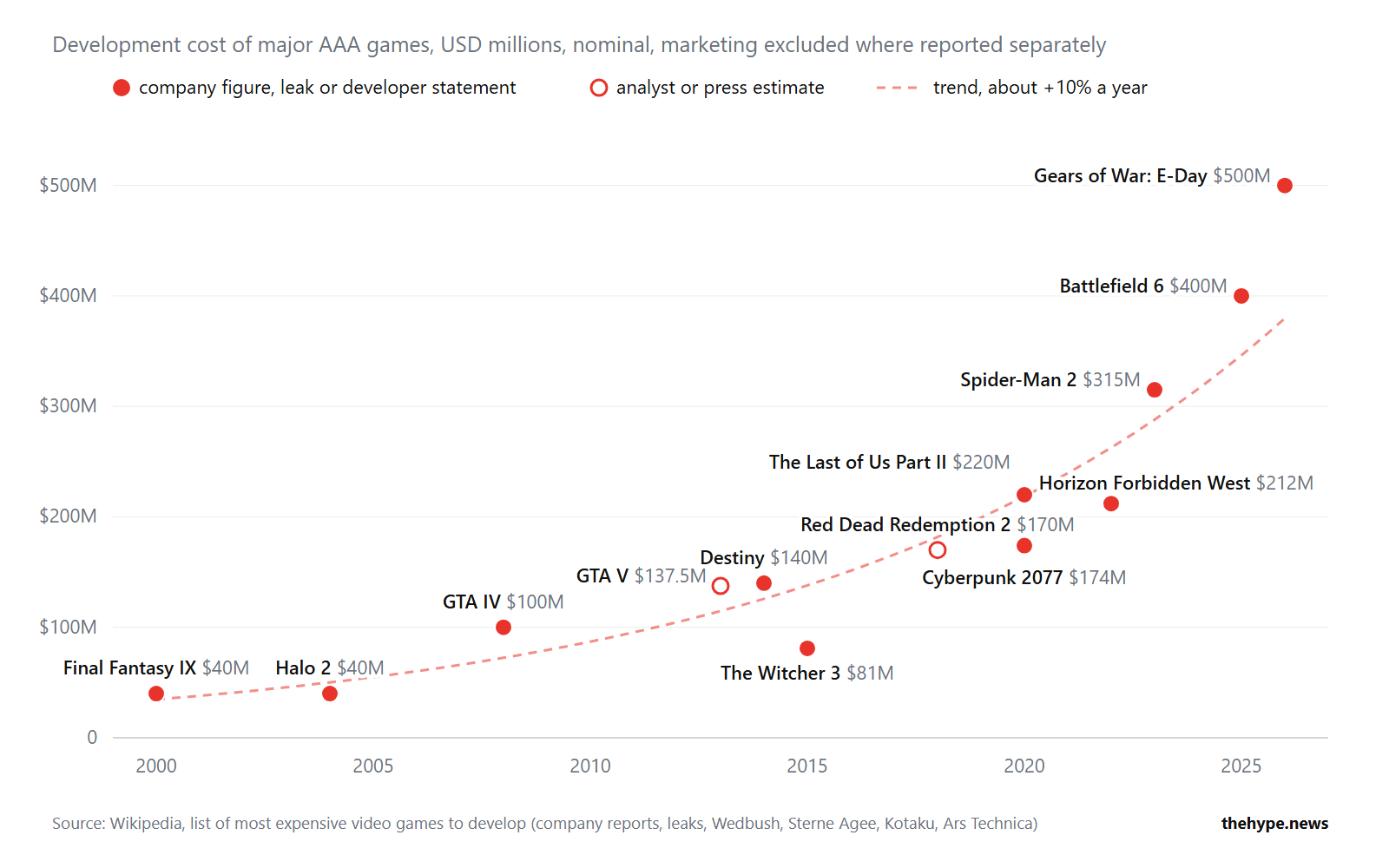
Over a longer stretch the curve is even steeper. Final Fantasy IX (2000) and Halo 2 (2004) cost about $40M each to develop. GTA IV reached $100M in 2008, and Cyberpunk 2077 cost $174M before marketing. Reported budgets for Battlefield 6 and Gears of War: E-Day are $400M+ and $500M+. That is roughly 10x in a quarter of a century, a trend of about 10% a year across these 13 games.
Why big budgets kill experiments
When one game costs $300M, a studio can't afford for it to flop. So publishers go back to what has already sold: sequels, remakes, open worlds built on a familiar loop. Players complain that nothing feels new, and they are right. But a failed experiment at that price can close a studio.
The same math hits small projects from the other end. For years, the story went like this.
An artist or a writer has an idea. Then they need programmers, who have to be paid or talked into working for free. They need a game designer to balance the systems and build a loop that holds. They need someone for sound and someone for the build pipeline. Most of these projects never got past that point.
What AI in game development changes
This is where AI is useful. A talented artist can now do much of the programming with an agent such as Claude Code. They can test ideas the same week and bring in people only where they are really needed. That lowers the bar for anyone who wants to make a game. It also leaves more room for ideas that would never get a budget.
For large studios, the same tools can cut the cost of the work around the creative core: prototypes, tooling, testing, ports. Every dollar saved there makes an experiment cheaper to try. Indie developers get to ship, big studios get to take risks again, players get new kinds of games. On paper everyone wins.
That is what makes the backlash so strange. Plenty of players are clearly unhappy with where the industry is: rising prices, safe sequels, studio closures. Yet the tool that could change the economics behind all of that gets rejected because it also produces slop.
Slop is a side effect, not the purpose of the technology. It has a fix: strict quality control on the platforms that distribute games. Stores already review builds, ratings and refund rates. The same bar for AI-made games filters out the junk and leaves the tool to the people who use it well.
None of this works by pressing a button. An agent doesn't design a good game by itself, and it doesn't replace a team. It is a tool. Like any tool, it gives a result in the hands of someone who knows what they want and checks what comes back.
Linux has already moved on
The software world outside games has mostly settled this argument. In April 2026, with Linux 7.0, the kernel adopted its first policy for AI coding assistants. The tools are allowed, the code is labeled with an Assisted-by tag, and a human signs off on every line. In July, Linus Torvalds told critics that Linux is not an anti-AI project. Anyone who disagrees, he said, can fork it or walk away.
In October, Torvalds posted a patch series for the Linux page cache. He says its code, test programs and first draft were done with Claude Code under his direction. In his synthetic benchmark on a 64-thread Threadripper, reads ran about 23x faster. He warned that no real workload will see that number. Within about four hours, Kiryl Shutsemau of Meta found a race condition the AI-written tests had missed. The series has not been merged.
That episode is the whole case in one story. One of the most critical codebases in the world is maintained by a person who uses an AI agent and labels it openly. Other humans review the result, and the review catches what the tool missed. Nobody suggested burning the patch.
Our take
A four-year-old early access game with a small, loyal audience reacting this hard is strange. The hate toward AI as something that will destroy all creative work isn't justified. Slop is made by careless people, and a ban on the tool doesn't stop them. It stops the modder, the artist and the solo developer who could use it well.
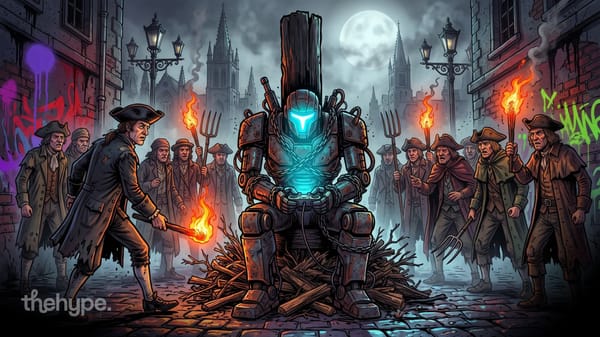
AI is not a magic button that delivers a finished game in place of a person or a whole team. It is a tool that has to be used properly. The Linux kernel already treats it that way, with rules, labels and human review. Much of the gaming community still treats it like witchcraft. To many, it is something to burn at the stake in the middle of Yharnam's central street, torches and pitchforks included.