
 Felix Laurent

GitHub Copilot Fusion picks the AI model for each coding task, so developers no longer have to. It became generally available on October 28, 2026, at GitHub Universe. On November 5 GitHub promoted it again on X with a 30% discount that runs through November 30.
In the model picker, Fusion looks like one more model. Behind it is a router that chooses which models handle a prompt and how they work together. The developer sets only an effort level.
What Copilot Fusion does
In GitHub's changelog, Fusion is a system that "routes and orchestrates models for each task" on the developer's behalf. It replaces the usual question of which model to use with a question of how hard the task is. There are three effort levels:
- Standard prioritizes versatile models for everyday coding.
- High prioritizes capable models for hard tasks and deeper reasoning.
- Max prioritizes the most capable models for the most demanding work.
GitHub does not publish a fixed list of models. The pool changes as new models arrive. Fusion works in VS Code, the GitHub Copilot app, Copilot CLI and JetBrains IDEs, and GitHub says more clients are coming.
The effort level sets the class of models. For every prompt, Fusion then picks one of three ways to run them.
Single, Cascade and Critique
The three execution patterns are the core of Fusion.
Single is the simplest. One model solves the task directly. It suits quick edits and short questions.
Cascade starts cheap. An efficient model drafts an answer, and a judge model checks it. If the draft passes, the developer gets it. If not, a stronger repair model starts over from scratch. Most easy tasks never reach the expensive model, which is where the savings come from.
Critique adds a review step. One model drafts the answer, and a critic reviews it without editing the code. The critic either approves the draft or asks for a revision, and the original model then fixes it. In the research preview, the critic came from a different model family than the drafting model. The current docs say several models can critique in parallel, with their feedback combined.
The developer sees only the final answer. That has a cost in speed. GitHub's docs warn that Cascade and Critique take longer than a single model, since each adds model calls. GitHub's case for that wait rests on its own benchmark numbers.
How Copilot Fusion compares with Claude Code
GitHub tested Fusion Max on the Artificial Analysis Coding Agent Index. It scored 60, two points behind Claude Code running Opus 5.5 at Max effort. GitHub says Fusion got there at about half the average API cost per task. It also used about half as many tokens and about 40% less time.
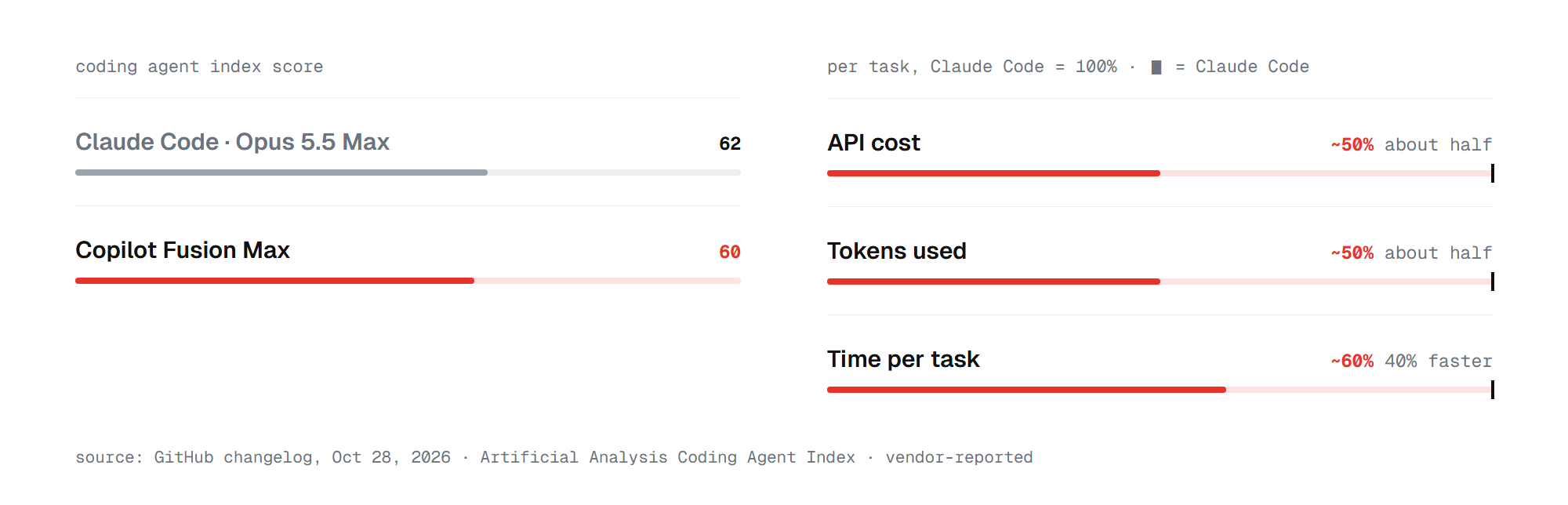
The idea goes back to Project HydraFusion, a research preview GitHub opened on September 4 in Copilot CLI. In offline tests, it beat Claude Opus 5 on TerminalBench 2.1 by 4.9 points at an estimated 67% lower cost. On DeepSWE it trailed by 1.5 points while costing 36% less. GitHub tuned the system on these evaluations and ran them itself, so independent tests have yet to confirm the numbers.
The savings depend on how Fusion is billed, which has a few catches.
Copilot Fusion pricing and the 30% discount
Fusion has no fee of its own. GitHub charges for each model Fusion calls, at that model's standard rate. A Cascade that escalates or a Critique with several reviewers therefore uses more AI credits than one model would. GitHub's docs add that High and Max may consume more.
Through November 30, 2026, users on paid Copilot plans get a 30% discount on model costs inside Fusion. The X post on November 5 was a reminder of that offer.
Which levels a developer can use depends on the plan. The changelog says Fusion is available on all Copilot plans. The docs table is narrower. Standard is open to everyone, including Free and Student. High starts at Pro+, and Max needs the Max, Business or Enterprise plan.
The bigger shift is in who chooses the model.
Why GitHub wants to pick the model
For two years, Copilot users have picked models from OpenAI, Anthropic, Google and others in a growing menu. Fusion moves that choice to GitHub. The developer trades control for a promise of similar quality at lower cost.
That trade has a transparency problem. Fusion shows only the final response, and GitHub does not say which model wrote a given answer or how often Cascade escalates. For a team debugging an odd suggestion, the answer to "which model did this" stays hidden.
The pitch is also aimed at a rival. GitHub chose Claude Code with Opus 5.5 as its benchmark, and it frames Fusion as nearly as good for half the money. Claude Code users who pay per token are the obvious target.
Is Copilot Fusion worth switching on
For most Copilot users, Fusion at Standard effort is a sensible default. It costs nothing extra to try, and the November discount makes heavier levels cheaper to test. Teams that need to know which model touched their code, or that care most about latency, may prefer to keep picking models by hand.
The claim that matters, near-Claude Code quality for half the cost, comes from GitHub's own tests. Until independent benchmarks and real billing data back it up, those savings remain GitHub's promise.
Sources
- Route and orchestrate models with GitHub Copilot Fusion, GitHub changelog – October 28, 2026
- Copilot Fusion, GitHub Docs – accessed November 5, 2026
- Project HydraFusion: frontier quality via multi-model orchestration, GitHub blog – September 4, 2026
- GitHub post on X – November 5, 2026