Felix Laurent

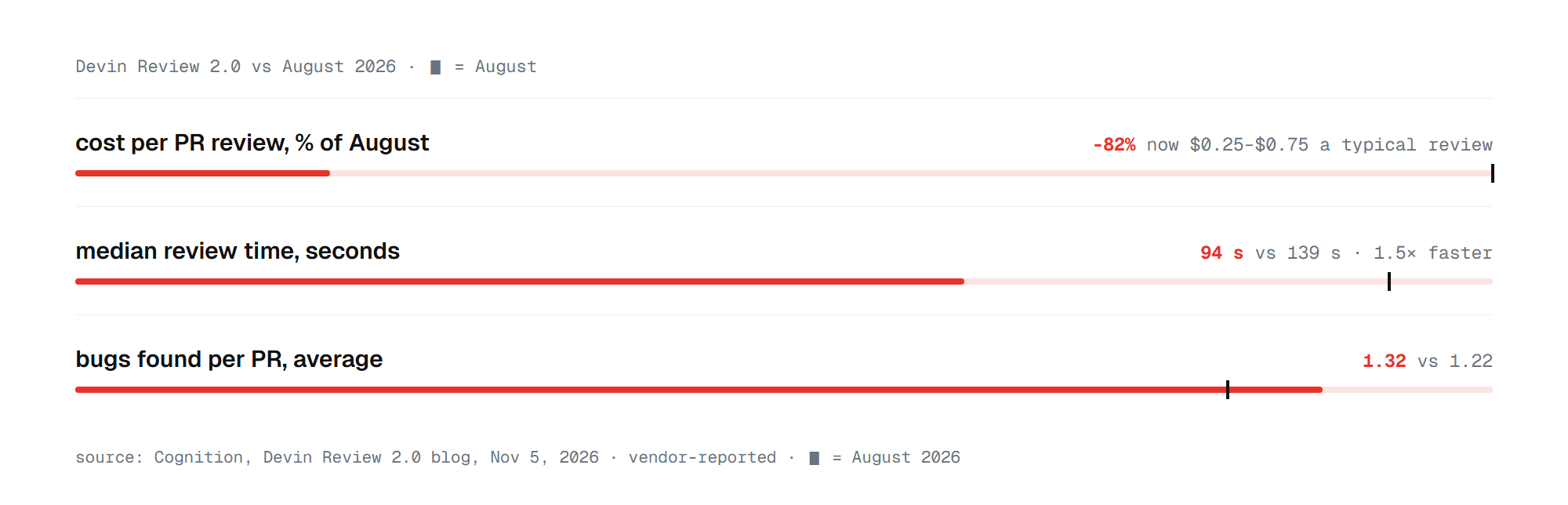
Cognition released Devin Review 2.0 on November 5, 2026. The update makes Devin Review the default tool for checking pull requests when teams work with Devin, the company's AI software engineer. The headline numbers are about money and time: a typical review now costs $0.25 to $0.75, and runs 1.5 times faster than in August.
The timing fits a wider shift. Companies now count every dollar their teams spend on AI. Cognition is pitching review as something cheap enough to run on every pull request.
What changed in Devin Review 2.0
Devin Review first launched in January 2026 as a new interface for reading complex pull requests. It groups related changes, flags likely bugs and lets developers ask questions about the code. Version 2.0 keeps that base and changes how often and how cheaply it runs.
Cognition reports three main gains since August:
- the cost of reviewing a pull request fell by 82%;
- median review time dropped from 139 to 94 seconds;
- average bugs found per pull request rose from 1.22 to 1.32.
The savings came from a better mix of models and changes to the agent's harness, Cognition says. Across its customers, each bug that gets fixed costs about $2.25 on average.
All of these figures come from Cognition and have not been checked independently. The lower price matters most once reviews run automatically.
Reviews that run like CI
A developer can start a review with a /devin review comment on GitHub or GitLab. Reviews also start from the Devin Review page in Devin Cloud and Devin Desktop. Teams can also set Devin Review to run on its own once a pull request is ready. Cognition compares this to CI: the review is waiting when the developer opens the pull request.
Rules decide which pull requests get reviewed. Teams can filter by file path, branch and label, and choose whether to include drafts. Customers use these rules to skip low-value pull requests and keep spending down.
When a pull request gets new commits, Devin Review now checks only the parts that changed. Findings stay focused on the latest work, and each pass costs less. About 80% of pull requests cost under a dollar to review, including every push. A per-PR spending limit stops a runaway review from growing the bill.
Cognition's pitch goes beyond finding bugs. The company says the reviewer works best paired with its own coding agent.
How Devin Review works with Devin
Devin Review can check pull requests from any source, human or AI. When it runs together with Devin, the agent takes each finding and decides whether to fix it, dismiss it or pass it to a human. By the time the developer returns, only the bugs and decisions that need a person are left.
Two new features give teams more control. Devin Review Ultra is a higher effort level for code where a missed bug is expensive, such as billing or security. It reviews more thoroughly and costs more.
Custom Reviewers, now in beta, turn a team's own checks into reviewers with written instructions. Cognition runs them internally to enforce backend security practices, safe database migrations, fast SQL queries and accessible UI components. Each custom reviewer follows the same spending controls as the main review.
The cost focus has a clear business reason.
Why AI code review is getting cheaper
Cognition's argument is that code review has become the bottleneck in software development. AI agents write more pull requests than ever, and human reviewers cannot keep up. Skipping reviews speeds things up for a while, but it lets more bugs reach users.
Price decides whether teams review every pull request or only some. Companies already cap AI spending. Apple cut some engineers' daily AI budget from $300 to $200. Uber limits each agentic coding tool to $1,500 a month per employee. A reviewer that costs under a dollar per pull request fits inside those limits.
The release also belongs to a busy few weeks for Cognition. The company crossed $1 billion in annualized revenue in September. It released the SWE-2 Flash coding model on November 4. In October it added deep scans with frontier cyber models to Devin Security. Devin Review 2.0 adds a cheaper review step to that set of tools.
Is Devin Review cheap enough to run on every pull request
By Cognition's own numbers, yes. At $0.25 to $0.75 per PR, a team with 1,000 pull requests a month would pay roughly $250 to $750. Incremental reviews and custom reviewers with their own rules keep heavy pull requests from blowing past that.
The open question is quality. Cognition reports more bugs found after the price cut, but the figures are its own. And 1.32 bugs per pull request says nothing about false alarms. Teams that already use Devin get the most from the update, since the agent can fix findings on its own. For everyone else, the low price makes it easy to test Devin Review on real pull requests before trusting it with every merge.
Sources
- Devin Review 2.0, Cognition – November 5, 2026
- Cognition announcement on X – November 5, 2026
- Cognition blog – SWE-2 Flash, Devin Security and the $1B revenue run rate
- Devin release notes, 2026 – GitLab support for Devin Review