Felix Laurent
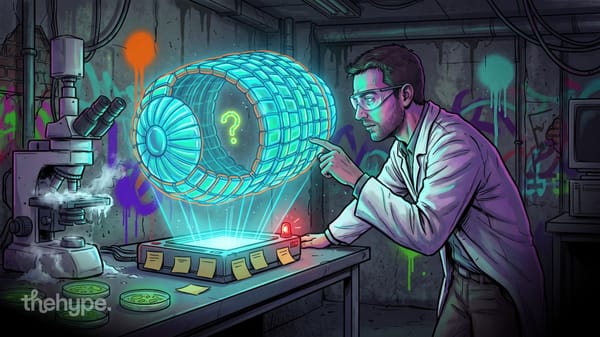
Anthropic's biology research lab used Claude to solve the first 3D structure of a vault particle from prokaryotic life. Vaults are giant protein barrels found in our cells, and 40 years after their discovery, nobody knows what they do.
The company published the work on November 4, 2026. Claude searched protein databases, designed DNA, helped speed up purification and processed the microscopy data. Anthropic also lists Claude's mistakes, including one that cost the team two weeks.
What vault particles are
Leonard Rome and Nancy Kedersha discovered vaults in rat liver cells in 1986. Under the electron microscope, the ribbed shells reminded them of the vaulted ceiling of a cathedral, hence the name.
A vault is a hollow shell of protein about three times the mass of a ribosome. In mammals, it is made of 78 copies of the major vault protein, arranged in two identical halves. Its structure was solved in 2009, from rat vaults.
Vaults appear across most complex life, from slime molds to humans. Scientists have proposed that they move molecules around the cell, protect it from toxic drugs or support immunity. None of these ideas has been confirmed. Mice bred without vault components develop normally.
That makes vaults hard to study. They are also missing from the favorite lab organisms of geneticists, such as baker's yeast, fruit flies and nematode worms. A simpler system was needed, and Anthropic went looking for one in bacteria.
What Anthropic found
Bioinformaticians had already spotted distant relatives of the vault protein in the genomes of bacteria and of bacteriophages, the viruses that infect them. In 2016, researchers proposed that these proteins might form vault-like assemblies. Nobody had shown that they actually did.
Anthropic's team did. Seven of the 15 proteins it produced in E. coli formed vault-like particles. Cryo-electron microscopy confirmed the vault shape for four of them, two from phages and two from bacteria.
The team mapped one in detail: a phage protein it calls L05. Its vault is built from 96 copies of the protein, with a combined mass of about 9.5 megadaltons. It is among the largest protein shells ever found in prokaryotes.
| Human vault | L05 phage vault | |
|---|---|---|
| Protein copies | 78 (39 per half) | 96 (48 per half) |
| Size | about 67 × 40 nm | about 54 × 45 nm |
| Repeat segments in the wall | 9 | 7 |
| Enclosed volume | baseline | about 25% more |
The phage vault is shorter and wider than the human one, yet it holds more because it is rounder. Its caps close in three steps, like a tiered dome. Of every three neighboring chains, one stops at the first step, one at the second and one reaches the tip.
The team then changed the protein to learn how it assembles. Some single mutations near the cap stopped the shell from closing, leaving open, rosette-like particles. Copying two wall segments gave the protein nine, as in humans, and produced an even larger vault.
Anthropic's technical report says the engineered version is 50% larger than the human vault. The company has filed a provisional patent and suggests such shells could serve as nanocapsules for delivering enzymes. Getting there took a very different workflow.
How Claude sped up the research
The work started with a search. Using Claude Science, Anthropic's AI workbench for scientists, the team scanned about 15 billion predicted proteins. Vault relatives turned out to be rare but widespread: they appear in 29 groups of bacteria and four of archaea.
The researchers picked 44 candidates. Claude converted each sequence into DNA tailored to the host cell and prepared the designs for ordering. In living E. coli, 15 of 24 proteins came out soluble.
Purification was the next bottleneck. The standard method for vaults spins samples through sugar gradients and takes about three days. The team switched to size-exclusion chromatography, where large particles come out of a bead column first.
Claude first argued against the idea, because clumps of misfolded protein exit at the same point. The team tried it anyway. Claude then recommended a column and a way to check the particles. It also suggested loading raw cell contents straight onto the expensive column, which the team was wary of. It worked: about 90 minutes from cells to microscope grid.
Structure determination usually takes weeks or months of manual work. Here, Claude ran the open-source software RELION in an internal multi-agent setup on hundreds of GPUs. A first model was ready in 34 hours and final maps about a week later. "Claude wrote all code and carried out all computational analyses in this study," the report says.
The speed came with errors, and Anthropic is open about them.
Where Claude went wrong
One protocol Claude wrote called for a growth medium with an additive that interferes with getting DNA into cells. That set the project back by two weeks.
Early in the cryo-EM processing, Claude skipped a standard step. It produced a flawed map blended with its own mirror image. The team told it to stop improvising: "Please let's do normal things unless they don't work."
The researchers say they caught mistakes quickly in areas they knew well, but lost time in areas they didn't. None of them had worked with a protein assembly this large before. They shared their lab notes with the machine learning researchers who train Claude, and the model made fewer errors as new versions arrived.
Most of the work, Anthropic says, could be done by a typical lab with existing Claude products. Only the cryo-EM step needed more computing power than most universities have. The whole project took under four months.
Is the mystery of vaults solved
No. Anthropic says plainly that it hasn't found what vaults do. The vaults were made only in E. coli, and the team hasn't checked whether they form in their natural hosts.
There is one hint. A pocket in each of the 96 protein copies holds a small molecule the team couldn't identify. Claude noticed its shape resembles coenzyme A, a common helper molecule in metabolism. If confirmed, it could point toward a function.
Rome, who advised the project as a paid consultant, was cautious. "Figuring out the function of vaults is still enormously challenging," he said. Anthropic's broad findings suggest "it is going to be a complicated function and an interesting ride."
The full preprint has been submitted to bioRxiv but had not appeared as of November 5. Science magazine covered the work as an exclusive. Independent scientists have not yet weighed in publicly.
Anthropic's push into biology
The vault paper is the lab's latest in a fast series. Anthropic launched its AI for Science program in May 2025 and Claude for Life Sciences in October 2025. Claude Science, a beta workbench with a reviewer agent that checks citations and calculations, followed in June 2026.
In September 2026, the lab announced its first finding, an enzyme system it called ART. About 950 Claude agents ran for 21 hours on it. That claim drew criticism. In MIT Technology Review, a University of Copenhagen researcher said his team had studied these enzymes for years and had shared findings with Anthropic.
In October, the lab reported designed proteins that bind scorpion neurotoxins. Rivals are making similar bets. Google's AI co-scientist and FutureHouse's Robin both produced lab-tested results in 2025, and critics keep warning against calling every such result a breakthrough.
The vault work is framed more carefully. Anthropic presents it as a demonstration of "the potential (and the limitations)" of AI in science.
What Claude's vault research shows about AI in science
It shows that AI can let a small team work far outside its expertise, and fast. Claude helped a group with little structural biology experience screen dozens of candidates and solve a new structure in under four months. It cut purification from days to 90 minutes and produced a first model in 34 hours.
It also shows the cost. Claude made simple mistakes that experts would have caught, and one cost two weeks. The biggest scientific question, what vaults are for, is still open. The real test comes when the preprint and data are out and other labs can check the structures for themselves.
Sources
- Investigating vault particles with Claude, Anthropic – November 4, 2026
- Prokaryotic homologs of the major vault protein form engineerable vault nanocapsules, Anthropic technical report – November 4, 2026
- Anthropic on X – November 4, 2026
- When can we say AI made a scientific discovery?, MIT Technology Review – September 28, 2026
- Isolation and characterization of a novel ribonucleoprotein particle, Kedersha and Rome, Journal of Cell Biology – September 1986