Felix Laurent
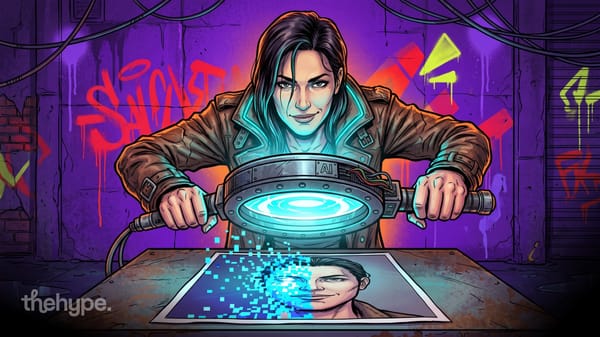
Pangram released Pangram Image 1.0 on Nov 4, a model that checks whether an image was made by AI. Pangram says it identifies 99.2% of AI-generated images while keeping a 0.27% false positive rate. A second model, Pangram Image Flash 1.0, does the same for video. The figures in the launch post on X do not appear in Pangram's blog, and the blog does not say which data produced them.
What Pangram announced
Pangram is best known for its AI text detector. Its co-founders, chief executive Max Spero and chief technology officer Bradley Emi, met as freshmen at Stanford. In a January 2025 study by researchers at the University of Maryland and Microsoft, Pangram's text detector was the only system that beat trained human experts at spotting AI writing, the company says.
The new image model is built into Pangram's Chrome extension, so users can check images and video on social feeds, shops and rental listings. The API now accepts both images and video, and the dashboard takes video uploads. For images, the model also draws a heatmap of the areas it thinks were generated.
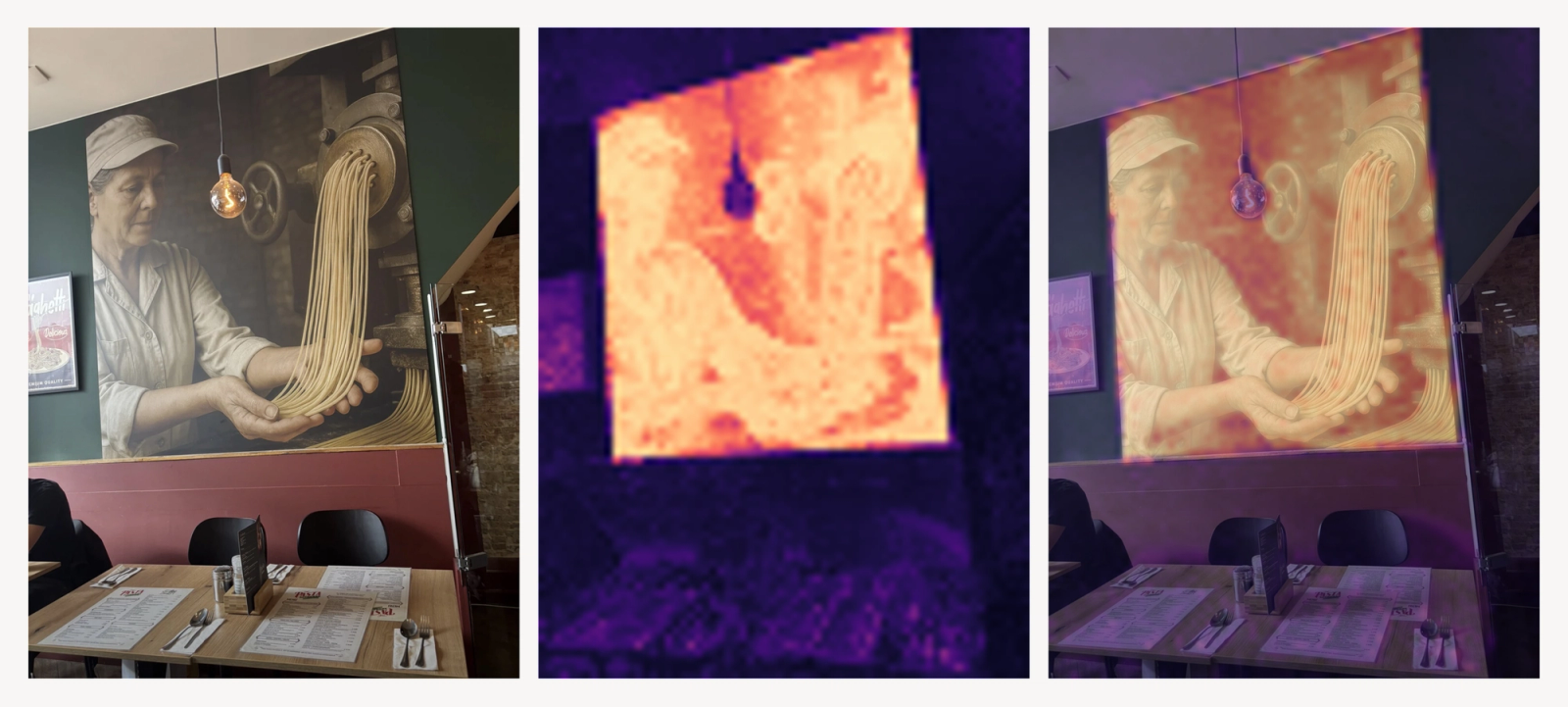
In Pangram's example, a real photo of a restaurant has an AI-generated mural on the wall. The heatmap lights up the mural and leaves the rest of the room dark. That helps with edited photos, where only part of the image is fake. The numbers behind the launch are harder to read.
What the numbers measure
The 99.2% figure is the share of AI-generated images the model flags. The 0.27% false positive rate is the share of real images it wrongly flags as AI, about one in 370. Both are Pangram's own results, and they come from the post on X.
The false positive rate matters most for a detector like this. A teacher, a marketplace or a newsroom that relies on it will mostly look at real photos, and every false flag accuses someone of faking one. The blog gives no false positive rate for Image 1.0 and does not name the set behind the 0.27%. It reports a different test.
Pangram's own test
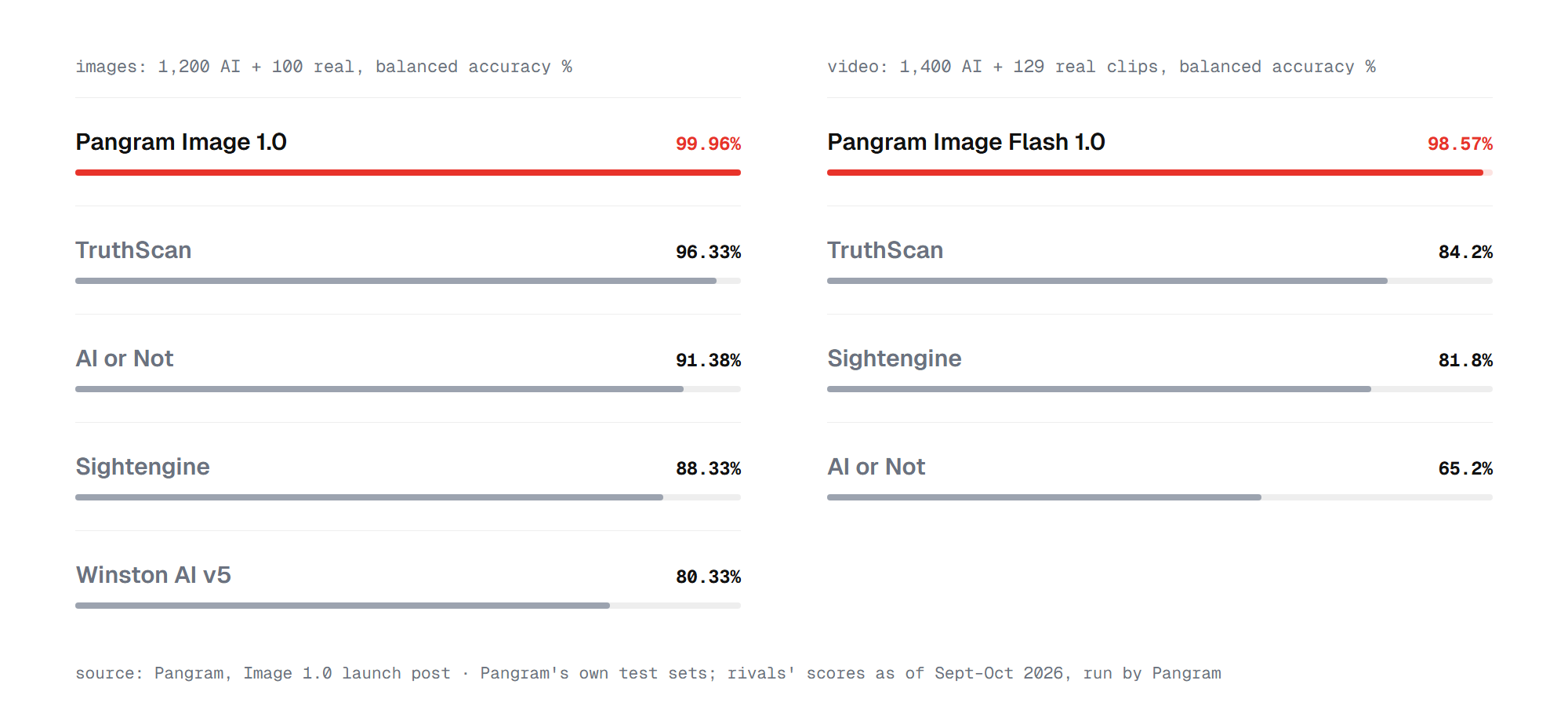
For the blog, Pangram took 100 real photos and made AI copies of each with 12 current image generators, among them GPT Image 2.5, Nano Banana 2.1, Midjourney 8.2, FLUX.3 and Seedream 5.0 Pro. That gives 1,200 AI images and 100 real ones. With metadata stripped, Image 1.0 scored 99.96% balanced accuracy, an average of its hit rates on AI and real images.
On the same set, Pangram reports TruthScan at 96.33%, AI or Not at 91.38%, Sightengine at 88.33% and Winston AI at 80.33%. Two academic detectors scored 63.00% and 52.79%. The rival scores are historical results from October 2026, and Pangram ran the comparison itself. With only 100 real photos in the set, a single wrong flag moves the false positive rate by a full point, so the test says more about catching AI images than about sparing real ones.
Video detection
Pangram Image Flash 1.0 checks video frame by frame. On 1,529 clips, 1,400 from 14 video generators such as Sora 2 Pro, Veo 3.1, Kling 3.0 and Seedance 2.5, plus 129 real ones, Pangram reports 98.57% balanced accuracy. TruthScan scored 84.2%, Sightengine 81.8% and AI or Not 65.2%, as of September 2026. On DF26, a public deepfake benchmark, Pangram says Flash scored 98.7%, 29 points ahead of the next detector.
Real videos are again a small part of the set, so the false positive side stays thin. Pangram also tested how the image model holds up when files are changed.
Compression and screenshots
Images online rarely stay in their original form. They get compressed, resized, screenshotted and re-uploaded, and those changes can erase the traces a detector looks for. Pangram shows one AI image run through ten such changes.
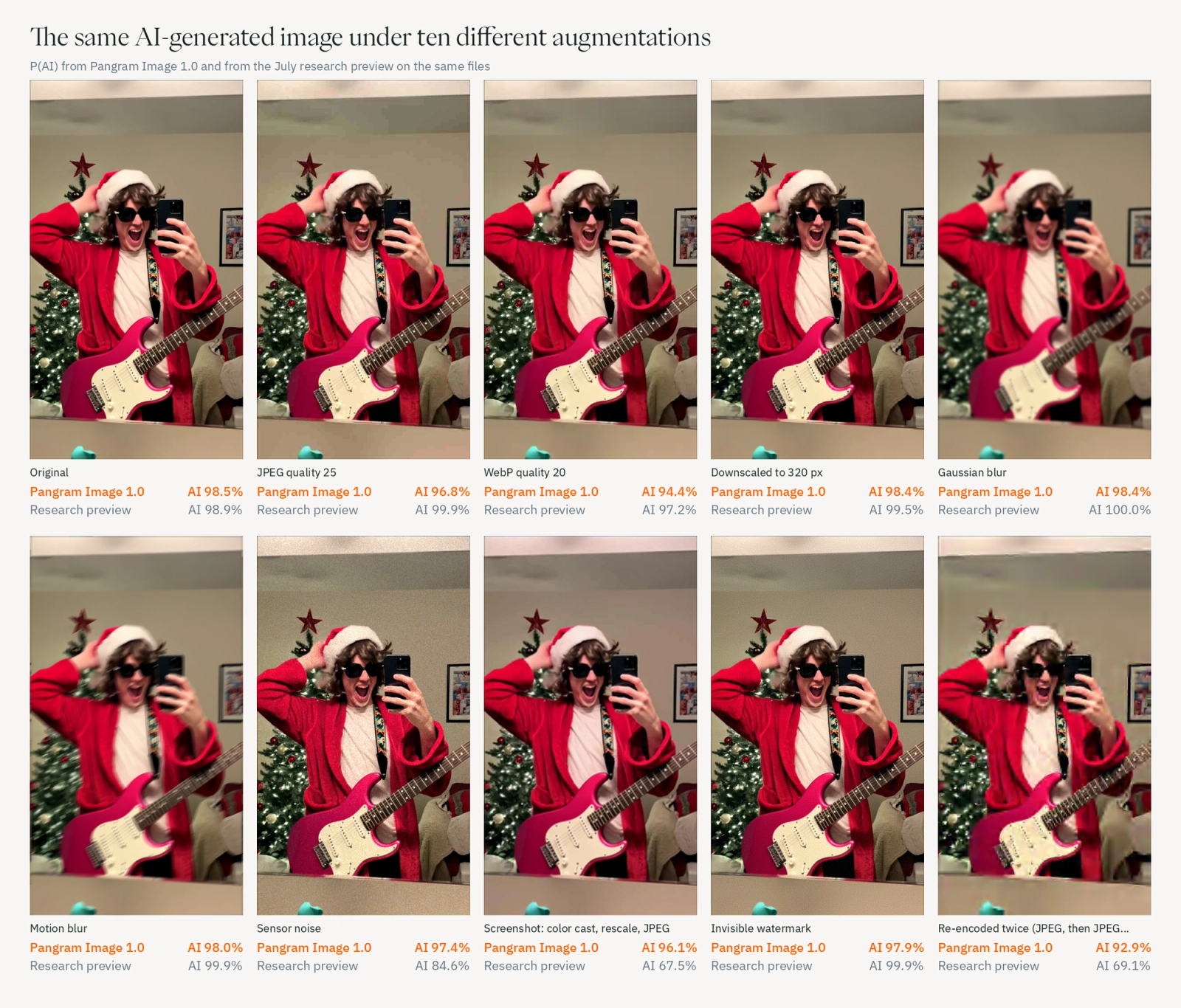
On the original, Image 1.0 gives a 98.5% chance of AI. After a screenshot with a color cast, rescaling and JPEG, it still gives 96.1%, where the July research preview dropped to 67.5%. After saving the file twice as JPEG, Image 1.0 gives 92.9% and the preview gave 69.1%. This is one image, so it shows the direction of the change rather than a rate. Pangram also lowered the smallest image it accepts to 256 by 256 pixels, with a warning below 512.
How it compares with the July preview
Pangram first showed image detection as a research preview on July 29. That model was built on Meta's DINOv3 vision backbone. On 10,000 real images from ReLAION, a set of pre-2022 internet photos, web graphics and CGI, it had a 0.16% false positive rate, about one in 625. On all 2,000 artworks from WikiArt, it made no false flags.
The July post also compared rivals on images from six generators. Pangram scored 100% accuracy with no false positives on clean images, against 99.13% for Sightengine with a 0.40% false positive rate. After resizing and heavy JPEG compression, Pangram's false positive rate rose to 0.40%. The preview's numbers come from a separate, earlier test, and Pangram does not say whether the new 0.27% uses ReLAION or another set.
What is still open
Every figure here comes from Pangram, on test sets it built or chose, with rival scores it ran itself. No independent benchmark of Image 1.0 was found. Pangram argues that watermarks such as Google's SynthID and C2PA metadata can be stripped easily, which is why it detects images by their content. Pricing for the new models is not in the launch post.
So can Pangram Image 1.0 tell a real photo from an AI one? On Pangram's tests, it catches nearly every AI image from current generators and holds up well after compression and screenshots, better than its July preview. The weak spot is the side that matters most for real people. The launch post's 0.27% false positive rate has no named test set, and the blog's own comparison has only 100 real photos. Until someone tests it on a large set of real images, treat a Pangram flag as a strong hint and check before accusing anyone.
Sources
- Pangram launch post on X, Pangram Image 1.0 – Nov 4
- Pangram blog: Introducing Pangram Image 1.0 – test sets, comparisons, robustness
- Pangram Image research preview, Pangram blog – July 29
- Unite.AI report on the launch, retelling Pangram's post
- Pangram on the University of Maryland and Microsoft text detection study – background