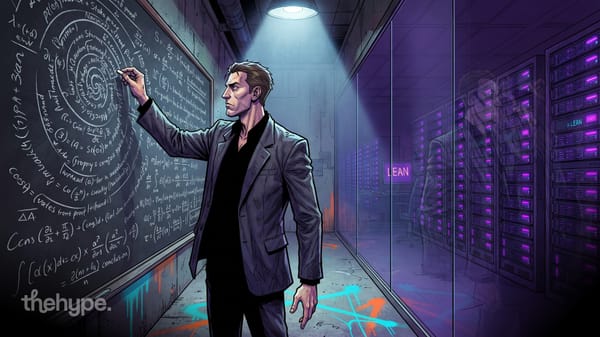
mathematician tristan buckmaster and his co-author levent alpöge, an anthropic employee, had been loading entire proof drafts into openai's codex for months while working on fluid dynamics problems closely related to navier-stokes. openai heard a rumor september 1 that someone was close. by september 5, ~10,000 agents running an unreleased model had produced a lean-verified navier-stokes proof – on a line of attack buckmaster says almost nobody else was using.
openai offered buckmaster co-authorship on their result – but only if he removed alpöge's name, because he works at anthropic. buckmaster refused. the head of openai's math team allegedly replied: "why would you ruin your career?"
from openai's blog: "we cannot rule out that de-identified data derived from their usage of our products helped improve our models."
as hacker news put it: "it would be extraordinarily easy to simply say 'this model was not trained on your work' – if that were the case."
the math itself may be sound – the lean proof formally verifies. but the question the builder community is now asking has nothing to do with fluid dynamics. it's about the structure: if you build something novel inside a lab's tools, and that lab hears a rumor about your progress, can they deploy 10,000 agents to reach the finish line before you?
one hacker news commenter from catastrophe risk modeling: this throws a giant ip question at every enterprise partnership built on these stacks. another: "a wake up call for anyone doing real novel work inside these models."
terence tao, widely considered the greatest living mathematician, warned that ai labs sprinting to solve open problems treat math as a non-renewable resource to be mined. the builder version: if your research lives inside a company's tools, and that company hears you're close to something valuable – what stops them?
openai solved navier-stokes for $22.5m – breakthrough may have been built on stolen drafts from their codex sessions
 Alina Fomine
1 min read
Alina Fomine
1 min read