 Felix Laurent
More information does not always make AI agents better at making deals. A new study from Stanford, the University of Maryland and All Purpose AI tested 10 frontier models in markets. Telling agents the exact values of the other side helped some models and badly hurt others. In one auction setup, Claude Opus 5.5 captured 94.6% of possible gains with partial information and 64.1% with full information.
The paper, "Who Should Know What? Empirical Information Design for Multi-Agent LLM Economies," appeared on arXiv on November 5, 2026. It drew wider attention after AI commentator Rohan Paul shared it on X on November 8. Its main lesson is practical: when AI agents negotiate for people, the model and what it is told have to be tested together.
How the study tested AI agents in markets
The researchers built three kinds of economic games with known payoffs, so every outcome could be scored exactly:
- trade, where two agents swap resources over up to eight messages;
- bargaining, where a buyer and a seller haggle over one good;
- double auctions, where three buyers and three sellers submit bids and asks at once.
Each model played against copies of itself. The only thing that changed was how much each agent learned about the other side's private values. At the lowest level, agents knew only their own values. A coarse level added rankings, such as which buyer valued the good most. Full disclosure revealed every exact value and cost.
The study covered 10 models from four labs. From OpenAI, it used GPT-5 mini, GPT-6 Luna, GPT-5.1 and GPT-6 Sol. The rest were Gemini 3.7 Flash, Gemini 3.1 Pro, Claude Sonnet 5, Claude Opus 5.5, Grok 4.3 and Grok 4.7. The team scored trade and auctions as the share of the maximum available gains that agents actually realized.
The intuitive expectation is that exact numbers should lead to better deals. The results show something messier.
When more information hurts LLM agents
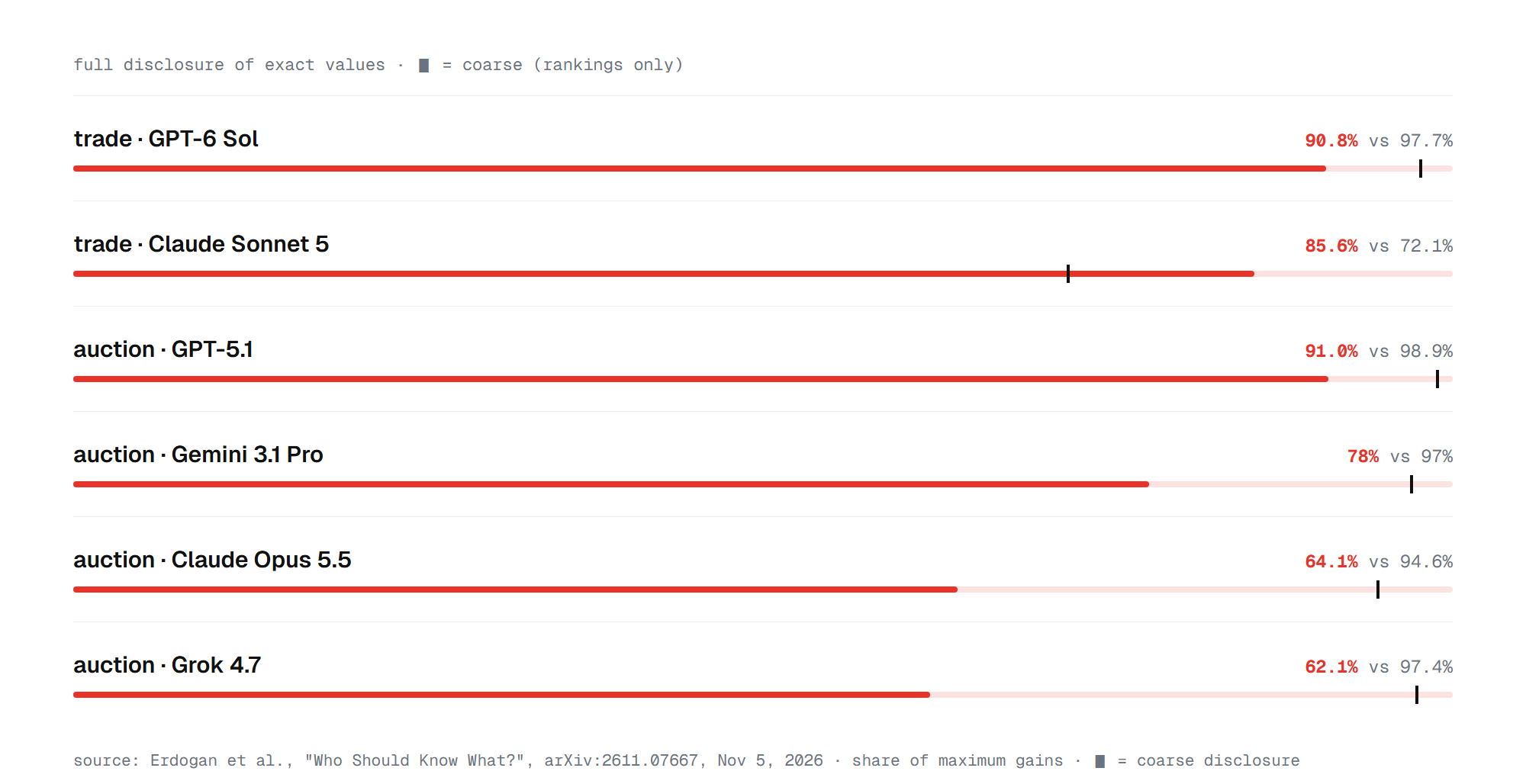
In trade, the effect depended on the model. Moving from coarse to full disclosure cut GPT-6 Sol's gains from 97.7% to 90.8%. GPT-5.1 fell from 97.2% to 88.4%. Claude Sonnet 5 went the other way, from 72.1% to 85.6%, and GPT-6 Luna rose from 68.9% to 79%.
Auctions showed the sharpest drops. Full disclosure lowered realized gains for nine of ten models. Grok 4.7 fell from 97.4% to 62.1%, Claude Opus 5.5 from 94.6% to 64.1% and Gemini 3.1 Pro from 97% to 78%. Gemini 3.7 Flash was the only exception.
Bargaining produced mixed results too. With six messages, GPT-6 Sol improved under full disclosure, from 0.71 to 0.83 on the paper's fairness score. Grok 4.7 collapsed from 0.71 to 0.17. It reached a deal every time, but the deals were badly lopsided.
The cause of these drops sits in how agents set their prices.
Why exact values make some models greedier
The models did not fail to spot good deals. In auctions, the best possible trades the agents could identify stayed above 99% for Opus 5.5 and Grok 4.7. They simply did not close them.
Once sellers knew exactly what buyers would pay, they asked for more above their cost. This happened with every model. Buyers also offered further below their value in every model except Gemini 3.7 Flash. The paper says the extra demands can "price them out of existence," so trades that should happen never do. Full disclosure reduced completed trades in wide-margin markets for nine models.
Trade showed the same pattern in counteroffers. With exact values, GPT-6 Sol made far more extractive offers in markets that favored the other side. Its measure of this behavior rose from 0.63 to 1.50.
In plain terms, some models treat extra knowledge as leverage. They push for a bigger share and lose the deal.
What this means for multi-agent systems
Agents that buy, sell and negotiate for people are moving from labs into products. The paper cites Anthropic's Project Deal, where Claude agents negotiated 186 deals worth more than $4,000 among about 70 participants. Microsoft's Magentic Marketplace simulated a whole market of buyer and seller agents in 2025.
In the authors' words, "model selection and information design must be co-optimized" for multi-agent systems. The rules about what each agent sees matter as much as which model runs it. One setup in the appendix supports this. With a neutral mediator agent, full information came close to optimal. In direct negotiation, coarse information tended to work better.
The study has limits. The games are simple and controlled, with known payoffs. Real agents face uncertain preferences, longer talks and messier markets. Results may change with different models, rules or prompts. The paper also does not claim a single best information policy.
Should AI agents get all the information
Not by default. The study shows that full disclosure helps some models and hurts others, sometimes by more than 30 points. A builder who picks a strong model and gives it every number may get worse deals than with partial data.
The practical advice is to test each model with the exact information it will see in production. Rankings instead of raw numbers can keep greedy models in check, while weaker negotiators may need the full picture. Before handing negotiation to an AI agent, teams should check how it behaves when it knows too much.
Sources
- Who Should Know What? Empirical Information Design for Multi-Agent LLM Economies, arXiv – November 5, 2026
- Rohan Paul on X – November 8, 2026
- Project Deal, Anthropic
- Magentic Marketplace, Microsoft Research, arXiv – 2025