 Nick Trenkler

a twitter user posted evidence of high correlation between claude fable 5 and chinese models – and deleted the post the day after
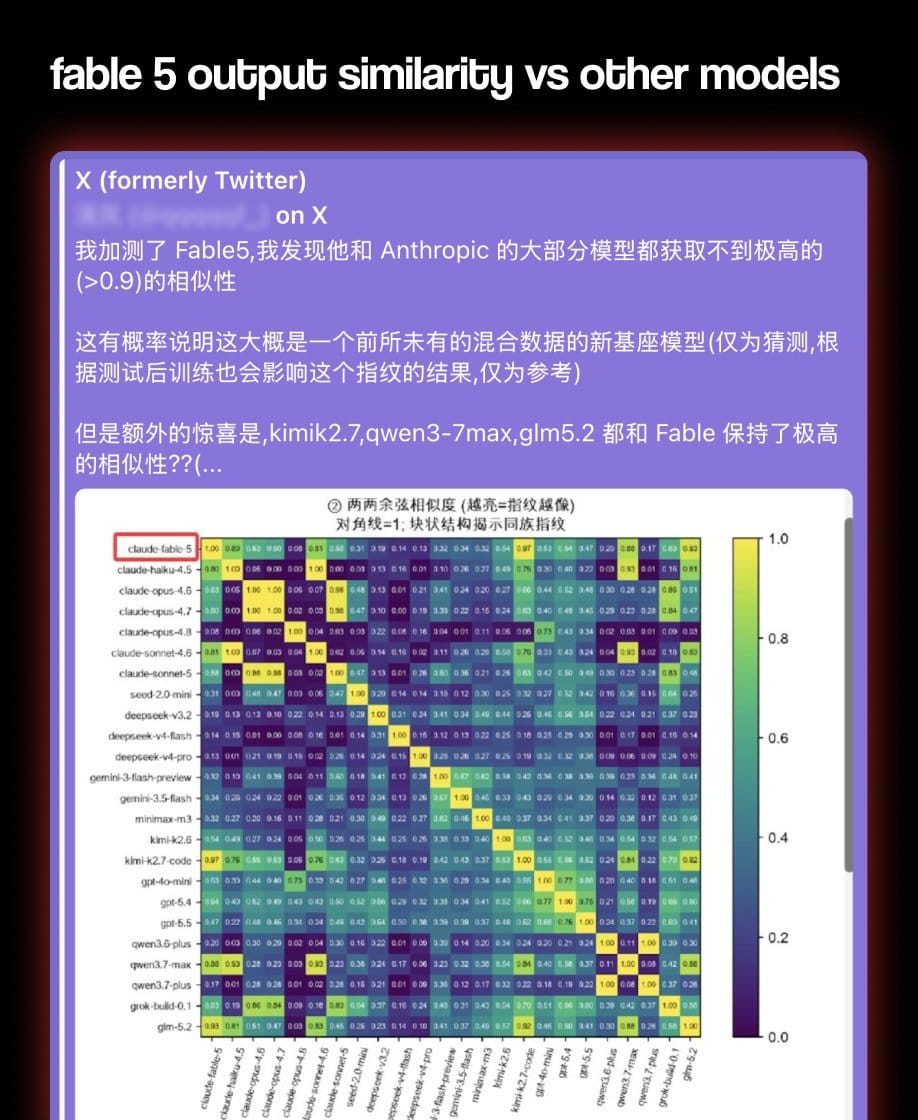
he ran a "model fingerprinting" test on claude fable 5. the method: probe a set of models, turn their output patterns into a vector, compute pairwise cosine similarity. the result is a heatmap where brighter = more similar fingerprint, and block structures indicate models that share a lineage or training data
fable 5 scored low against other anthropic models:
• claude-opus-4.8 – 0.08
• claude-opus-4.7 – 0.60
• claude-opus-4.6 – 0.63
• claude-sonnet-5 – 0.58
• claude-haiku-4.5 – 0.80
and high against three chinese models:
• kimi-k2.7-code – 0.97
• glm-5.2 – 0.93
• qwen3.7-max – 0.88
the day after, the author deleted the post, stating the method isn't his, that he ran it informally, and that the response – both from people treating it as fact and people disputing fingerprinting as a method – was affecting his image
possible explanations for the pattern:
- a shared upstream parent. fable and these models are all distillations of mythos preview. it's an interesting theory but nothing in the chart tests it directly
- method artifact. one person, unstated method, single run
whether or not the test holds up, the reaction is the real signal. it went viral fast and plenty of people took it seriously, and that tracks: distillation is routine now, so the idea of a closed model's fingerprint showing up downstream doesn't read as far-fetched to most people, even for a restricted release
the author deleted it anyway – but the fact that the theory landed this easily says something about how the field now assumes everything leaks into everything