 Nick Trenkler
release date, context window, a new reasoning mode, and the real reason for the delay – everything the gemini 3.5 pro leaks point to, plus what x users are already building with it. here's what's confirmed and what's rumored
what's rumored
- release around july 17. multiple accounts point to mid-july, though no date is official
So best guess is July 17th for Gemini 3.5 Pro. pic.twitter.com/BI1YgR4Apb
— David Hendrickson (@TeksEdge) July 4, 2026
- 2m token context window. this would be roughly 2x anthropic's current 1m ceiling (fable 5, sonnet 5, opus 4.8), and among the largest of any major frontier model
Google Gemini 3.5 Pro will launch with a massive 2 Million token context window by far the largest among major frontier models...
— Astro Polo (@astropol0) July 4, 2026
Anthropic's latest models (Fable 5, Sonnet 5, and Opus 4.8) support only up to 1 million tokens, making Gemini's rumored context window roughly 2×… pic.twitter.com/JWaDgUVBYt
- a new "deep think" reasoning mode aimed at logic and math
Gemini 3.5 Pro could be Google’s biggest AI release yet.
— Julian Goldie SEO (@JulianGoldieSEO) June 27, 2026
But most of what we know is still based on leaks and early signals.
Here’s what could make it different:
→ A reported 2M-token context window
→ Deep Think mode for complex reasoning
→ Stronger coding and multi-step… pic.twitter.com/SdDDEoXDcF
- stronger autonomous agent support for multi-step tasks
- a fresh base model. one leaker claims google scrapped the old base and started over
- mixed verdicts on where it lands. some leaks claim stronger zero-shot performance than claude fable 5 in private eval rings. others claim the opposite – that even with a new base it still won't beat fable 5 or gpt 5.6 on the hardest agentic and long-horizon work
what we know
the facts, mostly traced back to a business insider report and google's own i/o comments:
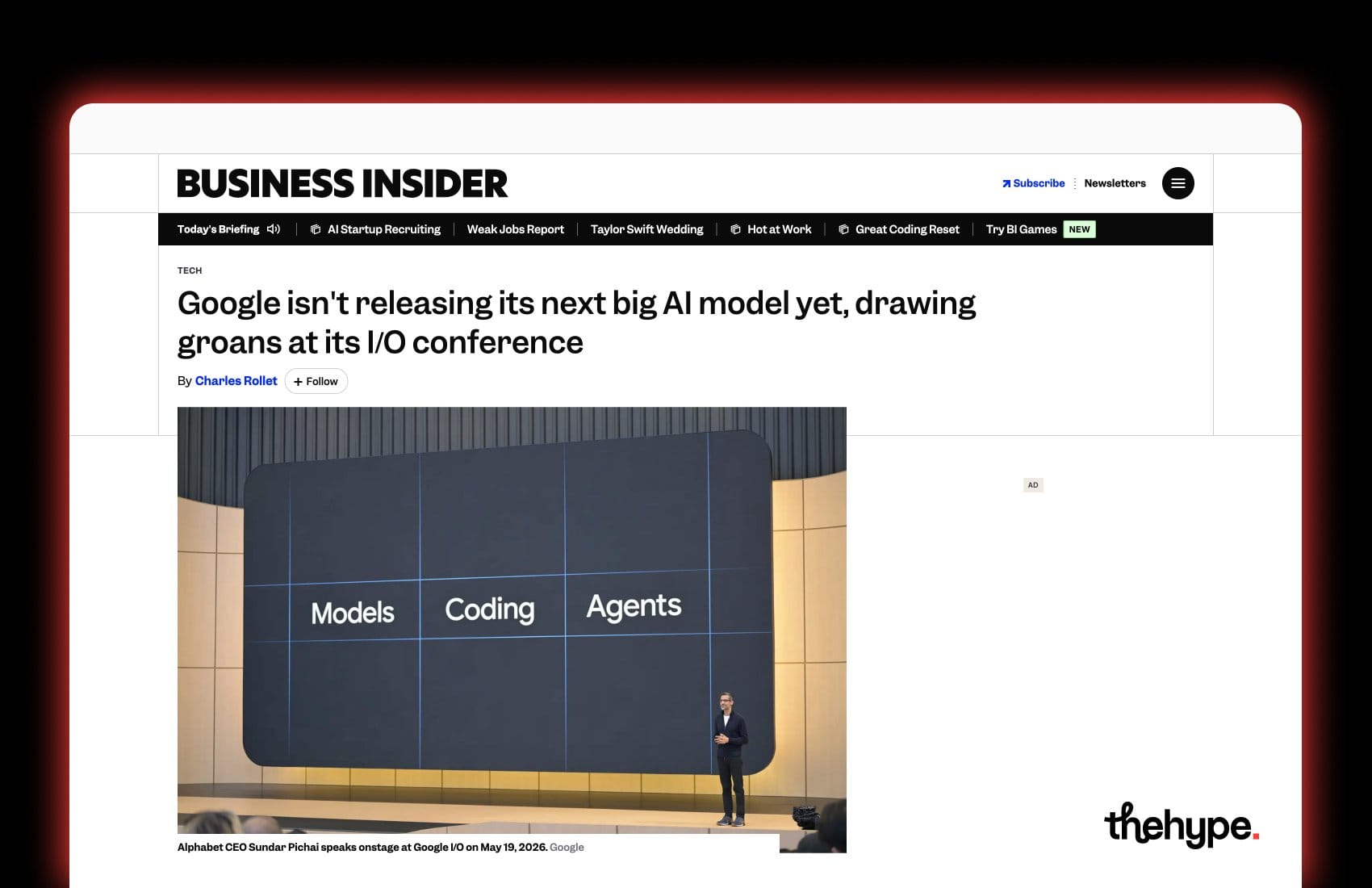
- it slipped from june to july. google previewed the model at i/o in may 2026, where sundar pichai said it would arrive "next month." the june window closed with no public launch
- the delay is about feedback, not a rewrite of the story. per business insider, google pushed the date back to gather more real-world use cases from early testers and keep tuning the model
- it's already in limited hands. early access exists through a vertex ai enterprise preview, google's antigravity platform, and the benchmarking site lmarena. broad public access hasn't opened
- it's aimed at long-horizon and agentic work. the model is positioned around long-context reasoning and running autonomous agents, not just faster chat
- flash 3.5 feedback got folded in. google reportedly took criticism that the earlier flash model burned through tokens too quickly and worked on token efficiency for the pro tier
- google is staying quiet. a spokesperson declined to comment on the schedule, and there are no official evals or benchmark numbers yet
what people are generating
the bulk of the public testing comes from two accounts, harshith (@harshithlucky3) and @ggg78g89, both running single-shot generation prompts and posting the outputs. worth noting: the model tags carry asterisks even from the testers themselves, since the arena checkpoints are stealth and nobody can confirm which model actually produced what. with that caveat, here's what they're buildingthree.js / 3d scenes – the model's most-shared category is fully working 3d scenes in a single html file:
- a futuristic maglev bullet train speeding through a transparent glass vacuum tube (posted as a head-to-head against fable 5 xhigh)
Gemini 3.5 Pro* vs Claude Fable 5 xhigh 🔥🔥
— Harshith (@HarshithLucky3) July 5, 2026
> A futuristic Maglev bullet train speeding through a transparent glass like vacuum tube using three js https://t.co/P3yOeqRprw pic.twitter.com/RumFr2EjMR
- a voxelized human heart that animates the voxels to expand and contract like a real heartbeat (run against a "3.6 or 4 flash" checkpoint)
Gemini 3.5 Pro vs Gemini 3.6 or 4 flash 🔥
— Harshith (@HarshithLucky3) July 4, 2026
> voxelized human heart where it actually animates the voxels to expand and contract like a heartbeat using three js
next, i want to test their frontend capabilities https://t.co/XWOD5xZQZs pic.twitter.com/6epTywPuYp
- a floating steampunk island
Gemini 3.5 Pro 🔥🔥
— Harshith (@HarshithLucky3) July 3, 2026
> Floating Steampunk Island using three js
i will share Gemini 3.6 or 4 flash output soon... https://t.co/sHEgmKLrmr pic.twitter.com/FwagxPdpfr
- a cinematic moon scene – astronaut, earthrise on the horizon, dusty footprints, a planted flag, harsh sunlight, black-space mood – built as one working html file
Three.js output from Gemini 3.5 Pro 🔥
— QASIM-livelifewithai (@ggg78g89) July 4, 2026
>A cinematic Moon scene with an astronaut, Earthrise on the horizon, dusty footprints, a planted flag, brutal sunlight, and pitch-black space mood.
Built in a single working HTML.
Google is locked in and ready to prove the doubters wrong. pic.twitter.com/gWM4H9IKB1
- an animated american flag where stars appear one by one to mark states joining the union over time, posted as a july 4th / 250th tribute
A Three.js tribute from Gemini 3.5 Pro 🔥
— QASIM-livelifewithai (@ggg78g89) July 5, 2026
Happy 250th, and God bless America 🇺🇸
A dynamic American flag with animated stars, each appearing over time to represent states joining the Union through the years.
Not just a demo. It felt like a living timeline.
Gemini is cooking pic.twitter.com/tnQrsKrzML
inline svg, technical precision – the community's benchmark is single-prompt svg, and the "precision" prompts are meant to stress geometry and detail:
- a minimal isometric card swiping machine (the original viral arena prompt)
Google is cooking 🔥
— Harshith (@HarshithLucky3) July 2, 2026
Gemini 3.5 Flash High vs Gemini 3.6 or 4 Flash* vs Gemini 3.5 Pro* vs Claude Fable 5 High
two new Gemini models testing in Arena under the name 3.1 pro, 3.5 flash and 3 flash
> SVG of minimal isometric card swiping machine https://t.co/6E1PGz4XOg pic.twitter.com/FTzCEdL5Lm
- a bmw m4 cs side view (from an early "3.6 / 4 flash" checkpoint test)
Gemini 4 flash or Gemini 3.6 flash first test
— Harshith (@HarshithLucky3) July 1, 2026
> SVG of BMW M4 CS side view 🔥🔥 https://t.co/7sXx1APfh6 pic.twitter.com/gUOTy7f7DQ
- an analog wristwatch reading 10:08:42, with a date window on 5, full 60-minute tick marks, metallic gradients and no text labels – the poster claimed this one edged out fable 5
Holy shit. Gemini 3.5 Pro🔥🔥
— QASIM-livelifewithai (@ggg78g89) July 5, 2026
>Just look at this SVG. It accurately made an analog wristwatch showing 10:08:42, a date window set to 5, full 60-minute tick marks, metallic gradients, and no text labels.
It’s beating Fable 5.
Gemini team, I can’t explain how happy this makes me pic.twitter.com/bTbjolpgIY
inline svg, narrative vignettes – a second flavor of svg prompt tests emotional and compositional range rather than mechanical accuracy:
- a stray dog and a street kid sharing a bun under a tiny shop awning in the rain, their shadows merging into one (posted next to a gemini 3.1 pro output for comparison)
Gemini 3.5 Pro🔥🔥🔥
— QASIM-livelifewithai (@ggg78g89) July 4, 2026
Mind-blowing result from this SVG prompt: a stray dog and a street kid sharing a bun under one tiny shop awning in the rain, their shadows merging into one.
Left: Gemini 3.5 Pro. Right: Gemini 3.1 Pro.
This model is a beast. pic.twitter.com/SUe7qLXUL5
- a mother quietly fixing her child's school uniform before sunrise, polished shoes waiting by the door
Gemini 3.5 Pro is going crazy 🔥🤯
— QASIM-livelifewithai (@ggg78g89) July 4, 2026
What a beautiful output. A mother quietly fixing her child’s school uniform before sunrise, with the polished shoes waiting by the door.
The emotion and creativity here are insane.
Google is going to amaze everyone.
DeepMind is cooking hard. pic.twitter.com/dgZiH117eY
- a tense scene of a mouse stealing cheese from a mousetrap while a cat sleeps nearby, lit by moonlight (posted as the model "mogging" fable 5 and glm-5.2)
Gemini 3.5 Pro is mogging Fable 5 and GLM-5.2 🥹
— QASIM-livelifewithai (@ggg78g89) July 4, 2026
I gave it a tense SVG scene of a mouse stealing cheese from a mousetrap while a cat slept nearby, with moonlight and visible tension, and it absolutely cooked.
Google is about to surprise every hater in the next few days. pic.twitter.com/jpWbLfHogk
functional apps and games – a few testers pushed past static scenes into interactive builds:
- a web-based, playable 3d subway-surfers-style game generated as roughly 800 lines of html – a city with streets, crossings, houses, moving cars, pedestrians, working traffic lights, skyscrapers and shops, with the model noting up front it would deliver a low-to-mid-poly prototype
Gemini 3.5 Pro 🔥🔥
— Harshith (@HarshithLucky3) July 2, 2026
~800 lines of HTML code
It already mentioned that it will provide low-poly/mid-poly prototype
Prompt:
provide me an HTML code of a web-based and functional 3D Subway Surfing game clone through a City with streets and crossings, as well as houses, Cars,… https://t.co/MNKnMS3ky8 pic.twitter.com/Qo8Fxgiej2
almost everything being generated is visual and single-shot – three.js worlds and svg scenes that either show off geometric precision or emotional composition. that's consistent with the "frontend mogging" reputation forming around the model, and it's also why the picture stays incomplete. these prompts test spatial and graphical reasoning, not the long-horizon agentic and debugging work that the other set of leaks says the model is weaker at
conclusion
even through the noise, the early outputs show a model that's clearly capable and competitive with the current frontier. and if the 2m token context window holds up, that alone could push it into the lead – twice the room of anything anthropic ships today, on a model already looking strong on frontend and visual reasoning. for now it's still leaks and stealth checkpoints. we'll wait for the release and test it ourselves