
 Felix Laurent

On October 29, 2026, attackers took about $6.34 billion in crypto from Binance's hot wallets in under four hours. On November 3, the exchange published its first report on the hack. It shows that the path to its wallets ran through AI tools.
One engineer downloaded a tampered installer while looking for a popular AI coding tool. Months later, the attackers used an internal Binance AI tool as a springboard to take over the engineers who ran wallet infrastructure. The FBI says North Korea was behind it.
What happened on October 29
The attackers got access to an internal wallet signing service. With it, they signed transactions outside Binance's normal withdrawal process.
Between 20:05 and 20:09 UTC, five Binance hot wallets sent 233.46 million XRP to an address the attackers controlled. Wallets on Solana and Optimism followed, with about 970,500 SOL and 44.2 million OP. Then a hot wallet sent 18,270 BTC, worth about $1.47 billion.
The biggest single blow came on Ethereum. At 20:24 UTC, one call emptied the wallet labeled "Binance 14" of about $2.53 billion in ETH and USDT, according to security firm Hypernative. The last unauthorized transfer, 2,961.9 ETH, settled at 23:56 UTC.
Stablecoin issuers moved fast. Tether froze more than 1.5 billion USDT within an hour, and Circle, Ripple and others followed. In total, about $2.85 billion was frozen or intercepted, CEO Richard Teng said.
Binance has absorbed the loss instead of users. By October 31, it said, 98% of the affected tokens had been replaced. Freezing assets did not end the attack, though, because of an Ethereum feature the attackers turned against the exchange.
How EIP-7702 kept the drain going
EIP-7702 arrived with Ethereum's Pectra upgrade in May 2025. It lets a regular account delegate execution rights to a smart contract without handing over its private key.
The attackers used the signing service to submit 50 authorizations in a single transaction. One of them gave an attacker-controlled contract partial control of the Binance 14 hot wallet. From then on, the contract could move funds without going through Binance's systems at all.
That is why pausing withdrawals did not stop the outflows. "The malicious EIP-7702 authorizations existed on-chain and operated independently" of Binance's withdrawal infrastructure, the report says.
Revoking the delegation was also slow. The wallet used multi-party computation, so there was no single private key that could cancel it quickly. Binance had to build a special procedure and only cleared the delegation at 00:10 UTC on October 30.
Since Pectra, EIP-7702 has mostly been abused by scammers draining individual wallets. Wintermute found in mid-2025 that most delegations pointed to copy-paste "sweeper" contracts. Binance is by far the largest victim yet. The more troubling part of the report, however, is how the attackers reached the signing service in the first place.
How the attack started with an AI coding tool
Binance describes a multi-stage campaign that began months earlier.
In June 2026, a Wallet DevOps engineer searched for a popular AI coding tool and downloaded a tampered Homebrew installation. Binance's security team caught the anomaly, replaced the device and rotated the credentials. But the attackers now knew who worked on Binance's wallet infrastructure.
In September, a second engineer was approached on a legitimate job platform by someone posing as a project director. A fake HR interview over video came first, then a "CEO" interview in a chat app. At the end, the engineer was asked to download a coding assignment onto his work computer.
The repository ran malicious code during setup. It quietly replaced pyenv, a common Python tool, with a malicious version that connected to the attackers' server. Endpoint security did not detect it.
On October 20, the attackers used that computer and "an internal AI tool" to gain control over two wallet engineers, Binance writes. One of them had a container deployment token on his computer. On October 29, the attackers logged into another engineer's machine, deployed a container with the stolen credentials and launched the attack.
Binance has not named the AI coding tool or the internal AI tool. It also has not explained how the internal tool gave access to other engineers' machines, as the security firm SafeDep pointed out. What the report does make clear is who the attackers were.
Who is behind the Binance hack
On October 31, the FBI blamed North Korea for "the theft of more than $6 billion USD in virtual assets" from Binance. It named the group TraderTraitor, which US agencies link to the Lazarus Group.
Blockchain analytics firm TRM Labs had already attributed the hack to TraderTraitor "with high confidence" on October 30. On November 3, Kim Yo Jong, the sister of North Korea's leader, called the investigation a "grave political provocation."
The tactics match past North Korean operations. Fake recruiters with malicious coding assignments have been tracked as the Contagious Interview campaign since 2023. Binance says it blocked 57 suspected North Korea-linked attacks in 2026 alone, from fake job interviews to malware disguised as developer tools.
Those 57 blocked attempts did not stop the one that worked, and its size has no precedent.
How it compares with Bybit and other crypto hacks
Before October, the largest crypto theft was Bybit's in February 2025. North Korean hackers took about $1.46 billion there after compromising a developer's laptop at wallet provider Safe{Wallet}.
The Binance hack is more than four times larger. In the words of Elliptic, it is "almost certainly the largest single theft of any kind in history" so far. Estimates vary by firm: Binance says $6.34 billion, TRM $6.36 billion and Elliptic $6.43 billion.
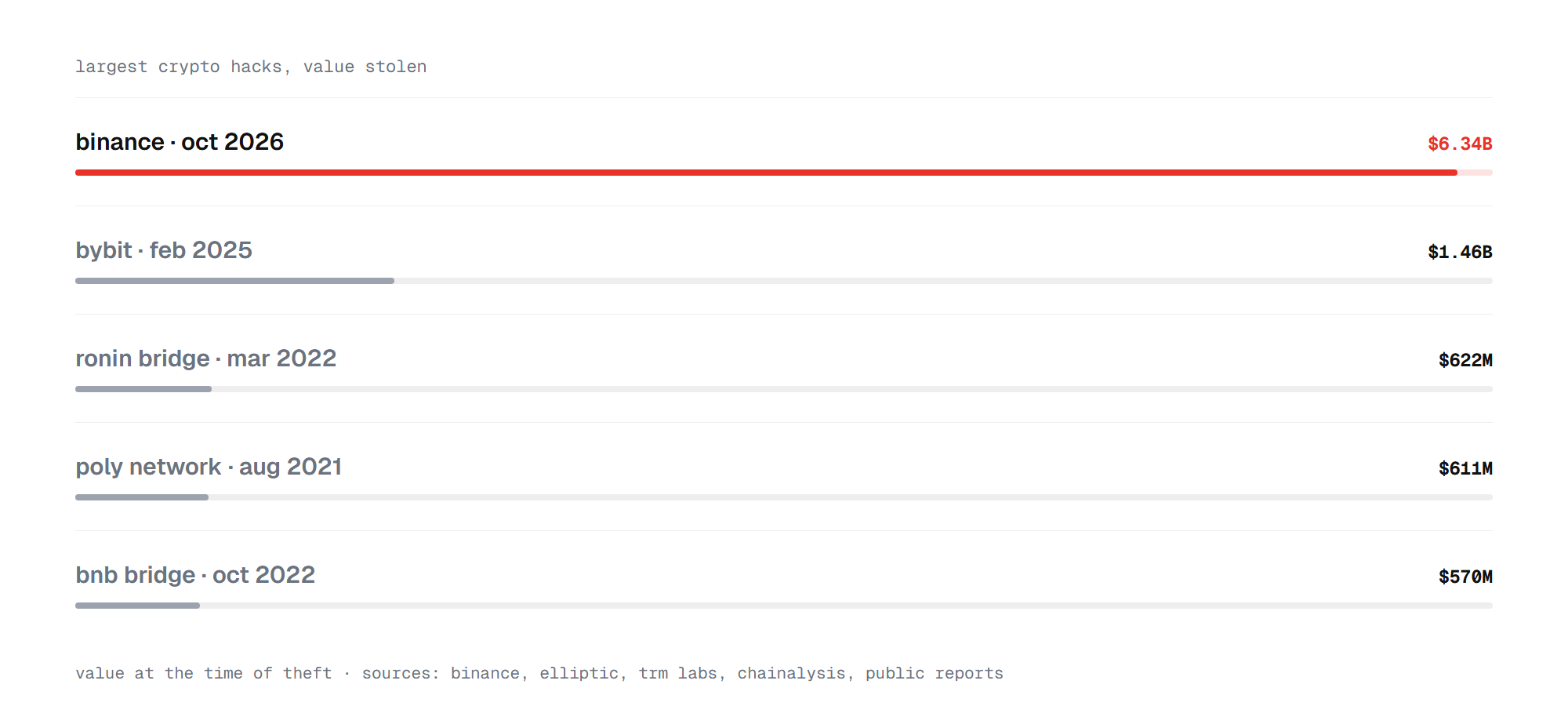
North Korea's crypto theft keeps growing. Chainalysis counted at least $2.02 billion stolen by North Korean hackers in 2025. TRM estimates about $7.4 billion in 2026 so far, or 85% of the value of all crypto hacks this year.
Bybit and Binance share a pattern. In both cases, the attackers did not break the cryptography. They went after the people and the developer tools around the wallets, and AI tools have become part of that surface.
AI tools are a new way in
Attackers have been using AI coding tools as bait for at least two years. In early 2025, a Google ad that showed Homebrew's address led to a fake site that installed the AMOS stealer on Macs. In 2026, similar ads for fake Claude Code installers pushed AMOS and MacSync malware.
AI tools that run on developers' machines have also been turned into weapons. In August 2025, the Nx supply chain attack used AI command-line tools installed on victims' computers to search for secrets. In February 2026, a prompt hidden in a GitHub issue led to a stolen npm token and a malicious release of the Cline coding agent.
Binance's report adds a new case: an internal company AI tool used to move from one compromised engineer to others. The exchange has not said whether the tool was tricked by prompt injection or simply had too many permissions.
What Binance changed after the hack
Binance says it rebuilt the affected wallet system in a new environment, along with the internal AI tool and its access controls. It replaced affected devices, revoked related credentials and tokens, and scanned all employee devices.
The exchange is also bringing in independent security firms to review the incident. It plans to spend more on AI-based detection and endpoint protection. It is working on a security research fund with "leading AI companies" focused on AI security in blockchain environments.
Users reacted with caution. When withdrawals reopened on November 1, customers took out $4.65 billion and deposited $1.01 billion within about nine hours, CNBC reported. That net outflow was about 2.1% of Binance's $171 billion in assets.
What the Binance hack means for AI tools at work
The Binance hack shows that AI tools are now part of the attack path, not just the defense. A search for an AI coding tool exposed the wallet team, and an internal AI tool helped the attackers reach the engineers who mattered.
The fixes are not new. Verify where installers come from, keep work machines away from strangers' "assignments" and give AI tools only the access they need. EIP-7702 adds a crypto-specific lesson. On-chain permissions can outlive a withdrawal freeze. Binance had the money to cover $6.34 billion. Most companies would not, which makes its report required reading for anyone running AI tools with access to production systems.
Sources
- 29 October Binance Security Incident: Initial Findings and Response Update, Binance – November 3, 2026
- North Korea steals $6.36 billion from Binance in the largest hack in history, TRM Labs – October 30, 2026
- Inside the largest crypto theft of all time, Hypernative – October 30, 2026
- FBI blames North Korea for $6.3 billion Binance crypto hack, Euronews – November 1, 2026
- Binance hack: the largest in history, Elliptic – October 30, 2026
- Binance outflows after the hack, CNBC – November 2, 2026