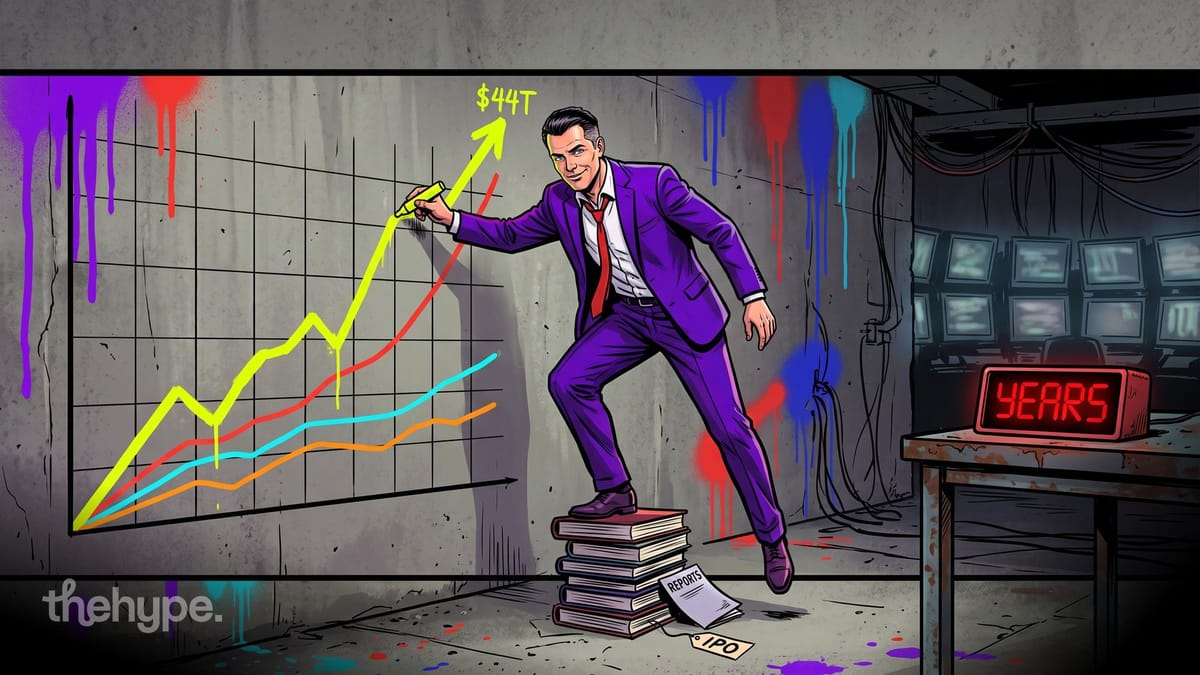
anthropic co-founder jack clark spoke at the imf and world bank annual meetings in bangkok. he said ai could lift us economic output to $44t by 2030, reuters reported. that is almost 50% above today's level of just over $30t. it is the most extreme of three scenarios in anthropic's econ scenario explorer. the company says the tool is not a forecast and assigns no probabilities.
what clark said
clark, anthropic's head of public benefit, presented the figure in a lecture to hundreds of government and finance officials. he called it "very outlandish" himself and tied it to two conditions. the technology has to keep improving. new industries and inventions have to appear to power that much growth. his case for the upside is science – ai as a force multiplier for research in math, engineering and biology, including drug discovery.
what anthropic has published
the econ scenario explorer (v1.0, september 2026) models the us economy as bundles of tasks that ai can augment, automate or create. it gives three paths for 2030, in 2025 prices:
| scenario | what it assumes | 2030 us gdp |
|---|---|---|
| without ai | the economy grows at its normal pace, with no ai effect | ~$33.5t |
| modest | ai's impact resembles the internet's: real, gradual | $34.1t (+1.6%) |
| substantial | ai can do about half of knowledge work by 2030, mostly on its own | $36.3t (+8.3%) |
| extreme | ai beats humans at most knowledge tasks, does them autonomously and creates almost no new ones | $44.4t (+32.4%) |
in the extreme case, us growth speeds up to about 15% a year by 2030. at that pace the economy doubles roughly every 4.5 years. anthropic says this path likely requires ai that improves itself and very fast adoption.
why the news says both 50% and 32%
the two numbers measure different things. "almost 50%" compares $44t with today's gdp of just over $30t. the model's own figures compare each scenario with the same economy in 2030 without ai. that baseline already includes four years of normal growth. against it, ai adds 1.6% in the modest case, 8.3% in the substantial one and 32.4% in the extreme one.
what the model leaves out
anthropic calls the model a stark simplification and a work in progress. it excludes policy responses, business cycles, financial disruptions, demand from data center construction, catastrophic risks and highly capable robots.
the labor side moves with the gdp line. in the substantial scenario, knowledge-worker wages stay roughly flat and labor's share of income falls. in the extreme one, knowledge-worker wages fall by more than 10% and unemployment could exceed typical recession levels.
the rest of the lecture
most of the lecture was about risk. clark said there is growing evidence that ai development may outpace human control, though humans are still in control today. the window for safeguards, in his estimate, is now a small number of years. he singled out biology as the field that needs the strictest human oversight. ai has already been used there to create new viruses. he also called for international rules for the technology and said ai is already cutting jobs in call centers and customer service.
what is still missing
anthropic has not said how likely each scenario is, and no independent estimate of the extreme path has been published. the figure was presented a month before anthropic's ipo, which reuters reports is expected in november at a valuation of up to $2t.