
 Nick Trenkler
by mid-2026, many assumptions of the first wave of genai have almost collapsed. the structural bottleneck in ai development is no longer model intelligence, nor is it raw context window size; it’s execution reliability. the industry is rapidly transitioning from passive chatbots to autonomous, multi-agent systems that can navigate software, manipulate databases, query legacy enterprise systems, and much, much more.
in this new paradigm, the critical friction is interoperability. ai models lack a standardized runtime environment to interact safely and predictably with the digital world. the solution that has captured the developer ecosystem over the last year is the model context protocol (mcp), an open-source standard originally introduced by anthropic in late 2024 and transitioned to a linux foundation governance model under the agentic ai foundation (aaif) in late 2025.
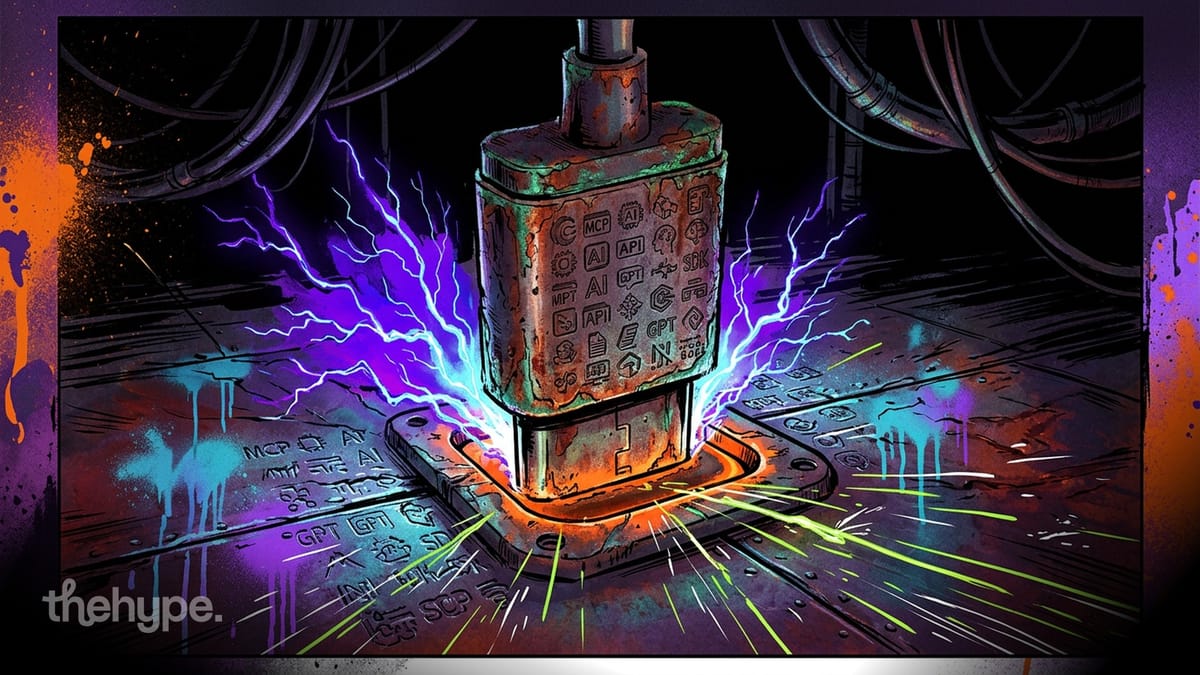
if llms are the central processing units of the agentic era, mcp is fast becoming its usb-c port: a unified protocol that allows any client application or frontier model to interact with any arbitrary data source or tool configuration via a standardized interface. yet, while the core protocol simplifies connectivity, running production-grade autonomous systems at enterprise scale creates severe structural challenges. it introduces massive token overhead, unmanaged security vectors, stateless tracking, and severe risks to runtime governance.
MCP is becoming the USB-C of AI agents. Every serious agent now speaks it.
— DePHY (@dephynetwork) May 28, 2026
The unsolved part isn't the protocol — it's who runs the servers. Self-hosting eats compute; unknown servers are a security liability.
That's what DePHY Service Mesh handles: hosted MCP servers, one… https://t.co/XoGxMjV6hI
from this new paradigm, a new breed of specialized infrastructure startups has emerged to solve the most pressing issues. moving beneath the noise of consumer-facing applications, these infrastructure players are here capturing the deepest, most defensible moats in the agentic ai landscape.
2026 mcp momentum by the numbers
before we look at these startups, let’s understand why the mcp infrastructure shift is sudden and massive, and look at the underlying adoption metrics tracking the protocol's expansion:
- monthly mcp sdk downloads across python and typescript have surged to over 97 million by march 2026.
- over 10,000 active mcp servers are running in production environments globally, connecting to over 500 ai clients, including claude, chatgpt, cursor, and vs code.
- in an ecosystem study analyzed by infoworld, 63% of early adopters rely on mcp servers explicitly to access underlying corporate data sources, documentation, or internal knowledge bases.
- exactly 50% of software engineers building mcp infrastructure cited security and access control complexity as their single greatest development challenge, while 38% noted that security concerns were actively blocking broader corporate adoption.
- a highly alarming metric from the same zuplo report highlights that 24% of active mcp servers currently operate with absolutely no authentication mechanism configured, exposing local systems to severe structural vulnerabilities.
taming the chaos of production-grade mcp
when developers move mcp architectures out of local development environments and into cloud-native enterprise production, they hit a wall. mcp requires secure, low-latency communication over protocols like server-sent events (sse). however, managing dozens of decentralized mcp servers across an organization means managing a chaotic web of api keys, scattered webhook connections, and insecure tool access.
Less than 1% of software on the internet has a CLI or MCP for AI agents to use.
— Matt Schlicht (@MattPRD) May 17, 2026
This is a big opportunity for new startups to leverage.
Be the first in your category to offer a CLI/MCP based product for AI agents to use and you will have exclusive access to the fastest growing… https://t.co/k6ZWsoVZFD
in 2026, the developer ecosystem is dealing with tool sprawl. an autonomous agent tasked with auditing financial records might need access to google drive, salesforce, quickbooks, and internal postgres instances simultaneously. if every single connection is managed ad hoc, token costs skyrocket, latency degrades the user experience, and compliance becomes impossible. that’s where mintmcp steps up, acting as a centralized, production-ready enterprise gateway that consolidates these scattered integrations into a single managed control plane. with data from the zuplo report showing that 24% of infrastructure runs completely unauthenticated, mintmcp provides the mandatory authentication, rate limiting, and governance boundaries needed to survive corporate security reviews.
today, the company is positioning itself to be the definitive orchestration middleware for agentic tool access. however, there are some open questions still left. as large hyperscalers like aws build out native context routing capabilities, such as the asynchronous design patterns seen in bedrock agentcore, mintmcp must maintain its neutral, multi-cloud advantage and outpace platform-native tools in raw performance and integration speed.
weaponizing go for ai speed
in complex multi-agent workflows, a single human objective triggers an iterative loop of multiple llm calls and cascading tool executions. python-based agent gateways introduce hundreds of milliseconds of latency at every single hop. furthermore, loading massive tool definitions directly into an agent's context window upfront blows through token budgets and degrades reasoning efficiency. bifrost solves this latency and token bloating problem by functioning as a high-performance gateway for both llm routing and mcp tool execution.
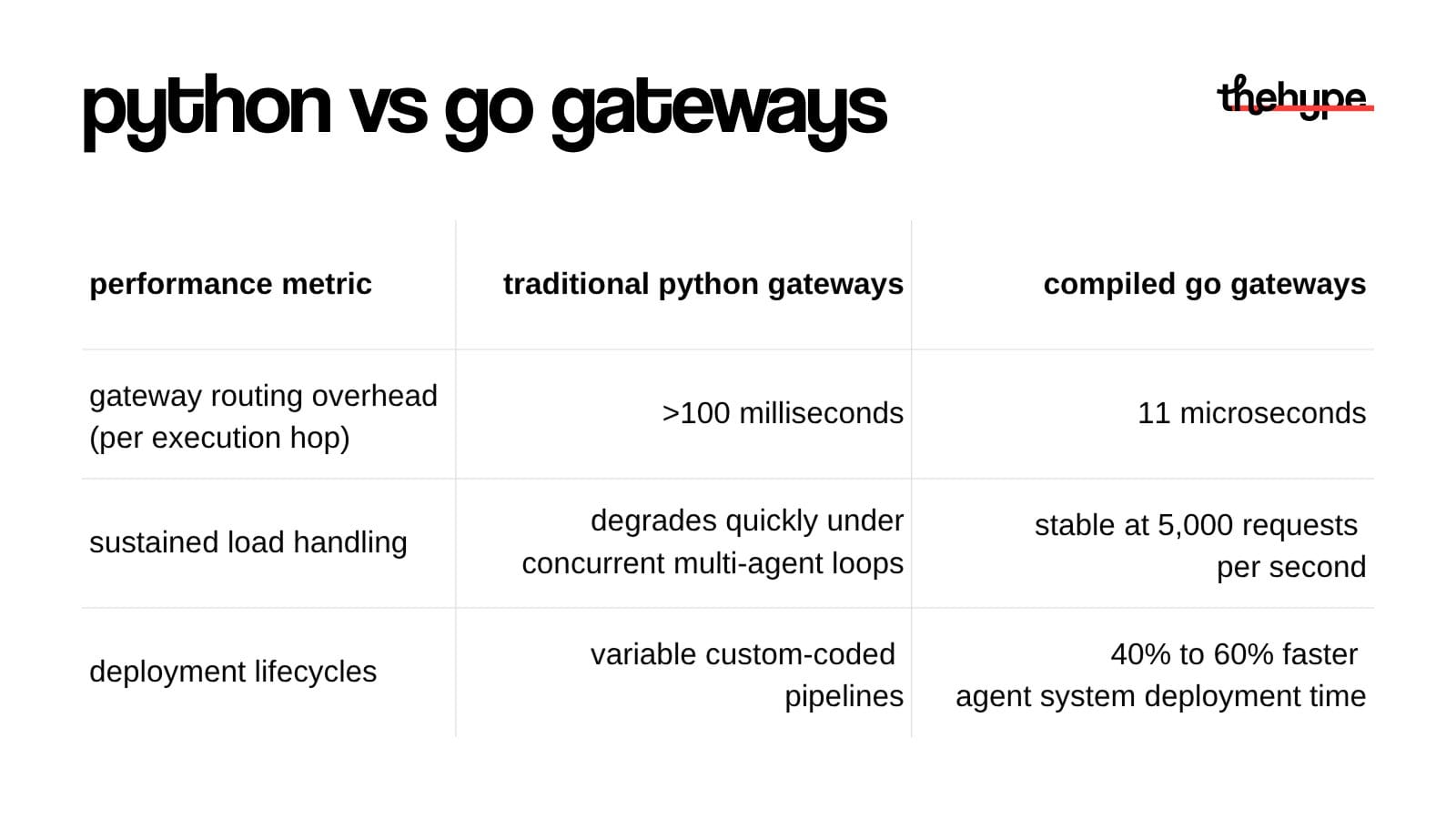
market research shows that while typescript and python dominate the experimental playground, high-performance compiled languages like go represent a tiny fraction of public server source code. bifrost capitalizes on this performance gap. written entirely in go, the platform introduces a mere 11 microseconds of gateway overhead under a sustained load of 5,000 requests per second. it unifies the model-calling plane and the tool-calling plane into a single api and features advanced semantic caching, which recognizes the intent of repeated tool queries and serves them instantly from memory rather than re-triggering expensive llm processing loops.
what’s important to remember, though, is the fact that bifrost sits at the critical path of both data delivery and inference. any edge-case downtime on their routing layer instantly paralyzes the dependent agent networks, meaning their architectural stability must match that of legacy cdns or dns providers.
the death of token bloat and hop latency
by default, the model context protocol is architecturally stateless across disparate sessions. when multiple specialized micro-agents collaborate on a long-running corporate objective, such as a multi-week software migration or a deep legal discovery process, they frequently lose track of historical context, intermediate data states, and past tool execution results unless forced to read massive, expensive logs in every prompt.
context7 provides both stateless and stateful context caching that works agnostically across openai, anthropic, and open-weights infrastructure. it allows developers to create "virtual context bridges." when an agent alters a data resource via an mcp server, context7 broadcasts that state change to all other active agents within the environment in real time without forcing a complete context window reload, slashing api expenses significantly.
New blog: Context7 vs Claude Code Web Search 🎉
— Context7 (@Context7AI) May 28, 2026
◆ Context7 uses ~99% less input tokens
◆ also 37% fewer tokens and 35% lower cost
The easiest way to make your agent write better code 👇 pic.twitter.com/9aOIIzMV5I
in the cloud computing era, we needed redis for fast session state and postgres for relational data. in the agentic era, we require specialized context-caching layers that maintain semantic coherence across distributed systems - and that’s what makes context7 important. however, the startup currently has a small open-source developer community and limited enterprise documentation. they face an aggressive uphill battle against entrenched enterprise data players like qdrant and pinecone, which are rapidly expanding their own native mcp memory capabilities - something that is yet to be overcome.
no pii leaves the building
many enterprise organizations are completely unwilling to route their core operational data or proprietary internal tools through proprietary third-party saas infrastructure. they want the flexibility of the mcp ecosystem, but they require total data sovereignty, local deployment capabilities, and a predictable open-source footprint that can be managed by their internal platform engineering teams. obot provides a fully open-source, kubernetes-native platform that bundles an mcp gateway, an extensible tool catalog, and an advanced agent orchestration framework.
Claude 4.8 is trending. Cool.
— Obot AI (@Obots_ai) May 29, 2026
The real upgrade is where you point it.
Obot’s Gateway gives Claude a governed catalog of MCPs and skills, access control policies, and real audit logs, so “agentic” doesn’t mean “uncontrolled.”
Start Your Free 2-Week Trial ➡️…
highly regulated sectors, such as defense, healthcare, and banking, are eager to leverage autonomous ai agents to clear operational backlogs. however, compliance frameworks prohibit sending internal code repositories, customer pii, or internal system schemas to external endpoints. obot is solving this by shifting agent runtime deployment models away from volatile saas setups and housing them entirely on native corporate kubernetes infrastructure.
yet, maintaining a completely open-source monetization strategy is notoriously challenging. obot will need to cleanly articulate the value of its commercial enterprise features (such as advanced compliance auditing and federation) without alienating its core open-source developer base.
security vs. speed: the latency bottleneck
giving an autonomous llm agent the ability to execute bash commands, edit databases, and call external apis opens up severe security vulnerabilities. if an agent encounters malicious text via a web search or an untrusted email file, it can succumb to an indirect prompt injection attack. the model can be manipulated into abusing its connected mcp tools - for example, exfiltrating sensitive corporate records or deleting cloud databases; and that’s where lasso security delivers a dedicated runtime governance, threat detection, and guardrail layer built specifically to intercept and neutralize these vectors.
Agentic AI breaks clear ownership. Approvals blur when an agent reads in one environment, reasons, then acts elsewhere via inherited permissions. Without runtime visibility, accountability gets messy >> https://t.co/ancEC10jXa pic.twitter.com/LPGU3gNWLZ
— LassoSecurity (@LassoSecurity) April 15, 2026
in 2026, agent security is no longer an afterthought; it is the single greatest obstacle to deployment. dynamic code scanning metrics reveal that roughly 6.5% of all publicly accessible mcp server repositories contain dangerous runtime execution bugs, including unescaped command pathways and unsafe execution scripts. that is why security teams need inline, semantic firewalls that read json-rpc payloads as they stream between clients and servers to detect behavioral hijacking in real time.
lasso security operates an inline inspection proxy that continuously analyzes json-rpc payloads moving between mcp clients and servers. it features real-time, low-latency threat detection engines that scan incoming data streams for indirect prompt injections, automatically mask sensitive personally identifiable information (pii) before it reaches the model, and assign dynamic reputation scores to individual mcp servers. if an agent attempts a high-risk tool operation that strays from its core operational boundaries, lasso instantly freezes the execution loop and triggers an enterprise authorization request.
there is always a downside, though. operating an active semantic inspection layer introduces a risk of latency degradation - that is why lasso must continuously optimize its ai-guardrail models to ensure their threat evaluations do not bottleneck the execution speed of high-velocity agent networks.
future market predictions
as the mcp economy matures throughout the latter half of 2026, the architectural landscape of enterprise software will undergo several major structural shifts:
- within the next few years, enterprise software will no longer be built primarily for human eyes using complex graphical dashboards. applications will increasingly ship with a native mcp server manifest as a default feature, exposing their core data resources and operational tools directly to agent networks. meanwhile, the primary consumer of software apis shifts from human developers to autonomous systems.
- the era of isolated, single-purpose agents is drawing to a close. enterprise workflows will be run by highly integrated, multi-agent networks that dynamically allocate tasks to one another. the primary technical challenge will shift from model optimization to multi-agent synchronization and context federation, turning state-management tools into highly critical infrastructure.
- security teams and cio organizations will enforce strict policies forbidding any unmanaged model connections. enterprise software purchasing will prioritize runtime governance platforms like lasso security and unified gateways like mintmcp as mandatory line items before any generative ai applications can be cleared for production deployment.
where the deepest moats are
the current state of the ai market mirrors the early days of the cloud computing boom. in 2006, public attention focused heavily on the initial web applications that emerged on the internet. yet the massive, compounding financial outcomes of that era did not go to individual web app wrappers; they went to the hidden infrastructure layer - the amazon web services, the datadogs, and the snowflake platforms - that made cloud computing reliable, scalable, and secure for global enterprises.
a similar transformation is occurring within the agentic ai landscape. while mainstream media attention remains fixed on the latest consumer chat updates and foundation model benchmarks, a quiet, infrastructure-driven economy is solidifying around the model context protocol.
the enterprise giants of tomorrow are not building prettier chat boxes or slightly more efficient prompt flows. they are the invisible infrastructure players constructing the protocols, the high-performance gateways, the stateful memory cages, the open-source runtimes, and the semantic security firewalls that will serve as the operating system for autonomous work.